Averaging Down vs. DCA: The Path to Total Loss
 By Tommy Tietze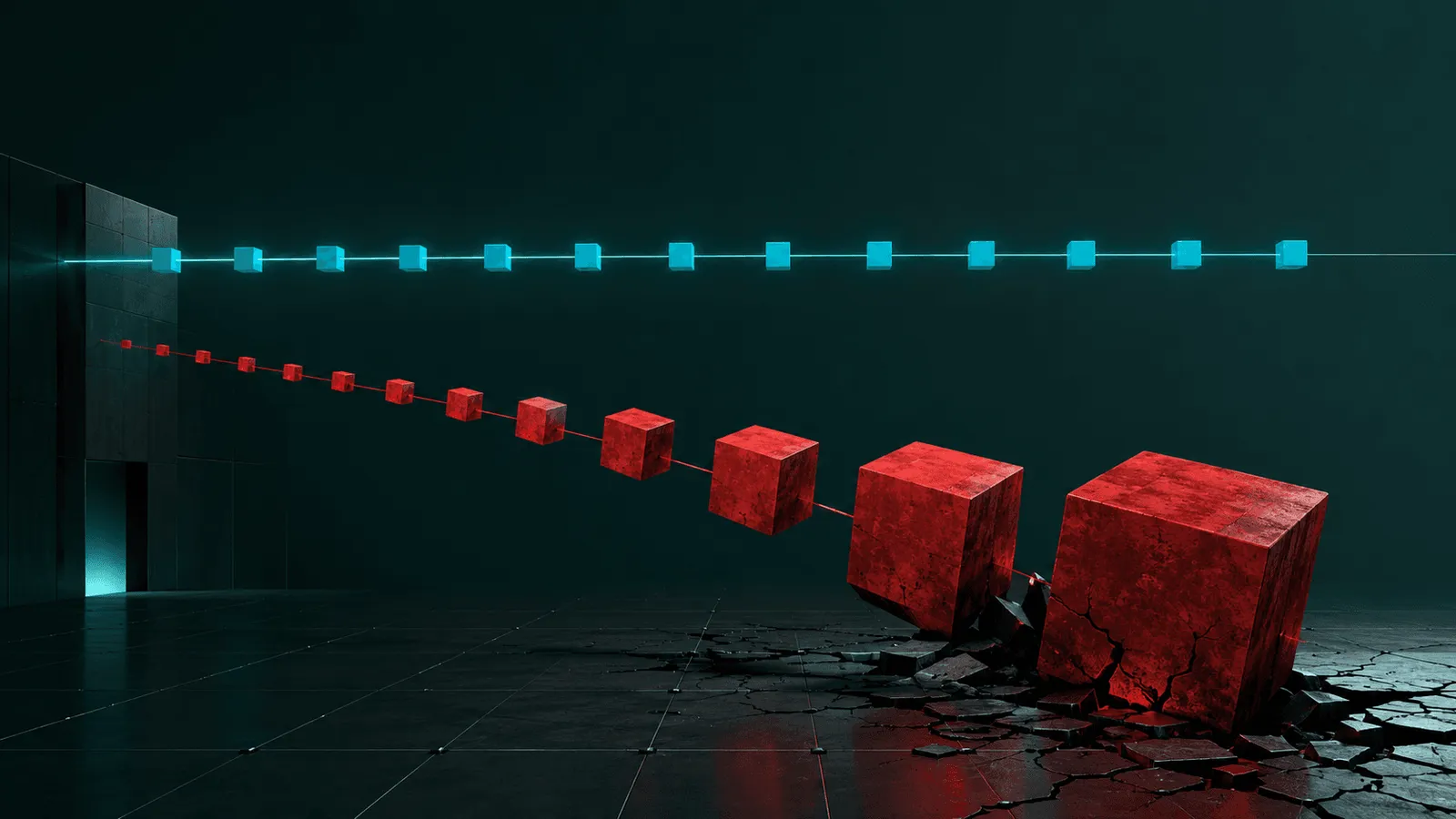
By Tommy Tietze, CEO of ArrowTrade AG
Many traders use the term "DCA" to feel better about losing money.
They buy an altcoin. The price drops 15%. Instead of accepting the loss, they buy more to lower their average entry price. They tell themselves they are executing a Dollar Cost Averaging (DCA) strategy.
They are not. They are averaging down. And in automated crypto trading, confusing these two concepts is the most common path to a total portfolio wipeout.
This article explains the critical difference between time-based accumulation and price-based rescue missions. It shows why adding capital to a losing trade usually destroys trading bots, and how serious systems handle bad entries without multiplying their risk.
The Definition of DCA
Dollar Cost Averaging (DCA) is a long-term investment strategy.
You buy a fixed dollar amount of an asset at regular time intervals, regardless of the price. You buy Bitcoin with 500 USD on the first of every month. Whether Bitcoin is at 40,000 or 90,000, the execution is blind to the chart.
DCA is designed to remove timing risk from macro-assets that you intend to hold for years. It is an accumulation strategy, not a trading strategy.
The Reality of Averaging Down
Averaging down is a reaction to a failing trade.
You buy an asset because your algorithm generated a signal. The signal fails, and the price drops. Instead of triggering a stop-loss, the system buys more of the asset at the lower price. The mathematical goal is to lower the average break-even point, so the system only needs a small bounce to exit in profit.
When an automated bot does this, it is often using Martingale logic.
To make the math work, the bot must buy increasingly larger amounts as the price falls. It buys 1 unit. Then 2 units. Then 4 units. Then 8 units.
If the market drops 5% and bounces, the bot looks like a genius. It closes in profit and maintains its 90% win rate. But crypto markets do not always bounce.
The Altcoin Death Spiral
The logic of averaging down assumes that every asset will eventually recover. In the stock market, broad indices like the S&P 500 eventually recover. In crypto, 95% of altcoins never reach their all-time highs again.
If your bot averages down into a dying altcoin, it will consume all your stablecoin reserves trying to rescue a structurally broken trade.
A 1,000 USD account might start with a 50 USD position. As the altcoin crashes, the bot doubles down. Within a few days, 800 USD is locked into a single, highly volatile token that is in a macro downtrend.
You have accidentally turned a highly diversified portfolio into a massive, concentrated bet on a losing asset. You have violated every rule of portfolio heat.
The Opportunity Cost of Frozen Capital
The damage of averaging down goes beyond the immediate loss.
When your bot consumes its stablecoin reserves to rescue a bad trade, that capital is now frozen. It is locked in "bag holding" mode.
When the broader market actually recovers and high-quality setups appear, your bot cannot execute them. It has no liquidity left. You are forced to sit on the sidelines, watching profitable trades pass by, waiting for a dead altcoin to bounce 40% just so you can break even.
This is the hidden cost of avoiding stop-losses. By refusing to accept a small loss on Tuesday, you forfeit the capital needed to make a large profit on Thursday.
Systematic Execution vs. Hopium
A mature trading system does not negotiate with bad entries.
If a trade setup is invalidated, the system accepts the loss, frees up the capital, and looks for the next setup. It protects its liquidity at all costs.
At unCoded, we provide the infrastructure for controlled spot execution on your own Binance account. Spot trading removes the risk of sudden margin liquidation, which is why grid bots and averaging-down strategies often take longer to blow up here than on futures platforms.
But spot trading does not protect you from a 90% drawdown if you program your bot to buy the entire way down on a token that goes to zero. Infrastructure secures your access; your strategy secures your wealth.
A system that adds risk to a losing trade is not managing risk. It is just automating hope.
Practical Checklist
Before allowing a bot to average down:
- Is this a macro-asset (like BTC) or a highly volatile altcoin?
- What is the absolute maximum capital limit the bot is allowed to deploy into a single pair?
- If the asset drops 50% and never recovers, does the accumulated position size destroy my portfolio?
- Am I using this feature to accumulate a long-term holding, or am I just trying to avoid realizing a loss?
- Do I have enough stablecoin reserves to survive if this capital gets locked for six months?
FAQ
What is the difference between DCA and Averaging Down? DCA is a proactive, time-based strategy to build a long-term position in a macro asset. Averaging down is a reactive, price-based strategy to rescue a losing trade by buying more at lower prices.
Why do so many trading bots use Averaging Down? Because it artificially inflates the bot's "Win Rate". By constantly buying lower and lowering the break-even point, the bot can close most trades in profit—until a severe market crash locks all its capital in losing positions.
Is Martingale safe in crypto trading? No. Martingale involves doubling your position size after every loss. In crypto, where assets can trend downward by 80% or more without a significant bounce, Martingale logic will mathematically bankrupt an account.
How should I handle a losing trade in an automated system? Define a clear invalidation point (stop-loss) before the trade opens. If the market reaches that point, the system should close the trade, accept the loss, and free up the capital for better opportunities.
Conclusion
Calling an averaging-down strategy "DCA" does not change the math.
Adding capital to a losing trade exponentially increases your risk on an asset that is currently proving your original thesis wrong. In traditional finance, this is known as "catching a falling knife." In algorithmic crypto trading, it is the primary reason why retail bots fail during bear markets.
Serious Crypto means respecting invalidation points. A loss is an operational cost of doing business. A frozen portfolio full of dead altcoins is a structural failure.
Disclaimer: This article is for educational purposes only and is not financial advice. Crypto trading and automated strategies involve substantial risk. Past performance is no guarantee of future results.
Learn more about automated crypto spot trading: unCoded
Built by: ArrowTrade AG
Recommended Reading

The Win Rate Illusion in Crypto Bots
By Tommy Tietze, CEO of ArrowTrade AG If you look at the marketing pages of retail crypto bots, you ...

Liquidation Cascades: Why Spot-Trading Is the Stabile Bot Architecture
By Tommy Tietze, CEO of ArrowTrade AG In crypto, prices don't just fall. Sometimes, they collapse ve...

Portfolio Heat & Correlation: The Illusion of Diversification
By Tommy Tietze, CEO of ArrowTrade AG There is a fundamental misunderstanding in retail crypto tradi...

Systematic vs. Emotional Trading
By Tommy Tietze, CEO of ArrowTrade AG Most traders do not lose control in calm markets. They lose co...

Position Sizing in Crypto Trading
By Tommy Tietze, CEO of ArrowTrade AG Many traders spend hours searching for the perfect entry. They...