The Win Rate Illusion in Crypto Bots
 By Tommy Tietze
By Tommy Tietze, CEO of ArrowTrade AG
If you look at the marketing pages of retail crypto bots, you will see the same metric repeated everywhere: "90% Win Rate."
It sounds mathematically flawless. If you win nine out of ten trades, you must be making money. It feels safe. It feels like the algorithm has solved the market.
In reality, a high win rate is often the easiest way to identify a dangerous trading system.
Win rate in isolation is a meaningless metric. It tells you how often a trade is closed in profit, but it completely hides the most important question in risk management: How much do you lose when you are wrong?
This article explains the mechanical deception behind high win rates, why the best systematic traders often operate at a 40% win rate, and why understanding the Risk/Reward Ratio (RRR) is the only way to survive automated crypto trading.
The Math Behind the Illusion
To understand why a 90% win rate can destroy your portfolio, you just need basic math.
Imagine a bot that executes 100 trades. It wins 90 trades. It loses 10 trades. The win rate is 90%.
If the bot takes a 10 USD profit on every winning trade, the gross profit is 900 USD. But what happens during the losses? If the bot is programmed to wait for a 10 USD profit but has no strict stop-loss, it might hold a losing position until the market drops severely.
If the average loss on those 10 losing trades is 150 USD, the gross loss is 1,500 USD.
- Gross Profit: +900 USD
- Gross Loss: -1,500 USD
- Net Result: -600 USD
The bot has a 90% win rate. And the account is bleeding to death.
This is not a theoretical example. It is the standard operating model of almost every cheap, grid-based or DCA bot sold to retail investors. They scalp tiny profits in a sideways market to build a beautiful "win rate" track record, and then give everything back (and more) in a single liquidation cascade or structural market dump.
How Bots Fake a High Win Rate
There is a very simple way to program a bot to achieve a 95% win rate: Never close a trade in loss.
When the market moves against the bot, the system simply refuses to sell. It holds the "underwater" asset, hoping the market will eventually bounce back so it can close the trade for a 1% profit.
In traditional trading, this is called bag holding. In crypto marketing, it is sold as a "high win rate strategy."
The problem with this approach is that it ties up your capital. As the market drops, your stablecoin reserves are depleted. Your bot is frozen. It cannot execute new, profitable trades because all your funds are stuck in losing positions that the bot refuses to close just to protect its win rate statistic.
This directly violates the principles of managing portfolio heat.
A mature trading system accepts losses. It closes bad trades quickly to free up capital, preserve liquidity, and look for better setups. A bot that never accepts a loss is not an intelligent system; it is just stubborn.
The Reality of the 40% Win Rate
Professional quantitative systems and trend-following algorithms rarely have a 90% win rate. Many operate successfully between 40% and 50%.
How does a system make money if it loses more than half the time? Through strict Risk/Reward Ratios (RRR).
If your system is designed to cut losses at 2% but let winning trades run to 6%, your RRR is 1:3. You are risking 1 unit to make 3 units.
Imagine 100 trades with a 40% win rate under this structure (risking 100 USD to make 300 USD):
- 60 Losing Trades × 100 USD Loss = -6,000 USD
- 40 Winning Trades × 300 USD Profit = +12,000 USD
- Net Result: +6,000 USD
The win rate is a terrible 40%. The net result is highly profitable.
The bot is designed to be wrong often, but it ensures that being wrong is cheap. This is the core of systematic trading. It does not try to predict the market with 100% accuracy. It manages the mathematical outcome of being wrong.
Win Rate and Position Sizing
When traders obsess over win rate, they usually forget position sizing.
If you believe your bot is "always right" because it has an 85% historical win rate, you will be tempted to increase your trade size. You allocate too much capital per trade, assuming the next signal is a guaranteed win.
Then the 15% probability hits you. Because your position size was too large, the single loss wipes out the profits of the last twenty trades.
Your position size should never be calculated based on how often you win. It must be calculated based on the maximum drawdown you are willing to accept when the inevitable losing streak occurs.
The unCoded Approach to Execution
At unCoded, we do not optimize for vanity metrics. We optimize for controlled spot execution.
When you connect your Binance account to unCoded, you are not buying a black box that promises a 95% win rate. You are deploying an infrastructure that respects market depth, manages slippage, and operates without the liquidation risks of futures leverage.
Capital stays on your exchange. API keys operate without withdrawal rights. The system focuses on absolute operational control.
If a trade goes against the strategy's defined limits, the system must have the capacity to accept the loss and move on. Protecting the capital base is always more important than protecting a statistical win rate.
Practical Checklist
Before evaluating a bot's performance:
- What is the average size of a winning trade versus a losing trade (RRR)?
- Does the strategy use a hard stop-loss, or does it hold losing positions indefinitely?
- How high is the Maximum Drawdown compared to the total net profit?
- If the bot experiences 5 losses in a row, is my account still structurally safe?
- Am I looking at closed trades only, or does the system have massive unrealized losses ("floating red") that are hidden from the win rate calculation?
FAQ
What is a good win rate for a crypto trading bot? There is no universal "good" win rate. A 40% win rate can be highly profitable if the average win is three times larger than the average loss. A 90% win rate can be unprofitable if the average loss wipes out dozens of small wins.
What does Risk/Reward Ratio (RRR) mean? RRR compares the potential profit of a trade to its potential loss. An RRR of 1:3 means you are risking 100 USD to potentially make 300 USD. High RRR systems can be profitable even with low win rates.
Why do so many retail bots advertise a 90% win rate? Because it is a highly effective psychological sales pitch. Retail traders fear losses. A bot that promises a 90% win rate feels safe, even though it usually achieves this by never using stop-losses and holding "underwater" assets indefinitely.
Should I avoid bots with high win rates? Not necessarily, but you must look under the hood. Check the maximum drawdown and the average loss per trade. If the system hides massive unrealized losses just to keep the win rate high, it is a structural trap.
Conclusion
A high win rate is the ultimate vanity metric in automated crypto trading.
It satisfies the human ego, which hates being wrong. But the market does not care about your ego, and it does not pay you for your strike rate. It pays you for your risk management.
If you are evaluating an automated system, ignore the win rate on the dashboard. Look at the size of the losses. Look at how the system behaves during a drawdown. Look at whether it frees up capital when a trade goes wrong, or if it stubbornly holds onto a losing position.
Serious Crypto means accepting that you will be wrong frequently. The goal is not to eliminate losses. The goal is to make your losses mathematically irrelevant.
Disclaimer: This article is for educational purposes only and is not financial advice. Crypto trading and automated strategies involve substantial risk. Past performance or backtested win rates are no guarantee of future results.
Learn more about automated crypto spot trading: unCoded
Built by: ArrowTrade AG
Recommended Reading

Liquidation Cascades: Why Spot-Trading Is the Stabile Bot Architecture
By Tommy Tietze, CEO of ArrowTrade AG In crypto, prices don't just fall. Sometimes, they collapse ve...

Portfolio Heat & Correlation: The Illusion of Diversification
By Tommy Tietze, CEO of ArrowTrade AG There is a fundamental misunderstanding in retail crypto tradi...
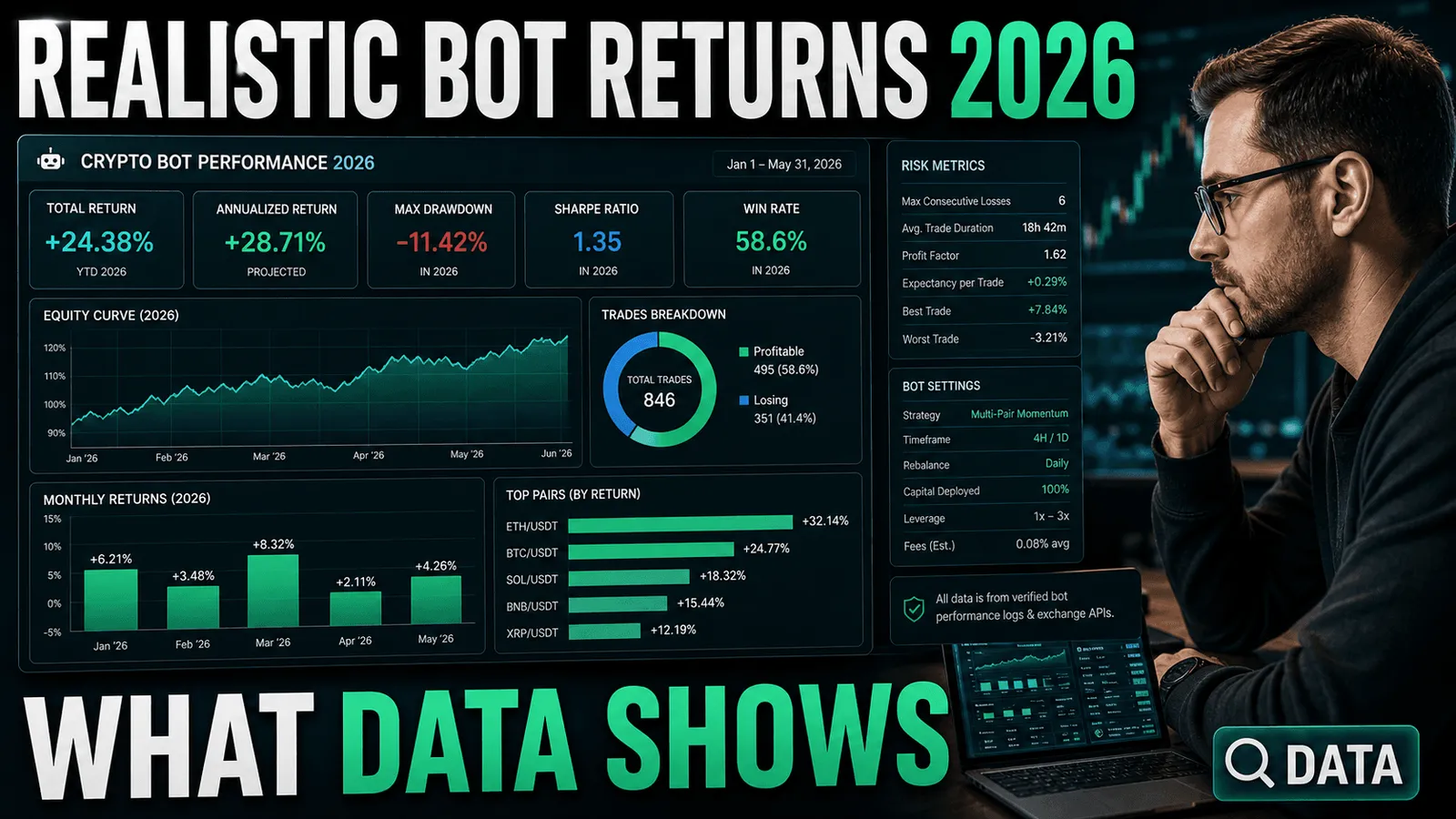
Realistic Returns from Crypto Trading Bots in 2026: What the Data Actually Shows
By Felix Götz – Co-Founder and CTO of ArrowTrade AG, building unCoded since 2016 in crypto trading. ...

Crypto Drawdown Explained
By Tommy Tietze, CEO of ArrowTrade AG Drawdown is one of the most honest risk metrics in trading. It...

Systematic vs. Emotional Trading
By Tommy Tietze, CEO of ArrowTrade AG Most traders do not lose control in calm markets. They lose co...

Position Sizing in Crypto Trading
By Tommy Tietze, CEO of ArrowTrade AG Many traders spend hours searching for the perfect entry. They...