Realistic Returns from Crypto Trading Bots in 2026: What the Data Actually Shows
 By Felix Götz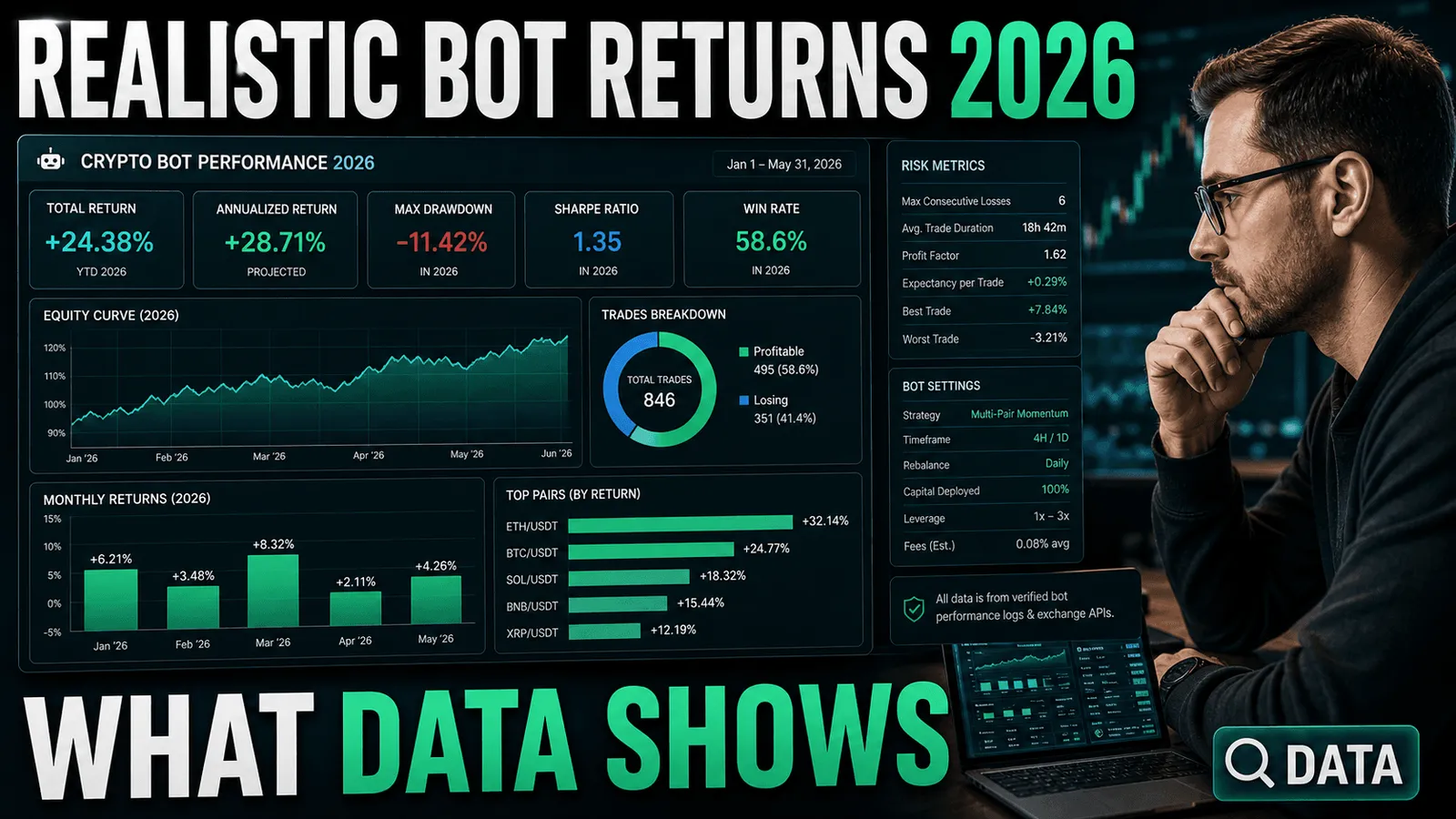
By Felix Götz – Co-Founder and CTO of ArrowTrade AG, building unCoded since 2016 in crypto trading.
Disclosure: I'm Co-Founder and CTO of ArrowTrade AG, the company behind unCoded, which I reference for verifiable backtest data later in this article. This article is for informational purposes only and does not constitute financial advice. Past performance and backtest results are not indicative of future results.
If you've spent any time researching crypto trading bots, you've seen the marketing.
"Make 1% per day with our bot." "Users report average returns of 300% annually." "AI-powered strategies delivering 10,000% APY." Screenshots of equity curves that look like rocket trajectories. Testimonials from users who supposedly turned $1,000 into six figures.
Then there's the other side of the internet. Reddit threads full of users who lost their entire deposit. Reviews complaining that no strategy works. Posts asking "are crypto bots a scam?" with hundreds of comments saying yes.
Both extremes are misleading. The reality lives in a much narrower band that almost nobody talks about openly, because it doesn't sell anything.
After five years of running commercial bot platforms on my own capital, building unCoded, and reviewing publicly available backtest data across hundreds of strategies and thousands of tokens, here's what realistic returns actually look like in 2026.
What "return" actually means
Before any discussion of numbers, we need to define what we're measuring. Most marketing exploits the ambiguity.
Gross return is what the bot's dashboard shows. The trades closed in the green. The strategy executed as designed. This is the number platforms love to advertise.
Net return is what's actually in your bank account at the end of the year, after subscription fees, exchange trading fees, slippage, tax software costs, and actual taxes. This is the number that matters.
These two numbers can differ dramatically. A bot showing "+30% gross return" can produce -2% net return for a small portfolio on a subscription platform once all costs are accounted for. The strategies didn't fail. The economics did.
Every realistic return discussion needs to specify which number is being discussed. From here forward, I'll be explicit about which one applies to each figure.
⚠️ The realistic range
Here's the band that actually matches reality for disciplined retail bot traders running well-configured strategies under appropriate market conditions.
1-3% per month for disciplined users with good strategy-market fit
This range describes what tends to be achievable for retail traders who run well-configured strategies, actively manage their deployment, match strategy types to current market regimes, and operate with realistic execution conditions. It's not a baseline expectation for any user – it's the upper band of what disciplined operation tends to produce.
Compounded over a year, 1% monthly produces roughly 12.7% annual return. 2% monthly produces about 26.8%. 3% monthly produces about 42.6%. These are gross figures before subscription costs, exchange fees, and taxes.
This range matches what I've observed across the unCoded community among traders running disciplined strategies, and what I personally observed across five years of running commercial bot platforms. It assumes the user is doing the work – not the user who deploys once and walks away.
12-25% gross annual for well-configured bots in mixed conditions
This is roughly equivalent to the monthly range above when accounting for losing months. The lower end represents conservative configurations during difficult markets. The upper end represents well-tuned configurations during favorable conditions, again assuming active monitoring and appropriate strategy-market matching.
To put this in context: a well-managed traditional investment portfolio targets 7-10% annual return. Crypto bots in this range deliver roughly 1.5-3x that, with significantly higher volatility and operational complexity. The return premium reflects the additional risk and effort, not free money.
Negative returns are normal in unfavorable regimes
Even well-configured bots produce losses when the underlying market regime is hostile to their strategy type. A grid bot in a strong downtrend. A momentum strategy in choppy sideways action. A DCA bot during sustained capitulation.
Users who can't tolerate negative months without panic-stopping their bots tend to do worse than users who can. The realistic range includes some bad months. Strategies that never have bad months are either lying or very recently deployed.
What's outside the realistic range
Above 5% per month sustained over a year is statistically rare for retail Spot strategies. When you see it advertised, the source is almost always cherry-picked time windows, leveraged trading on small samples (which has different risk characteristics), or marketing exaggeration. Real systematic strategies producing those numbers consistently exist at hedge fund scale, with infrastructure and capital that retail traders cannot access.
Below -10% annual sustained usually indicates either subscription fees consuming meaningful portions of capital on small portfolios, deployment of inappropriate strategies in the wrong market regime, or operational issues like poor stop loss execution.
The space between 1-3% monthly upside (under disciplined deployment) and -2% monthly downside is where most serious retail bot trading actually lives.
Why marketing returns are unreachable for most users
The gap between marketing claims and realistic returns isn't just exaggeration. It's structural.
Cherry-picked backtests don't generalize
Most marketing materials show single-token results from specific favorable periods. Take the same configuration to a different token or different year, and the result often falls apart entirely.
unCoded publishes the full distribution of backtest results across the entire Binance Spot market for multiple years. Here's what real data looks like for one of our standard strategies (BasicMode):
2023 BasicMode results across 191 token configurations:
- 78.5% of tokens profitable
- Average return: +18.08%
- Median return: +21.52%
2025 BasicMode results across 373 token configurations:
- 7.8% of tokens profitable
- Average return: -62.33%
- Median return: -73.83%
Same strategy. Same parameters. Different year. The profitability rate dropped from 78.5% to 7.8%. The strategy didn't change. The market regime did.
If a marketing screenshot shows you the 2023 result, you're seeing real data – it's just not predictive of what would happen if you deployed in 2025. Marketing rarely shows you both years side by side. You can verify all this data at uncoded.ch/backtesting.
Survivorship bias in user testimonials
Marketing testimonials are systematically selected from users who profited. The users who lost money usually don't appear. A platform showing 50 profitable user stories may have 5,000 unprofitable users who never made it into the marketing materials.
This isn't necessarily dishonest – it's how marketing works. But it produces a survival-biased view of typical outcomes. Real distributions of user returns include the losing users alongside the profitable ones.
Leverage and futures trading aren't comparable
Many "high return" marketing claims come from leveraged futures positions where 5x leverage transforms a 5% market move into a 25% account move. The flip side is that the same leverage transforms a 20% move against the position into a 100% loss plus liquidation.
Spot trading bot returns aren't comparable to leveraged returns. Comparing the two is comparing different categories of risk. Most realistic retail bot trading is on Spot precisely because it eliminates the catastrophic loss scenario that leverage introduces.
What actually determines returns
After watching hundreds of bot deployments over the past five years, the variables that actually matter aren't always what marketing materials emphasize.
Pricing model alignment
This is the single biggest factor for portfolios under $50,000.
A $130/month subscription on a $20,000 portfolio costs $1,560 per year. To merely break even on platform fees alone, the strategy needs to generate 7.8% gross return. To produce meaningful net returns, you need to clear that hurdle plus exchange fees plus tax software plus actual taxes.
Profit-sharing platforms remove this structural drag. unCoded's 30% performance fee on $20,000 with a 15% gross return produces $900 in fees on $3,000 of profit, leaving $2,100 net. The same portfolio on a $130/month subscription pays $1,560 fees plus tax software costs, often leaving close to zero.
Same gross return. Different pricing structure. Completely different net outcome.
Strategy-market regime fit
A momentum strategy in a bull market can produce 30%+ annual returns. The same strategy in choppy sideways action produces nothing but whipsaw losses. The same strategy in a bear market underperforms simple holding by significant margins.
Most retail bot users don't actively manage this matching. They deploy a strategy, see initial results, and continue running it through regime changes that destroy its edge. The bot didn't change. The market did. Returns adjust accordingly.
Realistic returns assume you're matching strategy type to current market conditions, or accepting reduced returns when conditions shift. Returns assuming you've nailed regime fit at every market phase are unrealistic.
Active monitoring versus passive deployment
Bots that users actively monitor, reconfigure when conditions shift, and pause during anomalous events tend to outperform bots run on autopilot. The difference between active and passive deployment can be substantial – often the difference between landing in the realistic range and underperforming it consistently.
The "set and forget" promise that many platforms make is structurally misleading. Bots are tools that enforce discipline. They don't replace strategy work, they automate strategy execution. Returns matching the realistic range require ongoing engagement.
Portfolio size relative to fee structure
This compounds the pricing model issue. A $5,000 portfolio on a $60/month subscription has subscription costs equal to 14.4% of capital annually. A $50,000 portfolio on the same subscription has costs of 1.4%. Same platform, same subscription, completely different impact on returns.
Realistic returns scale differently for different portfolio sizes. The 1-3% monthly range applies after fees on portfolios where fees are a reasonable percentage of returns. On portfolios where fees consume large fractions of returns, the realistic range is meaningfully lower.
Honest backtesting that matches live execution
Most retail backtest tools systematically overstate expected returns because they evaluate at candle close while live trading executes on wicks, calculate fees as percentages instead of in the actual asset fees are paid in, and assume zero slippage on illiquid pairs.
A strategy showing 30% backtest return often delivers 15-20% in live trading because the methodology systematically overestimates performance. Realistic returns assume you're using backtest results that reflect realistic execution, not the optimistic version most platforms produce.
The compounding math
The realistic monthly range matters because of what it produces compounded over time.
Starting capital: $10,000
At 1% monthly compound (12.7% annual):
- After 1 year: ~$11,268
- After 3 years: ~$14,308
- After 5 years: ~$18,167
At 2% monthly compound (26.8% annual):
- After 1 year: ~$12,682
- After 3 years: ~$20,398
- After 5 years: ~$32,810
At 3% monthly compound (42.6% annual):
- After 1 year: ~$14,258
- After 3 years: ~$28,983
- After 5 years: ~$58,916
These are gross figures. Subtract subscription costs, taxes, and tax software to get net returns. On a profit-sharing platform with no monthly subscription, the net figure is roughly 70-80% of gross depending on the fee structure and tax jurisdiction.
The takeaway: even modest realistic returns compound meaningfully over multi-year horizons. The five-year line at 2% monthly is more than triple the starting capital. That's the actual case for serious bot trading – not the marketing fantasy of 10x in a year, but disciplined compounding that builds capital over years.
Why the high end of the realistic range is hard to maintain
Sustaining 3% monthly compound over five years requires the strategy to maintain edge through multiple market regime shifts. Most strategies that produce 3% monthly in favorable conditions drop to 1% or negative in unfavorable conditions.
Realistic long-term returns average to the middle of the range, not the top. A strategy that produces 3% in good months and -1% in bad months over a year that includes both, ends up much closer to 1.5% monthly average than to the headline 3% number.
This is why marketing promotion of high monthly returns is structurally misleading. Even when the high number is real for short periods, it's not what the strategy produces over time horizons that actually matter.
Realistic expectations by bot type and market phase
Different bot architectures have different realistic ranges depending on what the market is doing. The numbers below are gross returns before all costs, and assume disciplined deployment with appropriate configuration.
Grid bots in range-bound markets
Realistic range under appropriate conditions: 1-3% per month during sustained ranging. Grid bots monetize volatility within defined price ranges. When the market moves sideways for weeks, well-configured grids produce steady output.
Range when conditions shift: 0% to negative when price trends out of the configured range. Grid bots fail catastrophically when the market makes a directional move that exceeds their grid.
DCA bots in mixed markets
Realistic range under appropriate conditions: 1-2% per month for properly configured DCA in markets with healthy volatility. DCA strategies accumulate during dips and harvest profit during recoveries.
Range when conditions shift: -2% to -10% per month during sustained downtrends, where the strategy keeps accumulating into falling prices without realizing profits. Capital exhaustion is a real risk if the strategy is configured aggressively.
Momentum and trend-following bots
Realistic range under appropriate conditions: 2-4% per month during clear trending periods. These strategies thrive on directional moves.
Range when conditions shift: -1% to -3% per month during choppy sideways action where false breakouts produce constant whipsaw losses.
Mean reversion strategies
Realistic range under appropriate conditions: 1-3% per month in markets that exhibit consistent mean-reverting behavior. Most crypto markets in ranging conditions.
Range when conditions shift: Negative when strong trends overwhelm mean reversion patterns. Bear markets and parabolic bull markets both reduce mean reversion edge.
What the cross-strategy average looks like
A diversified retail bot deployment across multiple strategy types typically produces 1-2% gross monthly average over multi-year horizons in mixed market conditions, accounting for both favorable and unfavorable regimes for each strategy type. That's roughly 12-25% gross annual under disciplined operation.
Net returns after all costs often run 60-80% of gross, depending on portfolio size and platform pricing structure. So 12-25% gross translates, in many cases, to 7-20% net for traders who do this seriously and operate on appropriate platform pricing for their portfolio size.
What returns look like after the full math
To make this concrete, here's what five years of disciplined bot trading actually looked like on my own capital.
I ran Cryptohopper Hero tier from 2020 to 2025. Conservative strategies. Multi-coin Spot. No leverage.
The dashboard side:
- Strategies executed correctly
- Most years showed positive gross returns
- Total trades: tens of thousands across the period
The actual financial outcome:
- Subscription fees: ~$7,800 over five years ($130/month × 60 months)
- Tax software: ~€2,000 over five years (averaging €400/year)
- German income tax on short-term gains
- Net result: consistently worse than simply holding Bitcoin during the same period
This isn't the strategies' fault. The execution worked. The economics didn't, because subscription pricing on portfolios in my range produced fee drag of 7-8% annually before any other cost. Most years my strategies didn't generate enough alpha over holding to overcome that drag plus tax friction.
This experience is what eventually built unCoded. The math fails for retail-sized portfolios on subscription pricing, regardless of how well the strategies execute. The structural problem isn't bots. It's the pricing model that retail bot platforms have settled on.
How pricing structure changes the realistic return picture
The same strategy producing the same gross return delivers very different net returns depending on pricing model.
Subscription model on a $20,000 portfolio at 15% gross return
- Gross return: $3,000
- Subscription cost ($130/month Hero tier): $1,560
- Tax software: ~€400
- Trading fees and slippage: ~$200
- Net before income tax: ~$840
- Effective net return rate: 4.2%
A 15% gross return became 4.2% net. The strategy worked. The structure didn't.
Profit-sharing model on the same $20,000 portfolio at 15% gross return
- Gross return: $3,000
- unCoded fee (30% on first $6,667 of profit): $900
- Tax software: ~€400
- Trading fees and slippage: ~$200
- Net before income tax: ~$1,500
- Effective net return rate: 7.5%
Same strategy. Same gross return. Same other costs. The pricing model alone produces nearly 80% better net return on the smaller portfolio in this hypothetical comparison.
The math at portfolio scale
For larger portfolios above $100,000, the difference shrinks because subscription costs become a small percentage of returns. Below $50,000, the difference between subscription and profit-sharing pricing is often the single largest factor in net returns.
This is why the realistic return discussion can't be separated from the pricing discussion. The same strategy operating on the same market with the same execution quality produces materially different outcomes depending on which platform you deploy it on and what your portfolio size is.
What I tell people to expect
After five years of watching retail bot trading evolve and now running unCoded as a profit-sharing alternative, here's the honest answer when someone asks me what they should expect.
For disciplined deployment with realistic strategy-market matching and active monitoring: 1-3% gross monthly tends to be the achievable range, averaging closer to the lower end over multi-year horizons. After all costs on appropriate platform pricing, this often translates to 8-20% net annually for users operating in this disciplined mode.
For passive deployment with set-and-forget mentality: Often near zero net or slightly negative, regardless of strategy quality, because regime drift erodes edge over time.
For users on subscription platforms with portfolios under $20,000: Net returns typically below the realistic range because fixed fees consume too much of the gross return.
For users deploying marketplace strategies without out-of-sample validation: Highly variable, often catastrophic. Most marketplace strategies haven't been validated across regimes and fail when conditions shift.
For leveraged futures bots: Wider distributions in both directions. Outsized gains in favorable conditions, outsized losses in unfavorable ones, with liquidation risk that makes the comparison non-comparable to Spot trading.
The 1-3% monthly figure isn't impressive by marketing standards. It's also genuinely achievable under disciplined operation, sustainable over time when you do the work, and produces meaningful capital growth when compounded across multi-year horizons. That's what realistic looks like for users who actually do the work.
The honest summary
Realistic returns from crypto trading bots in 2026 sit in a band that almost nobody markets aggressively because the band doesn't sell well.
Disciplined retail bot trading tends to produce approximately 1-3% gross monthly returns when strategies match current market conditions, when configurations are well-tuned, when deployment is actively monitored, and when pricing structure doesn't consume disproportionate portions of returns. After all costs, this often translates to 8-20% net annually for traders who get the variables right – not for every user automatically.
Below this range fall users on subscription pricing with small portfolios, users running passive deployments, users with poorly matched strategies, and users hit by adverse market regimes during their deployment period.
Above this range fall a small number of strategies that work exceptionally well during specific market phases, leveraged futures trading with different risk characteristics, and most of the marketing claims that have no basis in actual sustained performance.
The realistic range isn't impressive. It's also real, sustainable when properly executed, and significantly better than holding cash through inflation. Compounded across years, it builds meaningful capital. That's what serious bot trading is, when stripped of marketing exaggeration in either direction.
If you're evaluating bot platforms with realistic expectations, the variables that matter most are pricing model alignment with your portfolio size, strategy-market regime fit, willingness to actively monitor deployment, and use of honest backtesting methodology that doesn't systematically overstate expected returns.
unCoded is built specifically for traders operating in this realistic range. Profit-sharing pricing means the platform only makes money when users do, which forces alignment with actual user outcomes rather than subscription retention. Self-hosted custody removes platform-level security risks. Honest backtesting against the entire Binance Spot market exposes overfitting that single-chart backtests hide. Conservative defaults reflect the reality that long-term capital preservation matters more than short-term marketing-grade returns.
These choices don't produce the headline numbers marketing departments prefer. They produce the realistic numbers that compound into meaningful capital over multi-year horizons – when users do the work to operate in the disciplined range. That's the trade we make explicitly.
For users who want to evaluate the actual data behind any of the figures in this article, the full unCoded backtest distribution across all tested tokens and multiple years is publicly available at uncoded.ch/backtesting, including the years where strategies failed on the majority of tokens. We publish the bad years alongside the good ones because that's what honest data looks like.
Realistic returns aren't a secret. They're just rare to find published openly, because honest numbers don't sell as well as marketing fantasies. Now you have them.
Felix Götz is Co-Founder and CTO of ArrowTrade AG, the company behind unCoded — a self-hosted, non-custodial crypto Spot trading bot with profit-sharing pricing. After five years of running commercial bot platforms across multiple portfolio sizes, he built unCoded as a structural alternative for traders operating in the realistic return range. Documentation at uncoded.ch/docs . Public backtest infrastructure at uncoded.ch/backtesting . ArrowTrade AG, Switzerland.
Recommended Reading
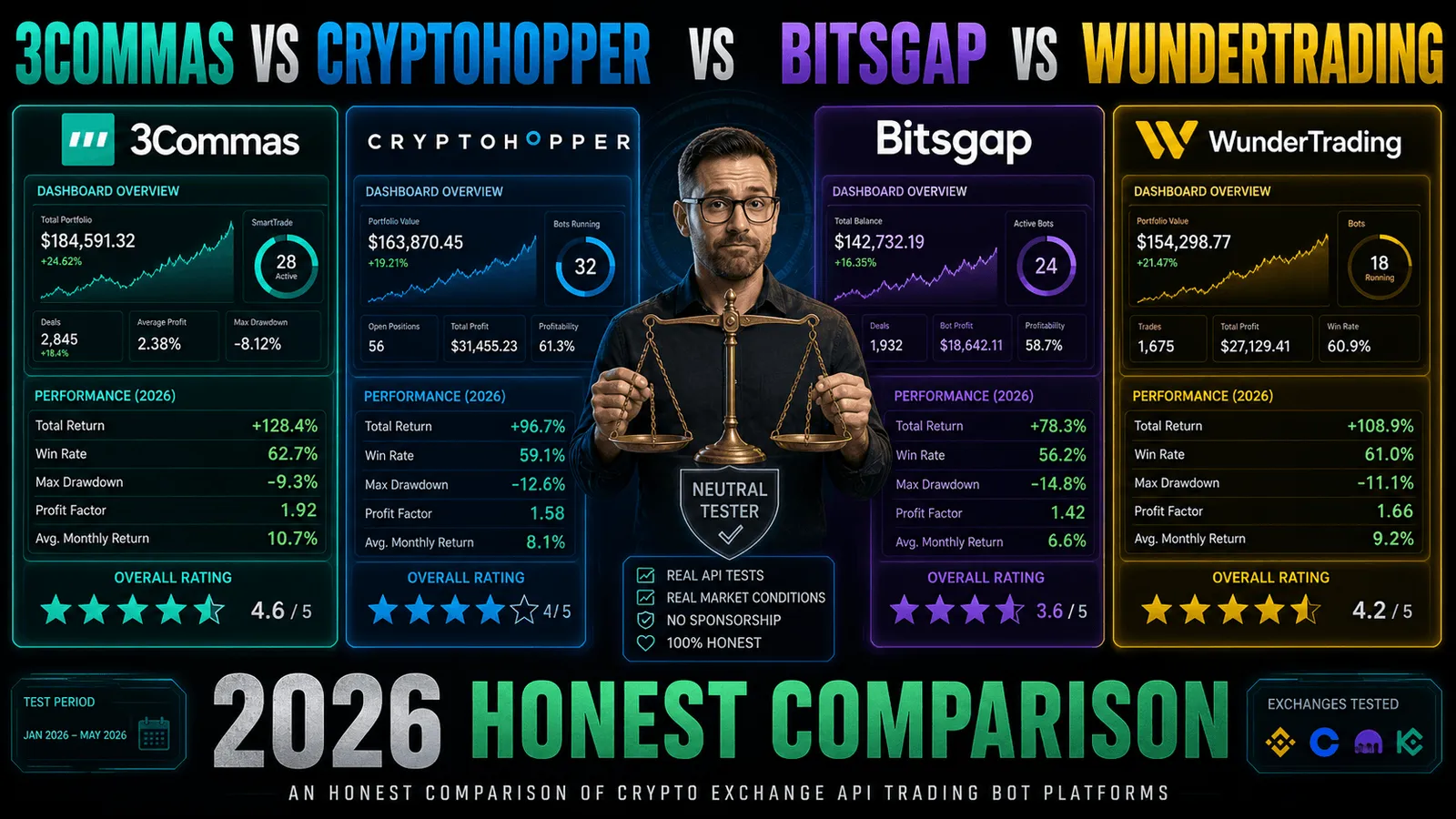
3Commas vs Cryptohopper vs Bitsgap vs Wundertrading: An Honest 2026 Comparison of Crypto Exchange API Trading Bot Platforms
By Felix Götz – Co-Founder and CTO of ArrowTrade AG, building unCoded since 2016 in crypto trading. ...

How to Validate a Crypto Bot Strategy Out-of-Sample: Practical Rules and Minimum Sample Sizes
By Felix Götz – Co-Founder and CTO of ArrowTrade AG, building unCoded since 2016 in crypto trading. ...
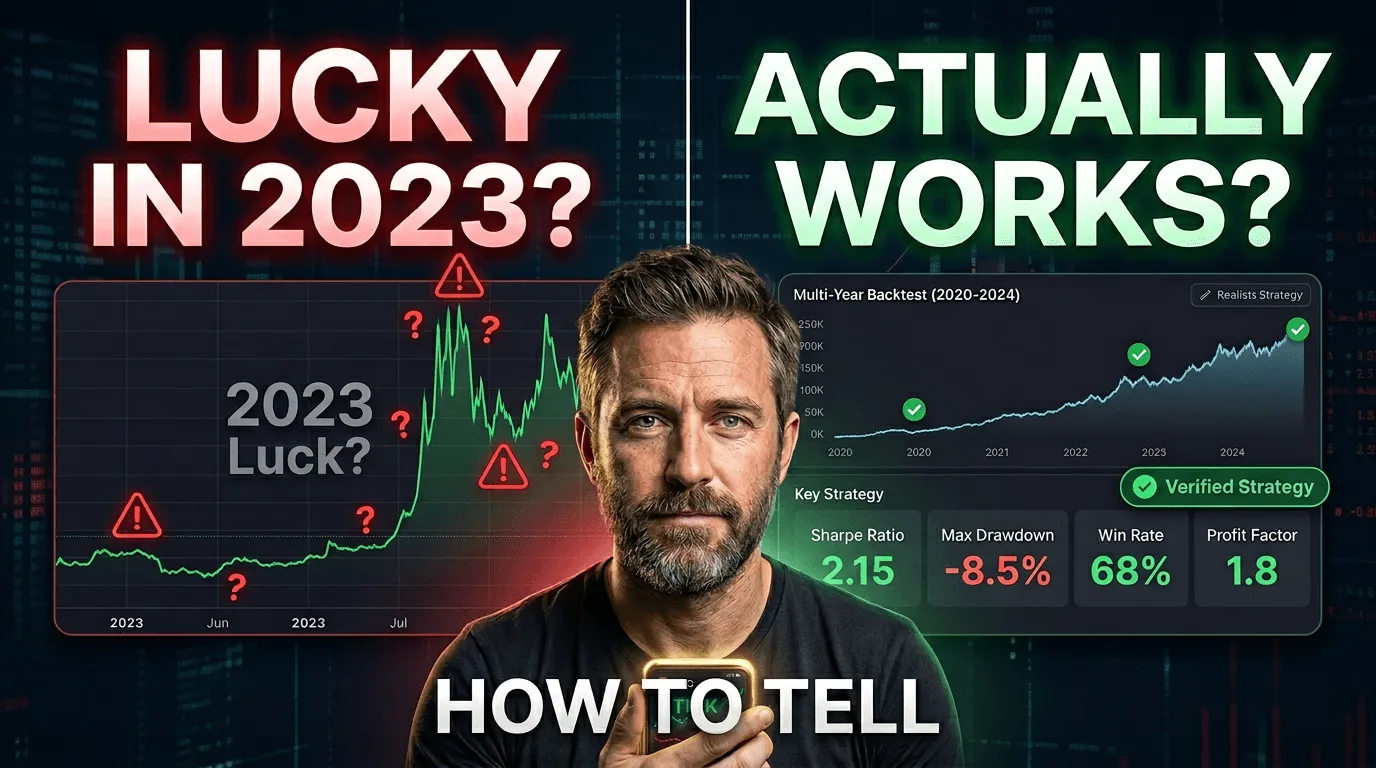
How to Tell If a Crypto Trading Bot Strategy Actually Works (Or Just Got Lucky in 2023)
By Felix Götz – Co-Founder and CTO of ArrowTrade AG, building unCoded since 2016 in crypto trading. ...

My Honest Experience with Crypto Trading Bots on a Normal Portfolio – Here’s What They Actually Cost Me
By Felix Götz – founder of unCoded, trading crypto since 2016. Before we start: What follows isn't f...

Are Crypto Trading Bots Profitable in 2026? An Honest Answer After Five Years of Running Them
By Felix – founder of unCoded, trading crypto since 2016. Before we start: What follows isn't financ...

How to Build a Crypto Trading Bot That Actually Works in Production
By Felix – founder of unCoded, trading crypto since 2016. I've had this conversation probably thirty...

unCoded Is an IQ Test. That's Not a Marketing Line.
By Felix – founder of unCoded, trading crypto since 2016. Most trading bot platforms optimize for th...