3Commas vs Cryptohopper vs Bitsgap vs Wundertrading: An Honest 2026 Comparison of Crypto Exchange API Trading Bot Platforms
 By Felix Götz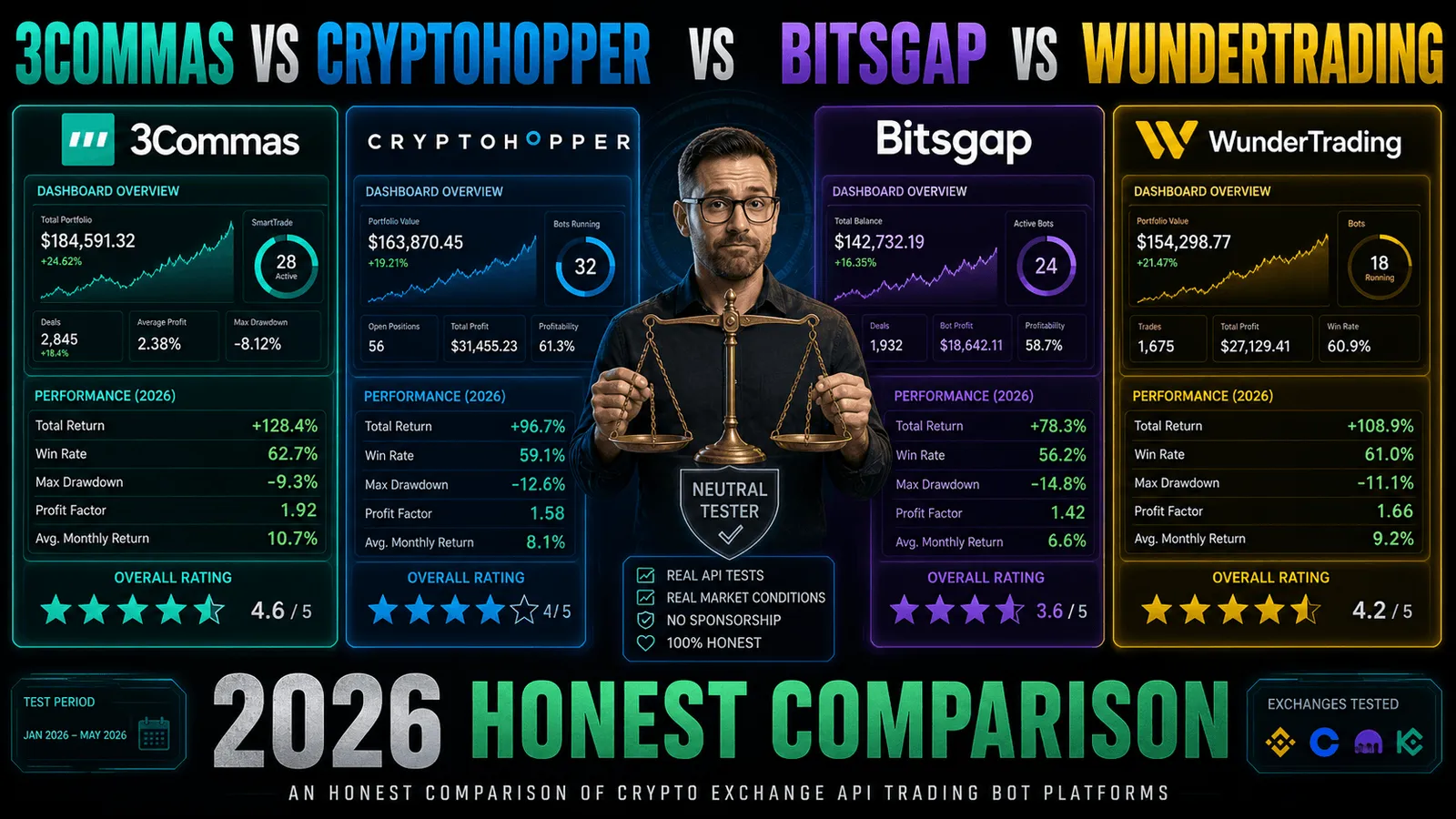
By Felix Götz – Co-Founder and CTO of ArrowTrade AG, building unCoded since 2016 in crypto trading.
Disclosure: I'm Co-Founder and CTO of ArrowTrade AG, the company behind unCoded – which is included as a fifth comparison option in this article. I've also been a paying user of Cryptohopper for five years (Hero tier, 2020-2025). What follows is an honest comparison based on direct experience and publicly verifiable information. This article is for informational purposes only and does not constitute financial advice. Run your own evaluation – don't trust mine or anyone else's blindly.
If you're reading this, you've probably already searched for variations of "best crypto trading bot 2026" and found dozens of articles that all read the same. Affiliate-driven rankings. Cherry-picked screenshots. Marketing claims that fall apart when you actually deploy capital.
This article is different in one specific way: I've actually paid for these platforms myself. I've watched them in production. I've seen what works and what doesn't on real capital across multiple market conditions. And as the founder of a competing platform, I have direct economic incentive to be honest about the strengths of the others, because dishonest comparisons damage my credibility more than honest ones cost me users.
Here's the comparison, as it actually looks in 2026.
All pricing and feature information referenced below is based on publicly available data at the time of writing and may change over time – verify current pricing directly on each platform's website before making decisions.
How to read this comparison
Before getting into the platforms, three principles for reading any bot platform comparison.
First: pricing model matters more than features. Whether the platform's revenue depends on user profitability or user retention is the single biggest predictor of long-term outcomes. Subscription platforms collect revenue regardless of trading results. Profit-sharing platforms only collect when users profit. This shapes which features get built and how strategies are tuned over time.
Second: portfolio size determines which pricing structure is right. A $130/month subscription costs $1,560 per year. On a $200,000 portfolio, that's 0.78% annual drag against capital. On a $12,000 portfolio, the same subscription is 13% annual drag. Same platform. Same fee. Different economics depending purely on capital size.
Third: ignore marketing returns, demand backtest distributions. Any platform showing you their best example without showing you the full distribution of outcomes is hiding information. Real platform quality shows in how a strategy performs across many tokens and many years, not in the single cherry-picked highlight.
With those principles in mind, here are the five platforms.
3Commas
Pricing: $37 to $91 per month depending on tier. Annual billing reduces by approximately 25%.
Custody model: Cloud-hosted. API keys stored on 3Commas infrastructure.
Exchange coverage: 14+ exchanges including Binance, Coinbase, Bybit, Kraken, OKX.
Strengths
3Commas is the most established commercial trading bot platform. The product has been around since 2017, the UI is polished, the mobile app works well, and the SmartTrade terminal for manual trading is one of the better implementations in the retail space.
For multi-exchange traders who want hosted convenience without managing infrastructure, 3Commas is the default choice. The Signal Bot integration with TradingView is reliable. The copy trading marketplace gives users access to community-developed strategies.
The platform has matured significantly since launch, with regular feature additions and a stable operational track record over many years of service.
Weaknesses
A structural consideration with any cloud-hosted bot platform: when API keys are stored on the platform's infrastructure, exchange security partly depends on that infrastructure. The retail bot industry has seen multiple publicly reported incidents over the years where user credentials on cloud-hosted platforms were compromised – sometimes through phishing operations targeting users, sometimes through other attack vectors. The relevant point isn't to single out any specific platform: it's that cloud-hosted custody architecture creates failure modes that self-hosted architectures structurally cannot have. This applies equally to 3Commas, Cryptohopper, Bitsgap, and Wundertrading – any platform where API keys leave user infrastructure.
Strategy depth is limited. DCA bots, Grid bots, and Signal bots are configurable but not deeply customizable. Users who want to build truly custom strategies will run into ceiling limits.
Backtesting evaluates at candle close, missing intracandle events. Live performance frequently diverges from backtest expectations on volatile assets.
At a 15% annual gross return assumption, the $60/month tier ($720/year) requires roughly $4,800 in capital just to cover platform fees ($720 ÷ 0.15 = $4,800). Add typical exchange fees and tax software costs and the realistic break-even rises to around $6,000-$8,000 depending on jurisdiction. Subscription pricing on portfolios under $30,000 produces unfavorable economics in practice.
Right for
Multi-exchange traders with portfolios above $30,000 who want hosted convenience and standard DCA/Grid strategies. The polished UX justifies the subscription cost when capital is sufficient and the user values not managing infrastructure.
Wrong for
Users with portfolios under $20,000 (subscription drag becomes punishing). Users who want self-hosted custody (not available). Users who need strategy depth beyond DCA/Grid templates (limited).
Cryptohopper
Pricing: $19 to $129 per month depending on tier.
Custody model: Cloud-hosted. API keys stored on Cryptohopper infrastructure.
Exchange coverage: Binance, Coinbase, KuCoin, Kraken, and others.
Strengths
Cryptohopper has the most active strategy marketplace in the retail bot space. Hundreds of community-developed strategies are available, with mixed quality but genuine variety. For users who want to explore configurations without building from scratch, this is a real advantage.
The AI assistant for strategy configuration is one of the better implementations. Documentation is comprehensive. The platform has been around since 2017 and is operationally stable.
For traders comfortable with the subscription model who want a feature-rich cloud platform with marketplace access, Cryptohopper delivers what it promises.
Weaknesses
I ran Cryptohopper Hero tier for five years on my own capital across multiple portfolio sizes. The strategies executed correctly. Across five years, my net return after subscription fees, tax software, and taxes was consistently worse than holding Bitcoin – the platform worked, the economics didn't, especially in the $10,000-$50,000 portfolio range where Hero tier ($129/month) exceeds most strategies' realistic edge.
Two technical limitations specific to Cryptohopper: check intervals of 2 minutes are too slow for small-cap tokens or any strategy depending on intracandle price movements, and the OHLCV-based backtesting with candle-close evaluation systematically overstates expected returns relative to live performance.
The strategy marketplace is a double-edged feature. Many configurations were optimized during specific periods (2021 bull market, 2023 recovery) and fail in current conditions. Most marketplace strategies haven't been validated out-of-sample, which means impressive historical screenshots don't predict forward performance. Cloud-hosted custody concerns apply as with all platforms in this comparison.
Right for
Portfolios above $50,000 where the subscription cost is a small percentage of generated returns. Traders who specifically want access to the marketplace and don't need tick-level execution. Users comfortable with cloud-hosted custody.
Wrong for
Portfolios under $30,000 (the math fails). Strategies requiring fast execution on volatile assets. Users who want self-hosted custody. Traders who plan to evaluate strategies seriously through honest backtesting (the methodology has known issues).
Bitsgap
Pricing: $24 to $149 per month depending on tier.
Custody model: Cloud-hosted.
Exchange coverage: Binance, Kraken, Bybit, KuCoin, and others.
Strengths
Bitsgap specializes in grid trading and does it well. The grid bot implementation is among the cleaner ones in the retail space, the UI is well-designed, and the multi-exchange portfolio view is genuinely useful for users trading across several exchanges simultaneously.
For range-bound markets where grid trading thrives, Bitsgap produces consistent results. The arbitrage scanner and demo mode are useful additional tools that justify the platform's positioning as a multi-tool rather than just a bot.
Weaknesses
Strategy variety outside of grid and DCA is limited. If your trading approach doesn't fit grid trading specifically, much of what you're paying for goes unused.
Backtesting is functional but not deep. Multi-chart validation isn't standard, which means strategies optimized in Bitsgap's environment may not generalize beyond the conditions they were tested in.
Pricing scales aggressively. The $149/month Pro tier is required for unlimited bots and full feature access. For users who want grid trading specifically and have sufficient capital, this is acceptable. For users below that threshold, the math doesn't work.
Cloud-hosted custody model with the same structural concerns as the other subscription platforms above.
Right for
Traders whose primary strategy is grid trading on multiple exchanges with portfolios above $30,000. Users who value the multi-exchange portfolio view and don't need deep strategy customization beyond grids.
Wrong for
Users whose strategies aren't grid-based. Portfolios under $20,000. Traders who want strategy programmability or signal-based custom logic.
Wundertrading
Pricing: $9.95 to $99.95 per month depending on tier.
Custody model: Cloud-hosted.
Exchange coverage: Binance, Bybit, OKX, and others.
Strengths
Wundertrading focuses heavily on copy trading and signal-based bot execution. For users who specifically want to follow signal providers or automate TradingView alerts across multiple exchanges, the platform is well-positioned.
Pricing at the lower tiers is more accessible than 3Commas or Bitsgap, making it a reasonable entry point for traders testing automated execution before committing to more expensive platforms.
The TradingView webhook integration is straightforward and the copy trading marketplace gives users access to signal providers across multiple exchanges.
Weaknesses
The product is primarily designed for following others, not for building independent strategies. Users who want to develop their own systematic approach will find Wundertrading limiting compared to platforms with deeper strategy customization.
Performance depends heavily on signal provider quality. Most signal providers in the marketplace haven't been validated across multiple market regimes, and historical performance frequently doesn't predict forward performance.
Backtesting is basic. Custom strategy development is limited compared to 3Commas, Cryptohopper, or HaasOnline.
Cloud-hosted custody with standard subscription pricing structure.
Right for
Users who specifically want copy trading or signal-based automation rather than developing their own strategies. Traders who want a low-cost entry point to test automated execution before scaling up.
Wrong for
Users who want to build custom strategies. Traders who don't want to depend on signal provider quality. Users who need deep backtesting capabilities.
unCoded
Pricing: Profit-sharing only. 30% of generated profits, dropping to 20% after $2,000 cumulative fees. No monthly subscription. Bad months cost zero.
Custody model: Self-hosted, non-custodial. Deployed on user's own VPS via one-click CapRover installation. API keys never leave user infrastructure.
Exchange coverage: Binance Spot live in production. 16 additional major exchanges (Coinbase, Kraken, KuCoin, OKX, Bybit, MiCA-compliant EU alternatives, and others) currently in internal alpha testing with no firm release dates.
Strengths
The pricing structure is the primary differentiator from the four platforms above. Bad months cost nothing. The platform's revenue depends entirely on users actually generating profit. This alignment shapes every product decision over time, from honest backtesting methodology to conservative defaults.
Self-hosted, non-custodial architecture eliminates the cloud-platform security risk. API keys stay in user infrastructure. Even a complete compromise of unCoded servers cannot affect user exchange accounts because the credentials were never there.
Strategy depth exceeds the subscription platforms. Buy Splits across up to 7 independent levels per position. Sell Time Curves that adjust profit targets based on position age. Per-split trailing stops. Micro-Trading with hard stop losses. Signal Editor with 152 technical indicators and full boolean logic.
Backtesting is built on 1-second base candle data with intracandle evaluation. Sharpe ratio annualization is correct per timeframe. Fee calculation accounts for the actual asset fees are paid in. Multi-chart testing runs strategies against the entire Binance Spot market simultaneously, exposing overfitting that single-chart backtests systematically hide.
Tick-based architecture processes every order book movement in real time, rather than polling at intervals. This enables strategies that polling-based platforms cannot reliably execute.
The full distribution of backtest results is published publicly, including years where strategies failed on the majority of tokens. The 2025 BasicMode results show 7.8% profitability across 373 token configurations – we publish that data because hiding it would be inconsistent with the pricing structure.
Weaknesses
Self-hosting requires technical capability the subscription platforms don't demand. Renting a VPS, installing CapRover, configuring API keys with appropriate permissions, monitoring the deployment. This is an investment of time during the first deployment, and an ongoing operational responsibility afterward.
Currently Binance Spot only in production. Users who trade on Coinbase, Kraken, or other major exchanges cannot use unCoded yet. The 16 exchanges in internal alpha will release as each one is genuinely production-ready, with no firm timeline.
No copy trading. No marketplace of pre-built strategies (though a Strategy Store with profit-sharing alignment is in development). Users who want to follow signal providers should use Wundertrading or 3Commas.
No futures or leverage. Spot trading only. Users who specifically want leveraged positions should use exchange-native tools or specialized platforms.
The first few weeks of operation require active monitoring and learning. unCoded is not a "set and forget" product – we make this explicit because users who expect autopilot performance are systematically disappointed.
Right for
Serious Spot traders with portfolios from $1,000 to $500,000 who have outgrown DCA and Grid templates and want strategy depth. Users who value custody over their own API keys and capital. Traders who want pricing that aligns with their trading outcomes rather than fixed subscription costs that drain capital during flat or losing periods.
Wrong for
Leverage traders. Complete beginners with no trading experience. Users unwilling to manage a VPS. Traders looking for autonomous wealth generation.
⚠️ The decision framework
Five platforms, five different fits. Here's how to actually choose.
If you have a portfolio under $20,000
The subscription math is structurally hostile to small portfolios on 3Commas, Cryptohopper, and Bitsgap. Wundertrading at $9.95-$24/month is the most accessible subscription option. unCoded's profit-sharing model doesn't penalize smaller portfolios – the fee scales with results, not with capital.
The honest evaluation: subscription platforms are wrong for this portfolio range unless you specifically need a feature only they offer (copy trading, specific exchange support).
If you have a portfolio between $20,000 and $100,000
This is where pricing model evaluation matters most. Subscription costs become acceptable but not negligible. Run the math: total annual cost of the platform's required tier divided by your expected gross returns. If the platform consumes more than 15% of expected gross profit, it's structurally working against you.
Profit-sharing pricing produces materially better economics in this range, particularly during years with mediocre returns where subscription fees still extract their full amount.
If you have a portfolio above $100,000
Subscription costs become a small percentage of expected returns. The economics work for any of the major platforms. The decision shifts to feature fit: what strategies do you actually want to run? What exchanges? What custody model?
For users in this range, 3Commas or Cryptohopper provide the broadest exchange and feature coverage. unCoded provides deeper strategy customization with self-hosted custody if those matter more than exchange breadth.
If you trade primarily on Binance
unCoded's deepest current strength is on Binance Spot specifically. The tick-based architecture, multi-chart backtesting against every Binance pair, and strategy depth specifically tuned for Binance's API characteristics are difficult to match on platforms designed for multi-exchange breadth.
If Binance is your primary exchange and you want serious strategy depth, this is the strongest available option in 2026.
If you trade across multiple exchanges
Currently 3Commas leads on exchange coverage breadth. Cryptohopper is also strong. unCoded's multi-exchange support is in internal alpha and not yet production-ready – if you need Coinbase, Kraken, or other exchanges today, the existing options are more practical.
If you primarily want copy trading or signal following
Wundertrading or 3Commas. These platforms are designed for this use case. unCoded explicitly doesn't offer copy trading because the design philosophy treats strategy understanding as a prerequisite for deployment.
If you primarily want grid trading
Bitsgap is purpose-built for this. The grid implementation is well-developed and the multi-exchange portfolio view supports grid strategies running across several exchanges simultaneously.
If you specifically want leveraged trading
None of these five platforms are right. Use exchange-native futures bots or specialized platforms. Spot-only platforms exist for risk-management reasons that align with the philosophy of long-term capital preservation.
⚠️ The pricing math compared
Here's a concrete comparison of what each platform actually costs at typical portfolio sizes.
The 15% annual gross return used below is a hypothetical figure for illustration only, not a representation of expected, typical, or guaranteed returns. Past performance and backtest data are not indicative of future results. Run these numbers with your own realistic assumptions before drawing conclusions.
Portfolio: $10,000 (hypothetical annual gross profit at 15%: $1,500)
- 3Commas Pro ($60/mo): $720/year, 48% of gross profit consumed by fees
- Cryptohopper Adventurer ($65/mo): $780/year, 52% of gross profit consumed
- Bitsgap Advanced ($65/mo): $780/year, 52% of gross profit consumed
- Wundertrading Standard ($24/mo): $288/year, 19% of gross profit consumed
- unCoded: $450 (30% of $1,500), or $0 if year is unprofitable
Portfolio: $50,000 (hypothetical annual gross profit at 15%: $7,500)
- 3Commas Pro ($60/mo): $720/year, 9.6% of gross profit consumed
- Cryptohopper Hero ($129/mo): $1,548/year, 20.6% of gross profit consumed
- Bitsgap Pro ($149/mo): $1,788/year, 23.8% of gross profit consumed
- Wundertrading Pro ($60/mo): $720/year, 9.6% of gross profit consumed
- unCoded: $2,167 in year one, drops to $1,500 in year two onwards (30% on first $6,667 of cumulative profit, 20% on everything beyond)
Portfolio: $200,000 (hypothetical annual gross profit at 15%: $30,000)
- 3Commas Pro ($60/mo): $720/year, 2.4% of gross profit consumed
- Cryptohopper Hero ($129/mo): $1,548/year, 5.2% of gross profit consumed
- Bitsgap Pro ($149/mo): $1,788/year, 5.96% of gross profit consumed
- Wundertrading Pro ($60/mo): $720/year, 2.4% of gross profit consumed
- unCoded: $6,667 in year one, drops to $6,000 in year two onwards (30% rate applies only until $2,000 cumulative fees, then 20% on everything beyond)
How unCoded's pricing works in detail
The 30% rate only applies to the first $6,667 of cumulative lifetime profit (30% of which equals the $2,000 threshold). Every dollar of profit generated after that threshold is capped at 20% permanently.
For long-term users, this means:
- Year one with profitable trading: blended rate between 22% and 30% depending on profit size
- Year two onwards (assuming year one crossed the threshold): flat 20% on all profit
- Bad years: $0 in fees, the threshold remains where it was
For comparison: subscription platforms charge their full fee in year one, year two, year three, year five, year ten – regardless of whether the strategies generated profit. The longer you operate, the more favorable the math becomes for profit-sharing relative to fixed subscription costs.
The honest takeaway: subscription platforms are structurally favorable for very large portfolios where their fees become rounding errors. Profit-sharing platforms produce favorable economics for smaller portfolios, during difficult market years where strategies don't perform, and for long-term users where the 20% rate dominates after the initial threshold is crossed.
Nothing in this comparison guarantees profitable trading on any platform. The math above only works if the strategies actually generate the assumed return, which requires strategy quality, market conditions, and operational discipline that no platform can guarantee.
What I recommend
If you're starting out and want low commitment to test automated trading: try Pionex's free exchange-native bots first. They're not on this comparison list because they're a different category, but they let you experiment with grid and DCA strategies without any platform fees.
If you want polished hosted convenience and have $30,000+: 3Commas is the safest default choice. Solid product, broad exchange coverage, mature platform.
If you want a marketplace and have $50,000+: Cryptohopper. The marketplace access is genuine, even if the math gets uncomfortable on smaller portfolios.
If you specifically want grid trading: Bitsgap. Purpose-built for this use case.
If you want copy trading: Wundertrading or 3Commas. Either works, depending on which marketplace you prefer.
If you trade Binance Spot seriously, want strategy depth, and want pricing aligned with outcomes: unCoded. Self-hosted requirement is real but the architecture and pricing structure produce different long-term results than the alternatives.
The honest summary
There is no universal "best" platform. There are platforms that fit specific situations.
Subscription platforms work well for large portfolios where fees become small percentages of generated returns. They work poorly for smaller portfolios where the fixed costs become structural drag.
Cloud-hosted platforms offer convenience at the cost of custody concerns. Self-hosted platforms offer custody at the cost of operational complexity.
Polished UX comes with feature ceilings. Deep strategy customization comes with steeper learning curves.
The question isn't "which platform is best?" – it's "which platform fits my portfolio size, technical comfort, strategy depth needs, and exchange requirements?"
Run the math for your specific situation. Be honest about your operational discipline – not the user you wish you were, but the user you actually are. Choose accordingly.
The platforms that survive five years of crypto market evolution are the ones whose users actually keep using them through bull markets, bear markets, and ranging conditions. That's a different selection criterion than which platform has the best marketing, and it's the criterion that ultimately matters for your capital.
You are solely responsible for your own trading decisions and risk management.
Felix Götz is Co-Founder and CTO of ArrowTrade AG, the company behind unCoded. After five years of running Cryptohopper as a paying user across multiple portfolio sizes, he built unCoded as a structural alternative to subscription-based bot platforms. unCoded operates from Switzerland under the Swiss DLT regulatory framework. The "unCoded" trademark is registered through EUIPO. Documentation at uncoded.ch/docs . Public backtest infrastructure at uncoded.ch/backtesting .
Recommended Reading
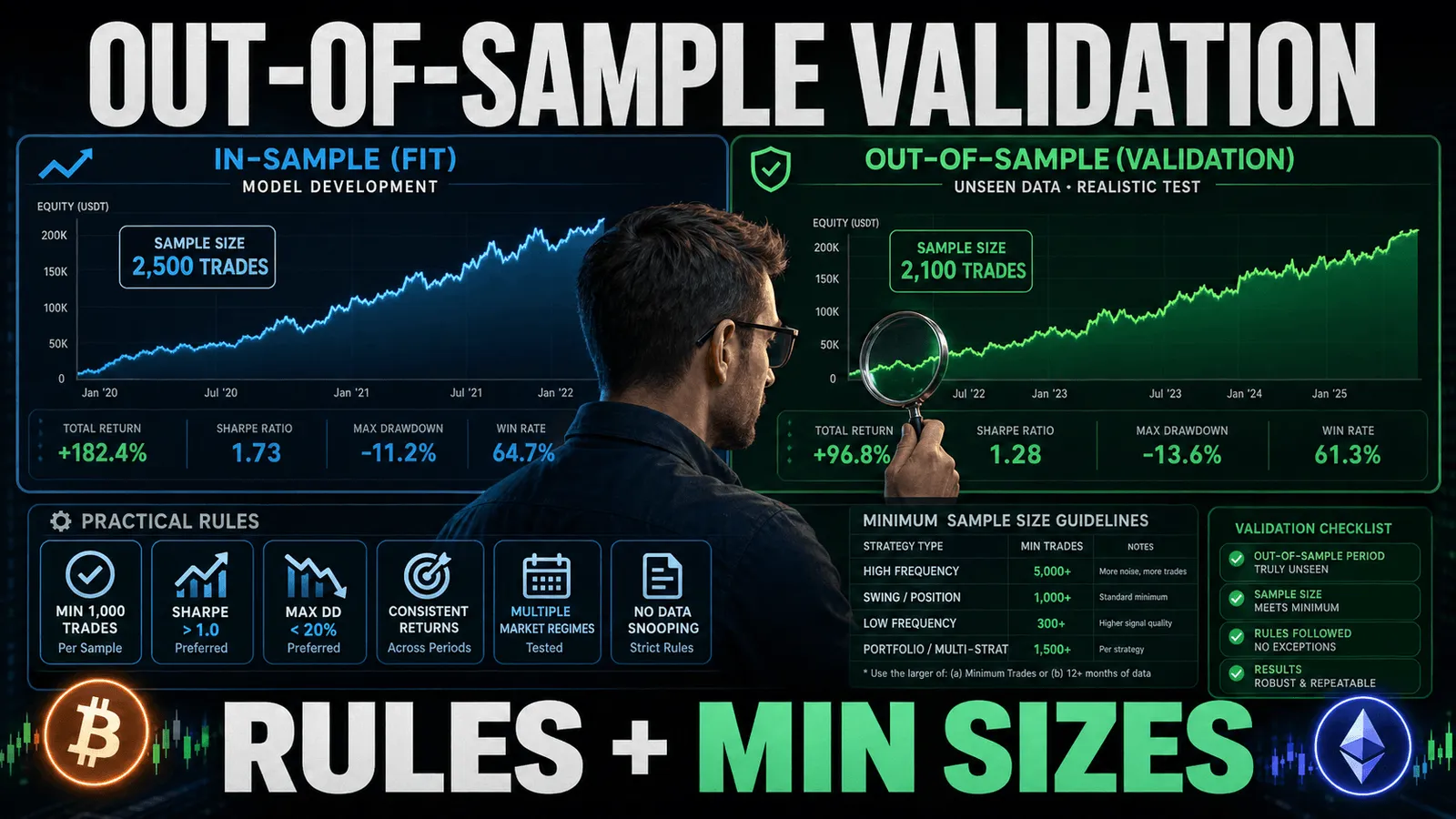
How to Validate a Crypto Bot Strategy Out-of-Sample: Practical Rules and Minimum Sample Sizes
By Felix Götz – Co-Founder and CTO of ArrowTrade AG, building unCoded since 2016 in crypto trading. ...
How to Tell If a Crypto Trading Bot Strategy Actually Works (Or Just Got Lucky in 2023)
By Felix Götz – Co-Founder and CTO of ArrowTrade AG, building unCoded since 2016 in crypto trading. ...

My Honest Experience with Crypto Trading Bots on a Normal Portfolio – Here’s What They Actually Cost Me
By Felix Götz – founder of unCoded, trading crypto since 2016. Before we start: What follows isn't f...

Are Crypto Trading Bots Profitable in 2026? An Honest Answer After Five Years of Running Them
By Felix – founder of unCoded, trading crypto since 2016. Before we start: What follows isn't financ...

unCoded Is an IQ Test. That's Not a Marketing Line.
By Felix – founder of unCoded, trading crypto since 2016. Most trading bot platforms optimize for th...
Trading XRP with a Bot: What Works, What Doesn't, and Why It's Different from BTC
By Felix – founder of unCoded, trading crypto since 2016. Ripple, XRP is one of the most polarizing ...

Five Years of Running Trading Bots: Six Things I Wish Someone Had Told Me at the Start
By Felix – founder of unCoded, trading crypto since 2016. I started running crypto trading bots in 2...

The canBuyDown Feature: Why unCoded's Approach to Buying During Crashes Is Different
By Felix – founder of unCoded, trading crypto since 2016. There's a feature in unCoded called canBuy...