Trading XRP with a Bot: What Works, What Doesn't, and Why It's Different from BTC
 By Felix Götz
By Felix – founder of unCoded, trading crypto since 2016.
Ripple, XRP is one of the most polarizing assets in crypto.
To one group, it's the future of cross-border payments – a utility token with real enterprise partnerships, finally free of the SEC lawsuit that shadowed it for five years, now sitting around $1.42 with ETF inflows accelerating in April 2026.
To another group, it's a banker coin. Centralized, pre-mined, with 55 billion tokens still locked in escrow and a price that spends most of its time ranging sideways while other altcoins run.
Both views have some truth in them. What almost nobody discusses is the actual question most XRP holders eventually ask: can you trade this thing with a bot, and does it actually work?
Short answer: yes, but XRP behaves differently from BTC or ETH, and most bot guides completely ignore the differences. Here's what five years of watching XRP has taught me about automating it.
Why XRP is harder to bot than BTC
If you've run bots on Bitcoin and expect XRP to behave the same way, you're going to lose money learning otherwise.
Volatility comes in bursts, not waves. XRP spends weeks or months trading in tight ranges. Then Ripple announces a partnership, the SEC case produces a headline, or an ETF flow data release drops, and price moves 20-40% in a few days. Bots tuned for Bitcoin's steadier volatility profile catch the ranging periods fine and get destroyed by the burst moves.
The news sensitivity is extreme. Bitcoin responds to macroeconomic news. XRP responds to Ripple-specific news in ways that dominate price action. A single tweet from a Ripple executive, an SEC filing update, or a central bank pilot announcement can move price more than a week of market structure. This creates gap risk that bots with tight stops will hit repeatedly.
Liquidity is concentrated during specific sessions. XRP has meaningful liquidity during the EU-US overlap (12:00-17:00 UTC) and during the Asian session when Japanese and Korean retail is active. Outside those windows, spreads widen and execution gets expensive. Bots running uniformly across 24 hours eat slippage during the thin periods.
Correlation with Bitcoin is unreliable. When BTC rallies, XRP might rally with it, lag it by days, or move in the opposite direction because Ripple-specific news dominated. Strategies that assume BTC-correlation as a baseline condition fail more often on XRP than on genuinely correlated altcoins.
None of this makes XRP unbotifiable. It means the strategies that work on BTC need to be adapted, and some strategies that work on BTC shouldn't be run on XRP at all.
What actually works on XRP
Range trading during consolidation
When XRP is trading sideways in a defined range – which it does for months at a time – grid bots and range-bound DCA strategies work well. The ranging behavior that frustrates holders waiting for breakouts is exactly what grid strategies monetize. Tight buy splits with small profit targets produce steady returns during these periods.
Mean reversion on short timeframes
XRP tends to overshoot on news-driven moves and revert within hours or days. Strategies that enter on RSI extremes and exit on mean reversion to short-term moving averages have historically worked on XRP better than on BTC, where trends persist longer.
Breakout capture with tight risk management
When XRP breaks out of a range, the move tends to extend further than Bitcoin breakouts of similar percentage. A bot that enters on confirmed breakouts with trailing stops can capture meaningful portions of these moves – but only if the breakout confirmation filters are strict enough to avoid false triggers.
Signal-based entries from TradingView
XRP responds well to technical levels because so many retail traders watch the same charts. Support/resistance, Fibonacci retracements, and moving average crossovers produce cleaner signals on XRP than on more institutionally-driven assets. A TradingView strategy with webhook execution into a bot that handles risk management on every trigger works better on XRP than generic time-based strategies.
What destroys capital on XRP
Naive DCA without directional filters
The worst thing you can do to XRP. And what most retail guides recommend.
"Just DCA into XRP" sounds good until XRP drops 40% over three weeks on regulatory news and your bot has deployed 80% of its capital at progressively worse prices before the bottom. The falling-knife pattern is particularly brutal on XRP because drops are news-driven and often continue further than technical analysis would suggest.
If you take nothing else from this article: do not run undirectional DCA on XRP.
High-frequency scalping
XRP's spreads widen meaningfully during thin liquidity periods. Strategies that rely on capturing 0.1-0.3% moves with tight execution get eaten by spread costs during every Asian overnight session. The theoretical edge disappears into slippage. What backtests as profitable runs at a loss in live markets.
Correlation-based pair trading
"If BTC goes up, XRP will follow" is a strategy that works often enough to look profitable in backtests and fails catastrophically when Ripple-specific news breaks the correlation. I've watched pair-trading strategies with beautiful Sharpe ratios on historical data produce flat or negative returns live because the correlation assumption broke at the worst moments.
Leveraged accumulation strategies
If you're trying to accumulate XRP over months, leverage doesn't help you. News-driven drawdowns will liquidate positions that would have recovered in Spot trading. Leave leverage for Bitcoin, where volatility is more predictable.
Exchange choice: where you trade sets your slippage floor
Where you trade XRP matters less than how you trade it – but it matters.
Binance is the liquidity king. XRPUSDT handles $1-3B daily depending on market conditions, tightest spreads in the market, best execution for anything latency-sensitive. Default here unless you have a specific reason to use something else.
Coinbase and Kraken offer clean US-compliant access with wider spreads than Binance. Fine for retail-scale strategies, noticeably more expensive for high-turnover bots.
For EU traders, MiCA is the real consideration. Bitvavo offers XRPEUR without USDT. Bybit EU offers XRPUSDC. Both avoid the USDT restrictions MiCA imposes on regulated EU exchanges. Less liquidity than Binance, but often the cleanest regulatory path for European users.
The practical rule: bot performance scales with the quality of your execution. On XRP, that means Binance if possible, MiCA-compliant alternatives if regulation dictates otherwise, and everything else only when you have a specific reason.
The SEC resolution changed the playing field
For five years, XRP traded under a legal cloud that made institutional adoption impossible and retail behavior unpredictable.
With the SEC case resolution, that changed. ETF inflows are now running at record levels for 2026 – roughly $65 million into spot XRP ETFs in April alone. Institutional capital is entering positions that were impossible while the lawsuit was active. The token's regulatory classification is finally clear enough for traditional finance to engage.
What this means for bot traders: XRP's price action is becoming more like a mainstream institutional asset and less like a speculative altcoin. The news-driven spike behavior is still there but moderated by a larger pool of participants. The historical volatility patterns are becoming less reliable as predictors because the underlying market structure has changed.
Strategies that worked on "lawsuit-era XRP" need to be revalidated. Backtests from 2022-2024 are now running against a fundamentally different market. This isn't necessarily bad news – many bot strategies work better on institutionally-participated assets because volatility is still meaningful but gap risk is lower – but assuming continuity with historical behavior is a mistake.
Which platforms actually handle XRP well
Most major bot platforms support XRP. The practical differences:
3Commas – standard DCA and Grid templates, works for range-bound strategies, subscription pricing needs to make sense for your portfolio size.
Cryptohopper – community-published XRP strategies exist, but most are backtested on cherry-picked periods. Paper trade before committing capital.
Pionex – free native grid bots, limited sophistication, fine for starting out.
Bitsgap – specialized grid trading, works well for XRP's ranging periods, expensive at higher tiers.
Freqtrade – full control if you can write Python, free, requires engineering effort.
unCoded – tick-based processing matters more on XRP than on BTC because news moves are fast and candle-close backtests misrepresent execution quality. The canBuyDown default prevents the falling-knife accumulation that destroys most XRP DCA strategies during regulatory news cycles. Currently Binance Spot only; more exchanges in internal alpha, no firm release dates.
The honest summary
XRP is tradable with a bot. It's not the easiest asset to automate, and most generic guides oversimplify what actually works.
The strategies that succeed on XRP are range trading during consolidation, mean reversion on short timeframes, and breakout capture with strict risk management. The strategies that fail are naive DCA, high-frequency scalping, and correlation-based pair trading.
The exchange choice matters less than the bot's architecture. Tick-based processing and proper risk management matter more on XRP than on BTC because XRP's news-driven moves are faster and sharper.
The SEC resolution has changed XRP's market structure. Historical backtests need to be revalidated against post-resolution data. Strategies that worked in the lawsuit era may or may not continue working.
Start small. Validate any strategy on forward paper trading before deploying meaningful capital. Never DCA into regulatory news without a directional filter. And if your bot platform doesn't support proper backtesting on tick-level data, the numbers it shows you for XRP strategies are approximately fiction.
No bot makes XRP a better long-term investment than it would be otherwise. If you believe in XRP's utility thesis, a bot can extract additional returns from the volatility around your long-term position. If you don't believe in XRP, a bot won't make holding it profitable.
The bot is a tool. The thesis is yours.
Felix is the founder of unCoded — a self-hosted, non-custodial crypto Spot trading bot with profit-sharing pricing. Documentation at uncoded.ch/docs . ArrowTrade AG, Switzerland.
Recommended Reading

The rsETH Heist: Turning Bridges Into Exit Liquidity
On April 17–18, 2026, roughly 116,500 rsETH – about 292 million USD at the time – were effectively “...

Crypto Trading Bots Won't Make You Rich – But They Can Pay Your Bills
By Felix – founder of unCoded, trading crypto since 2016. Every time I see an ad for a crypto tradin...

Five Years of Running Trading Bots: Six Things I Wish Someone Had Told Me at the Start
By Felix – founder of unCoded, trading crypto since 2016. I started running crypto trading bots in 2...

The canBuyDown Feature: Why unCoded's Approach to Buying During Crashes Is Different
By Felix – founder of unCoded, trading crypto since 2016. There's a feature in unCoded called canBuy...
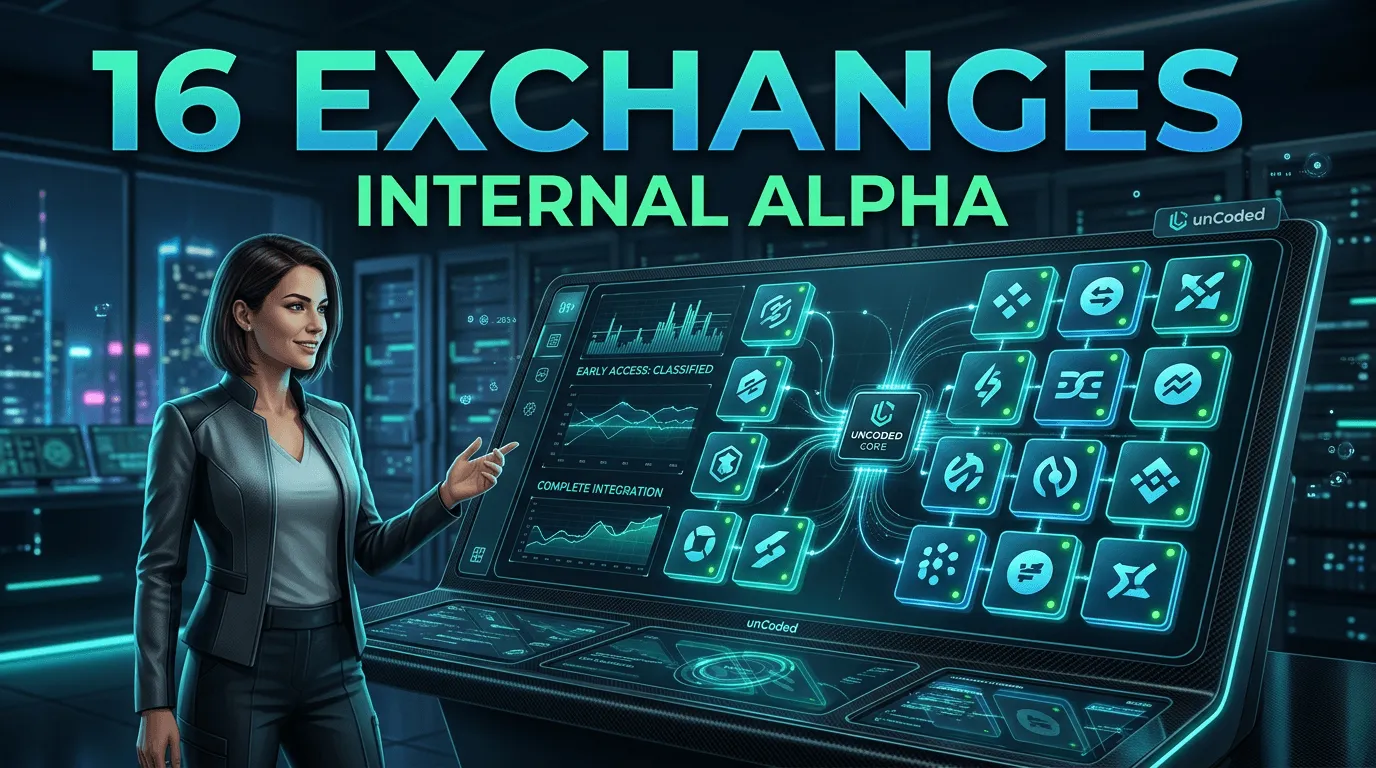
unCoded Expands: 16 Major Exchanges Now in Internal Alpha
By Felix – founder of unCoded, trading crypto since 2016. Something important to share about where u...