Crypto Drawdown Explained
 By Tommy Tietze
By Tommy Tietze, CEO of ArrowTrade AG
Drawdown is one of the most honest risk metrics in trading.
It does not care how good the strategy sounded. It does not care how clean the backtest looked. It does not care how confident the trader felt when the position was opened. Drawdown simply asks one question: how far did the portfolio fall from its previous high?
That question is uncomfortable because it measures risk in the way investors actually experience it. Volatility can sound abstract. A 25% drawdown feels personal. It changes behavior, confidence and decision-making.
The CFA Institute describes drawdown as the decline in value from a previous local maximum to a subsequent trough, while maximum drawdown is the largest accumulated loss from a high point to a later low point over the period analyzed.
In crypto, this metric matters because the market can move quickly, correlations can rise during stress and emotional decisions often appear exactly when drawdown becomes visible.
A serious trading setup does not pretend drawdown will not happen.
It defines what drawdown is acceptable before the market creates it.
What drawdown means
Drawdown measures the decline from a previous portfolio peak.
If your portfolio rises from 10,000 to 12,000 and then falls to 9,600, the drawdown from peak to trough is 20%. The peak was 12,000. The trough was 9,600. The decline was 2,400.
That is the simple version.
Maximum drawdown is the largest such decline in a given period. Binance defines maximum drawdown as the maximum observed loss in net asset value from the highest point to the lowest point that occurs after it during a specific period, and notes that higher MDD indicates higher risk.
This is useful because it turns risk into a path.
A portfolio can end the year positive and still have gone through a painful drawdown in the middle. Two strategies can both return 20%, but one may have lost 10% on the way while the other lost 45% before recovering.
The final return does not tell the full story.
Drawdown shows the road.
Why drawdown matters more than traders expect
Many traders focus on upside first.
They ask what a strategy can make, how often it wins, how strong the signal looks or how much capital it could compound. Those questions are understandable, but incomplete. The better first question is whether the trader can survive the strategy’s bad periods.
A strategy that looks profitable but repeatedly creates large drawdowns may be difficult to follow in real life. It may look good in a spreadsheet, but fail when the person running it loses confidence at the worst possible moment.
The CFA Institute notes that maximum drawdown is one of the clearest ways to measure an investor’s risk appetite and is an important factor when building portfolios.
That is exactly the point.
Drawdown is not only a financial metric. It is a behavioral metric.
It tells you when the strategy starts testing the person behind it.
Drawdown is not the same as volatility
Volatility and drawdown are related, but they are not the same.
Volatility describes how much prices move. Drawdown describes how far your portfolio has fallen from its previous high. A market can be volatile without creating a major portfolio drawdown if the strategy manages exposure well. A portfolio can also suffer a deep drawdown even if average volatility does not look extreme, especially if losses happen in a persistent direction.
type: embedded-entry-inline id: 4Zo2sk0OrjPPpcOA8pTSRd
Volatility is movement.
Drawdown is damage from peak.
That distinction matters because traders often misunderstand risk when they only look at volatility. A volatile strategy that repeatedly recovers quickly may be psychologically easier than a slow, grinding drawdown that lasts for months. On the other hand, a strategy with calm daily returns can still hide serious downside if it is exposed to rare but severe market events.
Drawdown makes the path visible.
And in trading, path matters.
Why crypto drawdowns feel different
Crypto drawdowns can feel more intense than drawdowns in many traditional markets for several reasons.
First, the market trades 24/7. There is no closing bell that forces distance. A portfolio can decline while you sleep, during the weekend or during a holiday.
Second, crypto assets often become highly correlated during stress. A portfolio that looks diversified during normal conditions can behave like one large position when Bitcoin drops sharply.
Third, social media amplifies the emotional experience. During drawdowns, the feed becomes a mixture of panic, predictions, blame, memes, liquidation screenshots and confident explanations from people who were silent before the move.
Fourth, liquidity can change quickly. A position that looked easy to exit during calm conditions may become harder to sell during stress.
Drawdown is therefore not only about price.
It is about price, liquidity, attention, emotion and infrastructure arriving at the same time.
The recovery problem
One of the most important things about drawdown is that recovery is not linear.
A 10% loss requires an 11.1% gain to recover. A 20% loss requires a 25% gain. A 50% loss requires a 100% gain. The deeper the drawdown, the harder the recovery becomes.
This is why protecting downside matters.
Not because losses can be avoided completely, but because large losses change the math. They also change the trader. After a deep drawdown, many people become more emotional, more impatient or more risk-seeking because they want to “make it back”.
That is where systematic trading can break down.
type: embedded-entry-inline id: xM4SN55RgGhIy5hLucxpQ
A system should prevent the trader from negotiating with the market during stress. If a drawdown limit is reached, the response should already be defined.
Reduce exposure. Stop new entries. Review the strategy. Check execution. Reassess correlations. Do not improvise under pressure.
Maximum drawdown and its limits
Maximum drawdown is useful because it is easy to understand.
But it has limits.
Binance notes that maximum drawdown can measure the size of the largest loss a portfolio has experienced, but it does not consider the frequency of large losses, how long recovery takes or whether the portfolio has already recovered.
This is important.
A strategy with one 25% drawdown and a quick recovery is not the same as a strategy with repeated 20% drawdowns that keep happening. A strategy that recovers in two weeks is not the same as one that takes two years to return to its high.
Maximum drawdown answers one question:
How bad was the worst peak-to-trough decline?
It does not answer everything.
That is why mature risk review should also look at:
- drawdown duration
- average drawdown
- frequency of drawdowns
- recovery time
- drawdown compared with market conditions
- whether the strategy followed its own rules
- whether fees and slippage were included
- whether stablecoin and exchange risks affected results
Risk is rarely one number.
Drawdown is a strong starting point, not the whole system.
Drawdown and position sizing
type: embedded-entry-inline id: 2fFkuELu9dXrITnRoCYTUj
Position sizing is one of the most direct ways to control drawdown. If individual positions are too large, normal market movement can create portfolio-level damage. If total exposure is too high, several correct-looking trades can still produce a painful drawdown when they move together.
This is especially relevant in crypto because many assets are not truly independent. A trader may hold Bitcoin, Ethereum, Solana, Chainlink and several smaller altcoins and believe the portfolio is diversified. In a risk-off move, all of them may fall together.
Position sizing must therefore happen at two levels.
At the trade level, each position needs a defined risk.
At the portfolio level, total exposure must be controlled.
A single trade can be reasonable while the total portfolio is not.
Drawdown and indicators
type: embedded-entry-inline id: 1vtbE44OqU1TUzn7CJpBNg
Indicators can help describe market conditions, but they do not protect a portfolio by themselves. A trader can buy because RSI looks oversold and still enter too early. A market can remain oversold during a strong downtrend. A bounce can fail. A signal can be correct directionally but still poorly timed.
This is where drawdown adds discipline.
If an indicator-based strategy enters during falling markets, the strategy must define how much decline is acceptable before the setup is considered invalid or the exposure is reduced. Otherwise, the trader may keep adding to a losing position because the indicator “still looks cheap”.
That is not risk management.
That is a story attached to a loss.
Drawdown and stablecoins
type: embedded-entry-inline id: 7joG9Hn4Jpfc1xK3wbhlZR
Stablecoins often become important during drawdowns because traders use them to reduce exposure, hold reserves or close positions into a quote currency. That makes sense, but stablecoins introduce their own infrastructure questions.
Which stablecoin are you using? Is the trading pair liquid? Are you paying maker or taker fees? Is the stablecoin supported in your region? Are your transactions exportable? Is the stablecoin held on an exchange or in self-custody?
A drawdown plan should include these questions before stress appears.
A trader who wants to reduce exposure during a fast market should not be discovering stablecoin liquidity, fee rules or withdrawal limits in real time.
Drawdown and exchange risk
type: embedded-entry-inline id: 3Rj7iDVXrRiBU8RLP5Lk3N
Drawdown can be caused by market movement, but it can also be made worse by operational issues. If an exchange has problems during a volatile period, if API access fails, if withdrawals are delayed or if orders do not execute as expected, the financial drawdown may become an operational drawdown as well.
This is why infrastructure belongs in risk management.
A serious setup should know:
- where capital is held
- which permissions are granted
- whether withdrawal rights are disabled for trading APIs
- whether IP restrictions are used
- whether trade exports are reliable
- whether the system can stop trading if needed
Drawdown is not only a chart event.
It is a stress test of the whole setup.
Drawdown and MiCA
type: embedded-entry-inline id: ZuOKvBuRdlf2zb681SbqB
MiCA does not prevent drawdowns. Regulation does not make crypto prices stable, and it does not remove market risk. But MiCA is part of a broader shift toward more formal crypto infrastructure, clearer disclosures and more supervised service providers.
For investors, this creates a practical lesson.
As the market becomes more regulated, the excuse of “crypto is messy” becomes weaker. Records, provider selection, stablecoin choice, custody structure and risk controls should become more professional too.
A regulated environment still requires disciplined users.
MiCA may improve the framework around the market. It does not define your drawdown tolerance for you.
Drawdown and tax records
type: embedded-entry-inline id: 2kA1pyMZJn94ImazMkpPbt
Drawdown can create tax complexity because traders often act more during stress. They close positions, rotate into stablecoins, rebalance, realize losses, realize gains, move assets between wallets or change strategies.
All of that creates records.
A portfolio can be down economically while still having taxable events depending on the jurisdiction, holding period and transaction history. That is why drawdown management should not be separated from documentation.
During stress, clean records matter more, not less.
If your strategy creates many small trades, your ability to export and explain those trades is part of the operating model.
Drawdown in automated trading
Automated trading makes drawdown more visible because the system can keep executing while the user is not emotionally involved in every trade.
That can be good.
It can also be dangerous.
If the strategy has clear limits, automation can help maintain discipline. If the strategy has poor limits, automation can keep adding exposure, repeating signals or trading through a market environment where it should stop.
This is why drawdown rules matter before automation begins.
An automated setup should define:
- maximum drawdown before reducing exposure
- maximum drawdown before pausing new trades
- maximum number of open positions
- maximum exposure per asset
- maximum exposure per stablecoin pair
- whether the system changes behavior during high volatility
- how the user is alerted
- how manual intervention is handled
A bot should not be allowed to discover its risk tolerance after the drawdown has already happened.
Why unCoded focuses on controlled spot execution
unCoded is built around a simple but important principle: automated crypto trading should be controlled before it is exciting.
The system focuses on Binance spot trading. User capital remains on the user’s Binance account. The API key does not need withdrawal permissions. The approach avoids futures leverage and the liquidation mechanics that come with it.
This does not remove drawdown.
No honest system can remove drawdown.
But it changes the risk structure. In spot trading, a falling market can create losses and book declines, but it does not trigger the same forced liquidation mechanics as leveraged futures. That gives the user and the system more room to manage exposure, review positions and work within defined limits.
Drawdown is still possible.
The point is to make it visible, bounded and understandable.
Practical checklist
Before trading
- What maximum drawdown is acceptable?
- Is the limit defined in percentage terms or absolute capital?
- What happens when the limit is reached?
- Does the system pause, reduce exposure or continue?
- Are position sizes linked to volatility?
- Is total portfolio exposure capped?
- Are stablecoin reserves defined?
- Are trade exports available?
- Are API permissions restricted?
- Is the strategy tested across different market conditions?
During a drawdown
- Is the drawdown within expected range?
- Are losses coming from market movement or execution problems?
- Are multiple assets moving together?
- Has liquidity changed?
- Are fees or slippage worse than expected?
- Is the strategy still following its rules?
- Is the trader overriding the system emotionally?
- Should new entries be paused?
After a drawdown
- How deep was the drawdown?
- How long did it last?
- How long did recovery take?
- Did the portfolio recover?
- Were rules followed?
- Did position sizing work?
- Were stablecoin conversions documented?
- Did exchange or API issues appear?
- Should the strategy be changed, or was the drawdown within expected limits?
FAQ
What is drawdown in crypto?
Drawdown is the decline in portfolio value from a previous peak to a later low. The CFA Institute describes drawdown as the decline from a previous local maximum to a subsequent trough.
What is maximum drawdown?
Maximum drawdown is the largest observed loss from a peak to a later trough during a specific period. Binance defines MDD as the maximum observed loss in net asset value from the highest point to the lowest point that occurs after it during a specific period.
Why does drawdown matter?
Drawdown matters because it shows how much pain a strategy or portfolio created on the way to its result. A portfolio can end positive and still have experienced a large drawdown that was difficult to tolerate.
Is drawdown the same as volatility?
No. Volatility measures price movement. Drawdown measures decline from a previous high. Volatility describes movement; drawdown describes peak-to-trough damage.
Can drawdown be avoided?
Not completely. Any market exposure can create drawdown. The goal is to define acceptable drawdown, manage position size, control exposure and avoid emotional decisions during stress.
Why is drawdown important for trading bots?
A trading bot can continue executing through changing market conditions. If drawdown limits are not defined, the bot may keep trading even when exposure should be reduced or paused.
Does spot trading remove drawdown risk?
No. Spot trading removes forced liquidation mechanics from leveraged futures, but the value of the assets can still fall. Spot-only changes the risk structure; it does not eliminate market risk.
Conclusion
Drawdown is where trading becomes real.
It is easy to like a strategy at new highs. It is harder to trust it when the portfolio is below its peak, the market is noisy and every decision feels heavier than it did during the rally.
That is why drawdown must be part of the plan before it becomes part of the account.
A serious crypto setup defines acceptable loss, total exposure, stablecoin reserves, execution rules, API permissions and documentation before the market applies pressure. It does not wait for panic to create a process.
At unCoded, this is the point of controlled spot execution. The goal is not to pretend risk does not exist. The goal is to make risk visible, bounded and easier to manage. Capital stays on the user’s Binance account. API permissions remain limited. The system operates without futures leverage.
Drawdown cannot be eliminated.
But it can be respected.
Disclaimer: This article is not financial advice. Crypto trading, stablecoins and automated trading strategies involve risk. Past drawdowns, backtests, market behavior or strategy results are no guarantee of future outcomes.
More about automated crypto spot trading: uncoded.ch
More about ArrowTrade AG: arrowtrade.ch
Recommended Reading
MiCA Explained for Crypto Investors
By Tommy Tietze, CEO of ArrowTrade AG Crypto regulation used to feel like background noise. For many...
Systematic vs. Emotional Trading
By Tommy Tietze, CEO of ArrowTrade AG Most traders do not lose control in calm markets. They lose co...
Crypto Volatility Explained
By Tommy Tietze, CEO of ArrowTrade AG Crypto volatility is usually discussed in the wrong tone. Some...
USDT, USDC and FDUSD Explained
By Tommy Tietze, CEO of ArrowTrade AG Stablecoins are often treated as if they were simply “digital ...
Position Sizing in Crypto Trading
By Tommy Tietze, CEO of ArrowTrade AG Many traders spend hours searching for the perfect entry. They...
What Happens During an Exchange Hack?
By Tommy Tietze, CEO of ArrowTrade AG An exchange hack sounds to many like a problem for the exchang...
Crypto Taxes Germany 2026
By Tommy Tietze, CEO of ArrowTrade AG Crypto taxes are no longer a niche topic. Anyone trading Bitco...
Why Your Crypto Trading Bot Backtest Fails: Test Against 100 Charts, Not One
By Felix – founder of unCoded, trading crypto since 2016. Every backtest you've ever run lies to you...
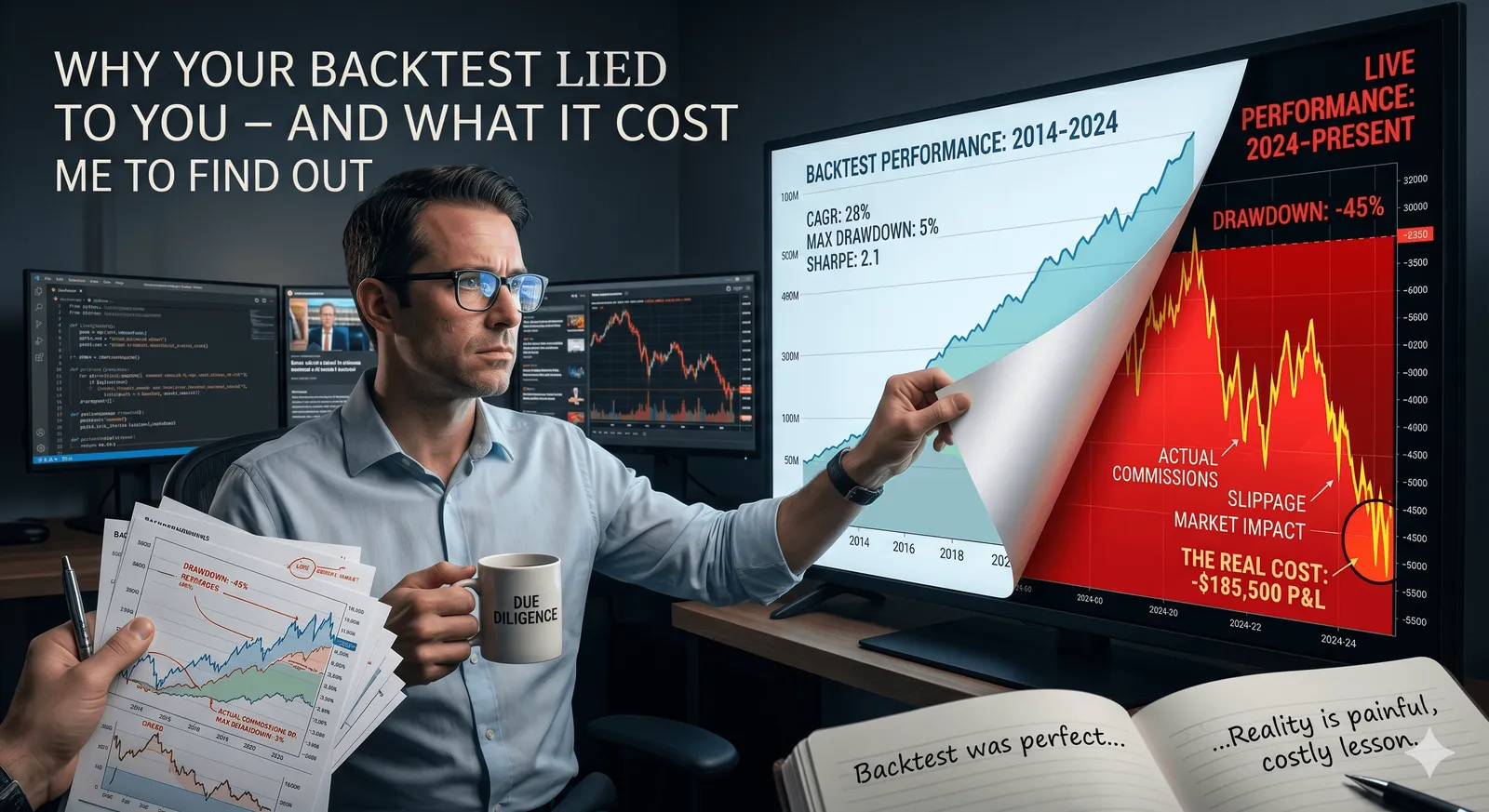
Why Your Trading Backtest Lied to You – And What It Cost Me to Find Out
By Felix – founder of unCoded, trading since 2016. I've run a trading bot in live markets since 2020...