Best Crypto Trading Bot Switzerland 2026: What Actually Matters If You're Trading from Swiss Soil
 By Felix Götz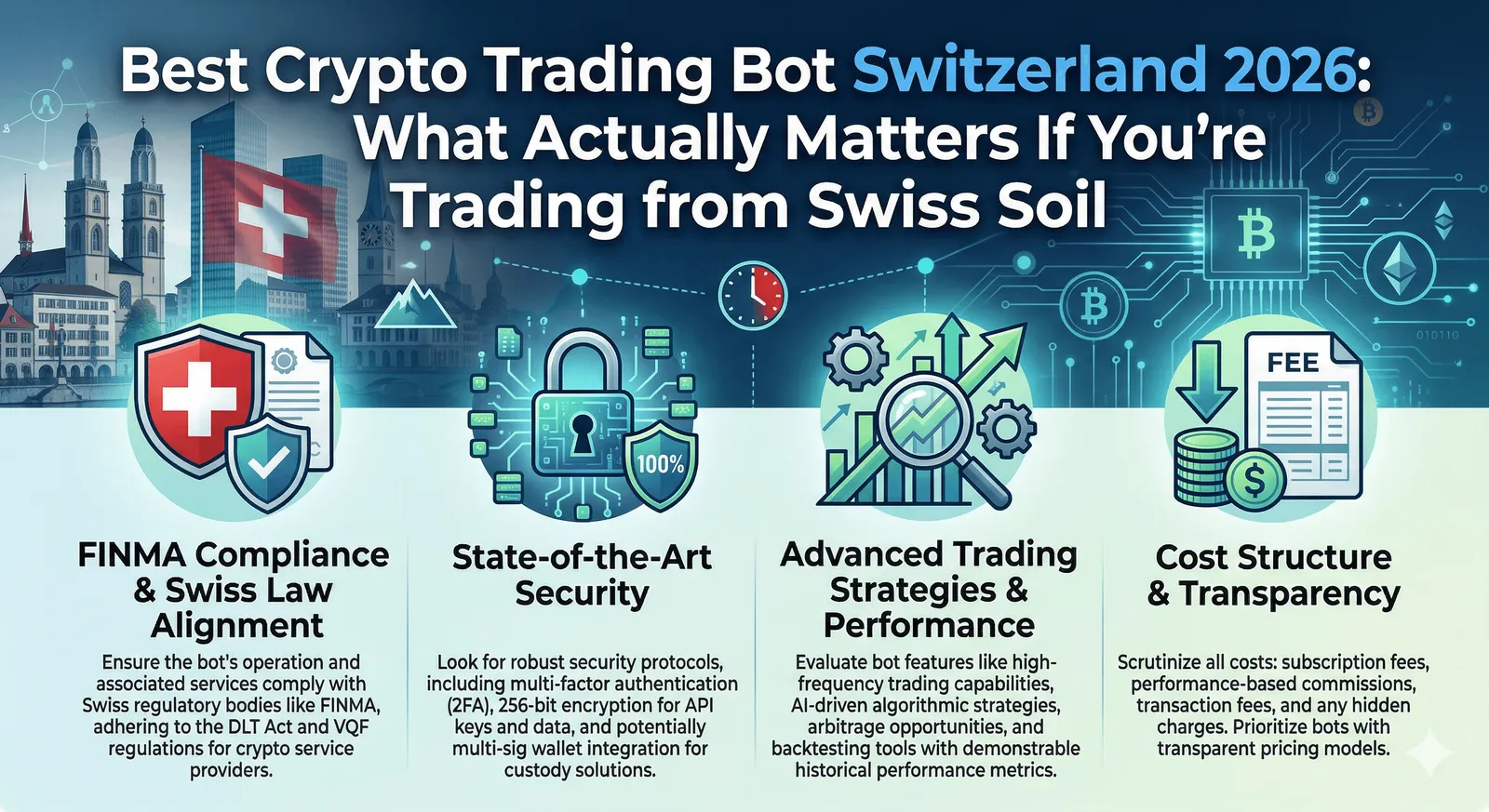
By Felix – founder of unCoded, ArrowTrade AG, Switzerland. Trading crypto since 2016.
If you're based in Switzerland and looking for a crypto trading bot, you have a specific set of considerations that most "best of" lists written for a global audience completely ignore.
The regulatory environment. The tax treatment. The fact that Switzerland is a crypto-forward jurisdiction with a clear framework – and that framework has real implications for how you automate your trading. And the fact that, if you're going to run something 24/7 with real capital, you probably want to know where the company behind it is incorporated and what that means for you legally.
I'll cover all of it. Including which bot I built and why I think it's the right answer for Swiss traders – but I'll also tell you honestly when the alternatives make more sense.
The Swiss context: why it actually matters
Switzerland is one of the most crypto-forward jurisdictions in the world. Capital gains and losses from private trading are tax-free in Switzerland, but cryptocurrencies are subject to an annual wealth tax. Blockpit This is a significant advantage compared to most European neighbors. But it comes with nuance.
The criteria for being classified as a professional trader rather than a private investor include: frequency of trading over short intervals, high trading volume, clear intent to make a profit, systematic and organized approach, and significant time spent on trading. Blockpit
This is directly relevant to automated trading. A bot running 24/7, placing hundreds of trades per month, could potentially trigger professional trader classification under Swiss tax law. That doesn't mean you shouldn't use a bot – but it means you should be aware of the distinction and keep proper records of every trade.
With the introduction of CARF in 2027, the Swiss tax authorities will receive information on relevant crypto assets and the income generated from them since January 1, 2026. Transatlanticlaw In practice: start keeping clean records now if you haven't been. The reporting window is already open.
From a regulatory standpoint, a platform allowing for the trading of cryptocurrencies such as Bitcoin or Ether would not be considered an "organised trading facility" under Swiss financial regulations. Global Legal Insights Using a trading bot on your own Binance account is trading your own assets – it's not providing financial services to others and doesn't trigger licensing requirements for the trader. The bot provider is a different question, but as a user, you're in clear territory.
What to look for in a bot as a Swiss trader specifically
Beyond the standard criteria (strategy depth, custody model, fee structure), Switzerland-based traders should consider a few specific factors.
Data jurisdiction. If your bot runs on a cloud platform's servers, your API keys and trade data live in their infrastructure – likely outside Switzerland. For most people this is an acceptable tradeoff. For those who take data jurisdiction seriously, self-hosted is the cleaner answer.
Company registration. A bot company registered in Switzerland operates under Swiss law, Swiss data protection (nFADP), and is subject to Swiss courts if something goes wrong. A company registered in a jurisdiction you've never heard of is a different risk profile.
Non-custodial architecture. Switzerland's crypto regulatory framework is built on clear ownership principles. Your assets on Binance are yours. A bot with trade-only API permissions that cannot withdraw funds respects that structure. A platform that requires you to deposit funds or grants itself withdrawal access is introducing counterparty risk that Swiss financial practice would generally counsel against.
Audit trail. Swiss tax authorities are increasingly crypto-aware. Administration costs related to cryptocurrencies can be deducted from taxes, but some cantons require actual proof. Blockpit A bot that keeps complete trade records – every entry, exit, fee, timestamp – is not just a convenience. It's what you need to file correctly and defend your tax position if asked.
The bots worth considering in 2026
1. unCoded — Best overall for Swiss Spot traders
Full disclosure: I built this. ArrowTrade AG is registered in Switzerland. Take that into account.
unCoded is a self-hosted, non-custodial Binance Spot trading bot. Your API keys stay on your infrastructure. Your capital stays in your Binance account. The bot has no withdrawal permissions. We're incorporated in Switzerland under Swiss law.
What makes it genuinely suited to serious Swiss traders:
Strategy depth that matches how traders actually think. Buy Splits divide every position into up to 7 parts, each with its own sell target – you're scaling out automatically at multiple price levels rather than trying to time one perfect exit. Sell Time Curves change the profit threshold over time: hold for more in the first few hours, relax the target as a position ages. Trailing Stop Loss per split. Automatic DIP Rebuying within hard exposure limits.
The Signal Editor adds a full strategy construction and backtesting layer: 152 parameterized technical indicators, a 40+ condition engine with full boolean logic and automated divergence detection, and a backtesting engine built on 1-second candle data – which means intracandle stop-loss triggers are caught accurately, not missed because the evaluation only happens at candle close. Sharpe ratio is annualized correctly per timeframe. Full drawdown, profit factor, and trade log output.
TradingView integration for traders who already have working setups there: configure your alert as a webhook to your bot instance and unCoded executes it with your risk management layer applied.
Tax records. Every trade is logged in full detail in the PostgreSQL database on your server. Entry price, exit price, quantity, fees, timestamps, profit per trade. Everything you need for Swiss tax reporting is there.
Pricing: Profit sharing at 30%, reducing to 20% at $2,000 invested. No subscription. First $100 in profit covered by the starting credit. The bot reports cumulative profit to the license server every few hours – the only external connection beyond Binance. You top up a license balance at uncoded.ch via Stripe. We have no access to your funds or your trades.
Setup: 10-15 minutes on your own VPS via CapRover one-click deployment. Documentation at uncoded.ch/docs.
Honest downside: Binance Spot only for now. More exchanges in active development. And self-hosting requires a VPS, which has a real setup curve for anyone who hasn't done it before – though the documentation addresses this step by step.
2. HaasOnline — Best for developers who want maximum depth on a hosted platform
HaasOnline is the most technically capable hosted bot platform available. The HaasScript scripting language lets you implement almost any logic you can express in code. The backtesting engine is among the best in the retail space. Multi-exchange support.
The tradeoffs: expensive subscription, API keys on their servers (US-based company), no self-hosted option. For a Swiss trader who wants maximum strategy flexibility without managing infrastructure, it's the strongest hosted option.
3. 3Commas — Best for multi-exchange traders who want a hosted solution
Solid multi-exchange platform, good DCA bot implementation, TradingView signal routing that works reliably. Monthly subscription. API keys on their servers.
Works well for traders running capital across multiple exchanges. Less appropriate if Binance Spot is your primary venue and you want the depth that comes with a specialized tool.
4. Coinrule — Best for complete beginners in Switzerland
Drag-and-drop no-code strategy builder, 150+ pre-built templates, accessible onboarding. If you've never used a trading bot and want to understand the basics before committing to a more sophisticated setup, Coinrule is genuinely beginner-friendly.
The ceiling is low. You'll outgrow it once you start thinking seriously about multi-factor entry conditions, split exits, or time-based logic. But as a starting point it's honest.
5. Pionex — Free option with zero additional cost
Built-in exchange bots, no subscription, grid and DCA available to all account holders. Your capital is on Pionex's exchange, not Binance. The bots are simple by design. For someone who wants to try automated trading with minimal friction and no upfront cost, Pionex works.
Not suitable if you're already on Binance and want to stay there, or if you want any meaningful strategy depth.
6. OctoBot — Open-source self-hosted option
Publicly auditable code, no mandatory subscription, self-hostable. Supports TradingView signal bots, DCA, grid, and some AI-based strategies. A legitimate option for traders who want open-source transparency and are comfortable with a more technical setup.
Less user-friendly than unCoded. More configuration work. But the code is fully open – you can inspect exactly what it does before trusting it with live capital.
The decision framework for Swiss traders
You want full custody, Swiss company, deep configuration, proper tax records, and Binance Spot: unCoded.
You want maximum coding flexibility on a hosted platform: HaasOnline.
You need multi-exchange and are fine with a subscription: 3Commas.
You're a complete beginner and want to learn: Coinrule or Pionex.
You want open-source transparency: OctoBot.
Trading and technical risks worth naming honestly
The Swiss regulatory framework is favorable. That doesn't mean automated trading is low-risk.
Flash crashes happen. Crypto markets have a documented history of rapid, severe price dislocations that can trigger stop losses, blow through limit orders, and execute at prices far from where you expected. A bot configured for normal market conditions can behave unexpectedly during a flash crash – selling at the absolute low before recovery, or averaging into a collapse before the position can be closed. No bot configuration fully eliminates this. Position sizing limits and conservative maximum exposure settings reduce the damage; they don't prevent it.
Backtesting gives you confidence that may not be warranted. A strategy that looks excellent on historical data can fail immediately in live markets if it was overfit to the specific characteristics of the historical period tested. The more parameters you optimize to match past data, the more likely you are to have built a strategy that trades the past rather than the market. Backtesting across multiple market regimes, using out-of-sample data, and starting with small live capital before full deployment are the practices that reduce this risk – none of them eliminate it.
Automated execution removes emotional decisions and introduces systematic ones. Your bot will execute your rules exactly. If your rules are wrong, the bot will be wrong consistently and at scale. This is the core tradeoff of automation: you're trading human emotional error for systematic rule error. The quality of the rules determines which is worse for your account.
The tax point worth repeating
Whatever bot you choose, set it up to keep complete records. Entry price, exit price, quantity, fee, timestamp – every trade, every time. Starting 2027, Switzerland introduces expanded international crypto reporting under CARF. Crypto providers will report relevant data to tax authorities — making it clear that crypto activities must be properly declared in your tax return. Blockpit
The days of crypto being an undeclared grey area in Switzerland are over. Run your bot properly, keep clean records, and talk to a Swiss tax advisor if you're trading at any meaningful volume. The rules are actually favorable for private investors here – capital gains tax-free for most people is a significant advantage. Just make sure you're actually classified as a private investor and not a professional trader under Swiss tax law. A bot generating high-frequency trades isn't automatically a problem, but it's a factor worth discussing with a professional. The authoritative reference for this distinction is ESTV Kreisschreiben Nr. 36 (Circular Letter No. 36 of the Swiss Federal Tax Administration), which defines the criteria the tax authorities apply when determining whether trading activity crosses the line into professional status. If you're running a bot at scale, reading it – or having your tax advisor walk you through it – is time well spent.
Bottom line
Switzerland gives you one of the best environments in the world to run this properly – clear tax rules, a crypto-forward regulatory framework, and favorable treatment for private investors. The infrastructure and legal clarity are there. What you bring is the strategy, the discipline, and the right tool for your setup.
If you're trading Binance Spot from Switzerland and want a bot built specifically for this environment – self-hosted, non-custodial, with full trade records for your tax reporting and a Swiss company behind it – the documentation is at uncoded.ch/docs. Start there, read through the setup guide, and reach out if you have questions. We're happy to walk you through it.
unCoded — uncoded.ch Documentation — uncoded.ch/docs ArrowTrade AG, Switzerland
Disclaimer: This article is for informational purposes only and does not constitute tax or legal advice. Swiss tax classification as a private vs. professional trader depends on individual circumstances. Automated crypto trading involves significant market risk including potential total loss of invested capital. Past performance in backtesting does not guarantee future results. Consult a qualified Swiss tax advisor for your specific situation.
Sources:
- Global Legal Insights: Blockchain & Cryptocurrency Laws Switzerland 2026
- Blockpit: Crypto Tax Switzerland 2026 Guide
- Transatlantic Law International: Switzerland Crypto AEOI 2026
- PwC Switzerland: Trading Regulation and Crypto Primer
- Koinly: Crypto Tax Switzerland 2026
- ESTV Kreisschreiben Nr. 36, Eidgenössische Steuerverwaltung