MACD Explained for Crypto Spot Traders
 By Tommy Tietze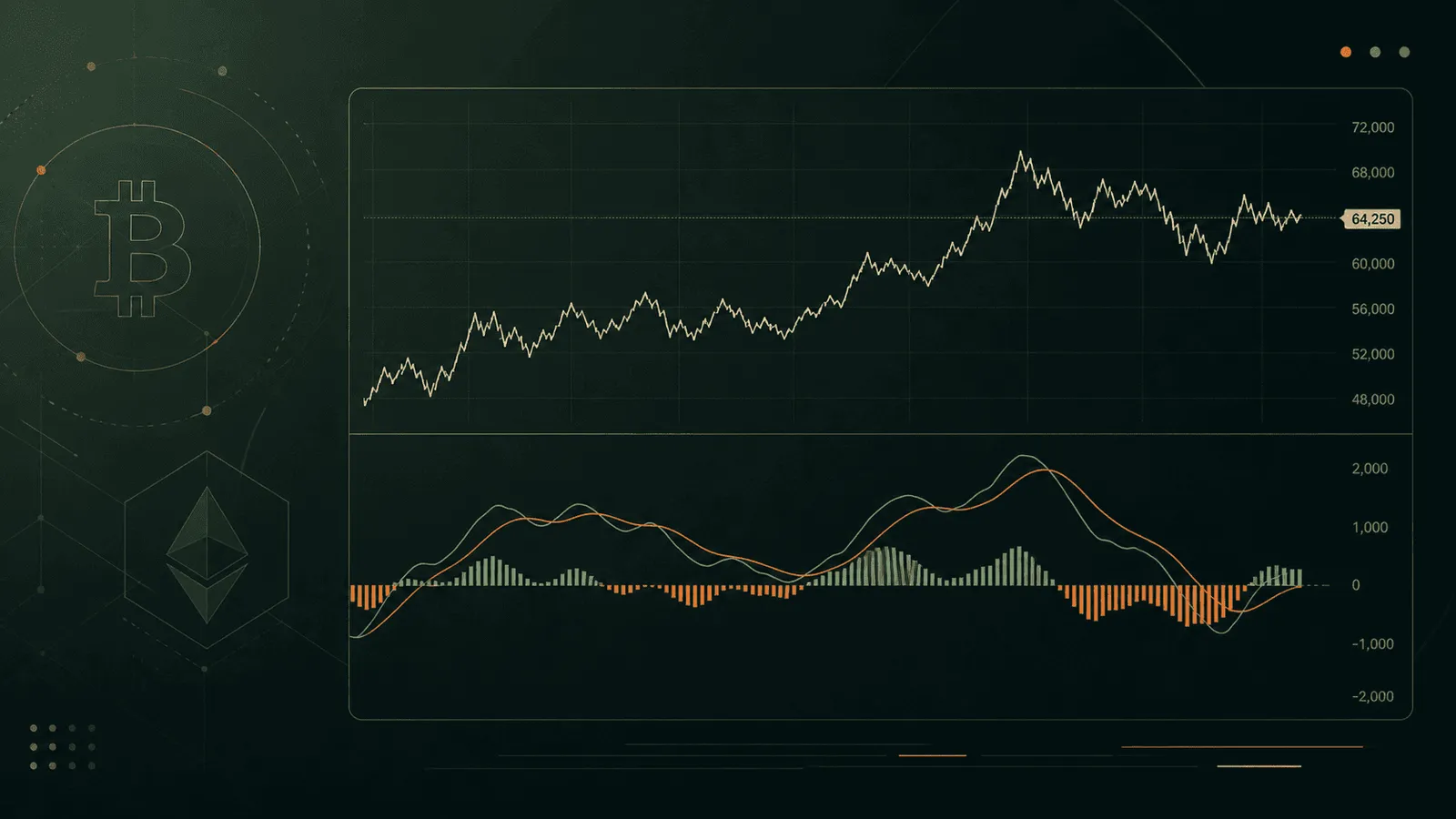
By Tommy Tietze, CEO of ArrowTrade AG
Most traders meet MACD very early.
It is already there in almost every charting tool. It looks clean, it is easy to add, and at first glance it feels more structured than price alone. One line crosses another line, the histogram changes direction, and suddenly the chart seems to give the trader something concrete to work with.
That first impression is exactly why MACD is useful and risky at the same time.
The indicator can help a trader understand momentum, but it should not be treated like a direct instruction from the market. MACD is built from moving averages. It reacts to price behavior that has already happened, then makes the relationship between short-term and longer-term momentum easier to see.
That is valuable, especially in crypto. It also means the trader has to understand what the indicator can and cannot show.
Crypto spot markets can move quickly, then spend hours or days in messy sideways structures. A clean crossover can work in one market phase and create noise in another. For anyone trading systematically, MACD should therefore be used as a structured input, not as a standalone reason to enter a trade.
What MACD means
MACD stands for Moving Average Convergence Divergence.
The indicator is used in technical analysis to identify trend direction, momentum strength and possible reversal areas, according to Binance Academy (Binance Academy).
The idea behind it is more practical than the name sounds.
MACD compares a faster moving average with a slower moving average. If the faster average moves further away from the slower one, momentum is changing. If both averages move closer together, momentum is usually weakening.
That makes MACD a momentum tool.
It does not measure trading volume. It does not read order book depth. It does not know whether a crypto asset has strong fundamentals, weak tokenomics or poor liquidity. It only shows how recent price movement behaves compared with slower price movement.
For a trader, that can still be useful. Many poor entries happen because price looks attractive while momentum is still moving against the trade. MACD can help slow that decision down and make the structure behind the move more visible.
The three parts of MACD
MACD has three main components: the MACD line, the signal line and the histogram (Binance Academy).
MACD line
The MACD line is usually calculated by subtracting the 26-period exponential moving average from the 12-period exponential moving average (Binance Academy).
In simple form:
MACD line = 12-period EMA minus 26-period EMA
If the result is positive, the shorter moving average is above the longer moving average. That usually points to stronger upward momentum (Binance Academy).
If the result is negative, the shorter moving average is below the longer moving average. That usually points to stronger downward momentum (Binance Academy).
For crypto spot traders, the practical value is not the formula itself. The value is that MACD turns a price movement into a momentum reading. It helps answer whether recent price action is gaining strength or losing it.
Signal line
The signal line is usually a 9-period exponential moving average of the MACD line itself (Binance Academy).
Because it smooths the MACD line, traders use it to identify shifts in momentum. A bullish crossover happens when the MACD line moves above the signal line. A bearish crossover happens when the MACD line moves below the signal line.
This is the part many beginners focus on first.
The problem is that a crossover alone does not describe the full market. A bullish crossover in a strong market structure is very different from a bullish crossover inside a flat, noisy range. The indicator can look similar in both situations, while the trade quality is completely different.
Histogram
The histogram shows the difference between the MACD line and the signal line (Binance Academy).
When the MACD line is above the signal line, the histogram is positive. When the MACD line is below the signal line, the histogram is negative (Binance Academy).
The histogram is often more useful than it looks at first.
StockCharts explains that momentum shows strength when MACD moves away from its signal line, while momentum weakens when MACD moves closer to its signal line (StockCharts).
That means the histogram helps a trader see whether pressure is building or fading. In crypto, where a move can become crowded very quickly, that extra layer of context can matter more than the crossover itself.
What MACD actually shows
MACD shows the relationship between short-term and longer-term price momentum.
A price can still move up while MACD weakens. A price can still move down while MACD starts improving. This happens because MACD is not measuring price direction alone. It measures how the relationship between two moving averages changes over time.
That is why traders often use MACD to read the quality of a move.
If price rises and the histogram expands, the move has momentum behind it. If price rises while the histogram contracts, the move may still continue, but the pressure behind it is no longer as strong.
The same logic applies to falling markets.
If price falls and the histogram becomes more negative, downside momentum is increasing. If price falls while the histogram becomes less negative, the market may still be weak, but selling pressure is starting to fade.
A serious trader does not need MACD to give certainty. It is enough if the indicator helps separate a strong move from a tired one.
Why MACD can help in crypto
Crypto markets often move in waves.
A strong move starts, traders react, momentum builds, then the move either pauses, continues or reverses. The chart rarely announces that transition cleanly. Most of the time, the trader has to read several signals at once and decide whether the move still has enough quality.
MACD can help with that.
It gives traders a way to compare current momentum with slower market behavior. That can be useful in spot trading because capital can get trapped in weak entries even without leverage. There is no liquidation mechanic in spot trading, but a bad entry can still sit in drawdown for a long time.
This matters especially when traders buy too early.
A coin drops, looks cheaper, and the first reaction is to call it an opportunity. Sometimes that is correct. Often the momentum is still clearly negative, and the better decision would have been to wait for structure to improve.
MACD can help identify that difference.
It will not remove market risk. It can, however, make the decision less emotional and more consistent.
The main MACD signals
MACD is usually read through three signal types: signal line crossovers, zero line crossovers and divergence.
Signal line crossover
A bullish signal line crossover happens when the MACD line crosses above the signal line. A bearish signal line crossover happens when the MACD line crosses below the signal line.
This is the classic MACD signal.
It can be useful when the broader market structure supports the move. For example, a bullish crossover after a controlled consolidation in an uptrend is more interesting than the same crossover in the middle of a random sideways range.
That context is where many traders lose discipline.
They see the crossover and treat every situation the same. The market does not work that way. The signal needs to be judged together with trend, liquidity, volatility, support and resistance, and the broader crypto environment.
Zero line crossover
The zero line shows where the MACD line changes from negative to positive or positive to negative.
When MACD moves above zero, the shorter EMA is above the longer EMA. When MACD moves below zero, the shorter EMA is below the longer EMA (Binance Academy).
This can help traders read broader trend direction.
A MACD line above zero usually supports a stronger bullish environment. A MACD line below zero usually supports a weaker environment. The signal is often slower than a signal line crossover, but it can filter some of the noise that appears on shorter moves.
For systematic spot trading, this can be useful as a market filter.
A bot or rule-based strategy may allow certain trades only when MACD is above zero, or it may reduce exposure when MACD remains below zero. The exact rule depends on the strategy, but the important point is that the condition can be tested.
Divergence
Divergence happens when price and MACD move in different directions.
A bearish divergence can appear when price makes a higher high, while MACD makes a lower high. That can suggest weakening upward momentum.
A bullish divergence can appear when price makes a lower low, while MACD makes a higher low. That can suggest weakening downward momentum.
Divergence is attractive because it feels early.
The difficulty is that early signals often require patience. A market can continue rising after bearish divergence. A market can continue falling after bullish divergence. The indicator may show that momentum is changing, but it does not force price to reverse immediately.
In crypto, that patience is especially important.
Trends can stretch further than expected because liquidity, sentiment and positioning can push markets beyond what looks reasonable. Divergence should create attention, but it should not create overconfidence.
Why MACD often reacts late
MACD is built from moving averages, and moving averages are based on previous prices.
That means MACD will usually react after price has already started to move. StockCharts notes that MACD uses moving averages and that moving averages lag price, which can make signal line crossovers late (StockCharts).
This is where many traders misunderstand the tool.
They expect MACD to catch exact bottoms or tops. When the signal appears after part of the move has already happened, they dismiss the indicator. That expectation is unfair to the tool. MACD is better understood as a way to read momentum structure after price has begun to show its hand.
For a discretionary trader, that can support better timing.
For an automated spot strategy, it can create rules that are easier to test and monitor. The system does not need to catch the perfect low. It needs a repeatable way to decide when momentum has improved enough to justify exposure.
That is a much more realistic use case.
MACD in sideways markets
Sideways markets are where MACD becomes difficult.
When price moves without a clear direction, the MACD line and signal line can cross repeatedly. The histogram moves above and below zero, but the market does not follow through. A trader who reacts to every small change ends up entering and exiting without a real edge.
Crypto spends a lot of time in these conditions.
The large breakouts are visible and memorable. The long periods of chop are easier to forget, even though they often do the most damage to impatient traders. Indicators look clean in hindsight, but during the live market they often produce signals that require filtering.
This is why MACD should rarely stand alone.
A trader can combine it with higher timeframe trend, volatility ranges, liquidity, support and resistance, or Bitcoin market structure. The goal is not to make the chart complicated. The goal is to avoid treating a weak signal in a messy market like a high-quality setup.
A crossover in a strong structure deserves attention.
A crossover in a flat range should be treated carefully.
MACD and automated spot trading
A bot cannot use MACD the way a human uses a chart visually.
A human can look at a chart and say that momentum “looks better.” That may be enough for a discretionary decision, but it is not enough for automation. A bot needs exact rules.
For example, a MACD-based rule could define whether the MACD line must cross above the signal line, whether the histogram must turn positive, whether MACD must be above zero, or whether the higher timeframe must agree.
The more precise the rule, the easier it becomes to test.
That is the real value of indicators in automated trading. They turn a vague market impression into a condition that can be monitored. The rule may still fail. It may need adjustment. It may only work in certain market phases. But at least it can be reviewed honestly.
For unCoded, this way of thinking fits the product philosophy.
unCoded is built around automated crypto spot trading. The user keeps capital on the Binance account, the API works without withdrawal rights, and every trade should be understandable enough that the user can monitor what the system is doing.
Indicators can support that structure.
They should never turn the strategy into a black box.
Common MACD mistakes
Treating every crossover as a trade
A crossover can be useful, but it does not know whether the asset is liquid, whether the spread is wide, whether Bitcoin is breaking down or whether the market is stuck in a range.
A signal becomes more useful when the environment supports it. Without that context, the trader is often just reacting to movement.
Ignoring the timeframe
MACD on a 5-minute chart and MACD on a daily chart can tell very different stories.
A short timeframe may show a bullish crossover while the higher timeframe still shows weakness. That does not make the short-term signal useless, but it changes the risk profile of the trade.
Using default settings without testing
The standard MACD settings are commonly 12, 26 and 9 periods (Binance Academy).
Those settings are widely used, but they do not automatically fit every crypto asset, timeframe or strategy. Faster settings react earlier and create more noise. Slower settings reduce some noise but may react too late for shorter trading systems.
Forgetting fees and execution
A MACD signal can look profitable on a chart while the real trade still loses quality through fees, spread and slippage.
For frequent spot trading, that matters. Indicator logic and execution logic belong together. A system that reads MACD but ignores trading costs is missing an important part of the market.
Confusing momentum with value
MACD can show improving momentum.
It does not prove that an asset is undervalued. It does not verify token economics. It does not assess exchange risk, regulatory risk or liquidity depth. It reads price momentum and should be used within that boundary.
How serious traders can use MACD
MACD works best when it has a clear job.
It can act as a trend filter. A trader may only allow long spot trades when MACD is above zero, because that suggests short-term momentum is stronger than longer-term momentum.
It can act as an entry confirmation. A trader may wait for the MACD line to cross above the signal line after price has already reached a defined support area.
It can act as an exit warning. A shrinking histogram during a strong move may show that momentum is fading before price fully turns.
It can also help avoid weak trades. If price looks interesting but MACD still shows strong downside momentum, waiting can be the better decision.
That last use case is often underestimated.
Indicators are not only useful when they trigger entries. Sometimes they create value because they stop the trader from forcing a trade too early.
MACD for BTC, ETH and altcoins
MACD behaves differently depending on the asset underneath.
On BTC, MACD often reflects the broader crypto cycle because Bitcoin is the market benchmark. If BTC momentum weakens, many other crypto assets struggle even if their individual charts looked good before.
On ETH, MACD may reflect both broad crypto momentum and Ethereum-specific narratives. Network usage, staking, protocol developments and rotation between BTC and ETH can all influence how traders interpret ETH momentum.
On smaller altcoins, MACD can become much noisier. Liquidity may be weaker, spreads may be wider and sudden price moves can distort the indicator. A clean MACD signal on an illiquid chart may still be difficult to trade properly.
That is why settings and interpretation should not be copied blindly.
The indicator may be the same across charts, but the market underneath it is different.
FAQ
What is MACD in crypto trading?
MACD stands for Moving Average Convergence Divergence. It is a momentum indicator that compares a faster exponential moving average with a slower exponential moving average to help traders read trend direction and momentum.
What are the standard MACD settings?
The standard MACD settings are usually 12, 26 and 9 periods. The MACD line is calculated from the 12-period EMA minus the 26-period EMA, and the signal line is usually a 9-period EMA of the MACD line (Binance Academy).
What does the MACD histogram show?
The MACD histogram shows the difference between the MACD line and the signal line. It helps traders see whether momentum is expanding or contracting (Binance Academy).
Is MACD good for crypto trading?
MACD can be useful in crypto trading when it is used as part of a broader system. It should be combined with market structure, liquidity, volatility, fees and risk management.
Does MACD predict price?
MACD does not predict price with certainty. It reacts to price data through moving averages and helps traders interpret momentum. Because it is based on moving averages, it can lag price movement (StockCharts).
Can a trading bot use MACD?
A trading bot can use MACD if the rules are clearly defined and testable. The bot needs exact conditions, such as crossover rules, histogram behavior, zero-line filters or higher-timeframe confirmation.
Conclusion
MACD is useful because it makes momentum easier to read.
It shows how short-term price movement behaves compared with longer-term price movement. That can help traders understand whether a move is gaining strength, losing pressure or entering a weaker phase.
For crypto spot traders, the indicator becomes most useful when it is part of a broader framework. Market structure, liquidity, volatility, fees, position sizing and risk rules still matter. A clean MACD signal does not fix a bad market environment.
For automated trading, the same principle becomes even more important.
A bot needs precise conditions. If MACD is part of the strategy, the logic should be visible, testable and monitored. That is where indicators can actually help: they turn market behavior into structured information that can be reviewed instead of guessed.
This article is for educational purposes only and is not financial advice. Trading involves risk, and past performance does not guarantee future results.
Learn more about unCoded: https://uncoded.ch Built by ArrowTrade AG: https://arrowtrade.ch
Recommended Reading

Ethereum vs. Bitcoin for Spot Traders
By Tommy Tietze, CEO of ArrowTrade AG Bitcoin and Ethereum are usually treated like they belong in t...

Market Maker vs. Taker: Crypto Fees Explained
Market Maker vs. Taker: Crypto Fees Explained By Tommy Tietze, CEO of ArrowTrade AG Most traders spe...

Crypto Drawdown Explained
By Tommy Tietze, CEO of ArrowTrade AG Drawdown is one of the most honest risk metrics in trading. It...

Systematic vs. Emotional Trading
By Tommy Tietze, CEO of ArrowTrade AG Most traders do not lose control in calm markets. They lose co...

Crypto Volatility Explained
By Tommy Tietze, CEO of ArrowTrade AG Crypto volatility is usually discussed in the wrong tone. Some...

Position Sizing in Crypto Trading
By Tommy Tietze, CEO of ArrowTrade AG Many traders spend hours searching for the perfect entry. They...
RSI in Crypto Trading Explained
By Tommy Tietze, CEO of ArrowTrade AG The RSI is one of those indicators almost every trader has see...