Crypto Portfolio Diversification Guide
 By Tommy Tietze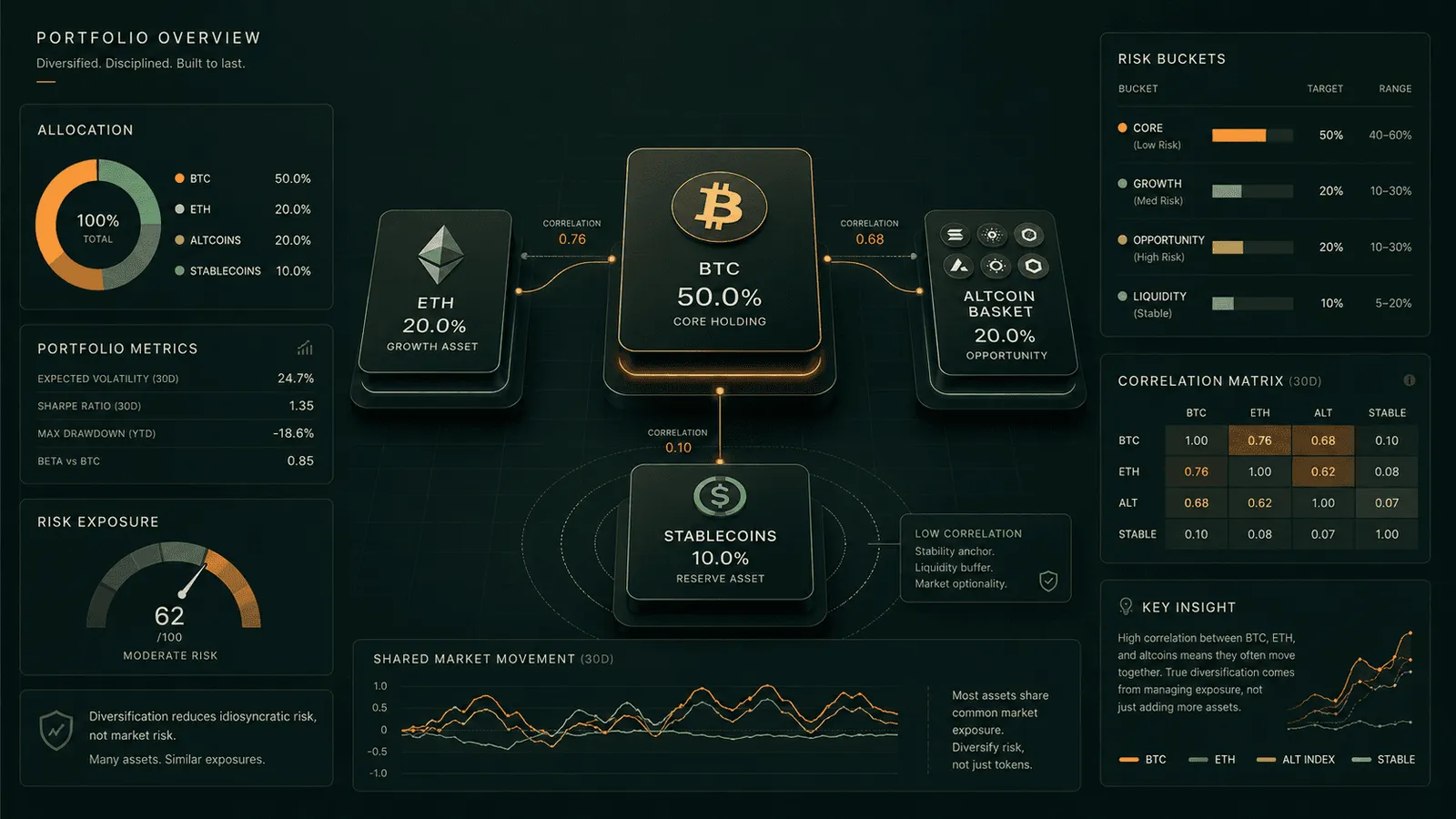
By Tommy Tietze, CEO of ArrowTrade AG
A portfolio with twelve coins can still be one trade.
That sounds exaggerated until Bitcoin drops five percent and every altcoin on the screen turns red at the same time. Different logos, different sectors, different Telegram communities. Same market reaction.
This is where crypto portfolio diversification gets misunderstood.
Many traders diversify by collecting more coins. A little BTC, some ETH, a few Layer 2 tokens, two AI tokens, one gaming project, one DeFi coin, maybe something small because the upside looks exciting. The portfolio feels spread out because the names are different.
The risk can still be concentrated.
Real diversification is not about how many coins are in the account. It is about how those positions behave when the market changes. If every asset depends on the same liquidity cycle, the same Bitcoin sentiment and the same risk appetite, the portfolio may only look diversified during calm periods.
For crypto spot traders, this matters because position sizing, drawdown, correlation and execution all meet in the portfolio. A good single trade can still become part of a bad portfolio if the overall exposure is not controlled.
What diversification really means
Diversification means spreading exposure across assets that do not all behave the same way under the same market conditions.
In portfolio theory, investors look at correlation because assets with lower or negative correlation can reduce the risk that everything loses value at the same time. Investopedia explains that modern portfolio theory focuses on optimizing expected return for a given level of risk by selecting assets whose returns are less likely to move together.
The crypto version of that idea is harder than it looks.
A trader may own BTC, ETH, SOL, BNB, AVAX and several smaller tokens. On paper, those are different assets. In a broad market selloff, they may all behave like crypto beta.
That does not make diversification useless.
It means the trader has to define what kind of diversification is actually being built. Diversification across coin names is weaker than diversification across risk drivers. Diversification across exchanges is weaker than diversification across custody models, liquidity profiles and strategy types.
A portfolio needs more than variety.
It needs assets and rules that behave differently when pressure arrives.
The problem with “more coins”
More coins can reduce single-asset risk.
If one project fails, gets hacked, loses liquidity or suffers from a bad token unlock, the entire portfolio is less exposed if that position is small. That part of diversification still works.
The problem appears when traders confuse single-asset risk with market risk.
A portfolio of twenty altcoins may reduce exposure to one specific project. It may still be heavily exposed to the same broad crypto selloff. Investopedia explains that diversification across more holdings does not remove systematic market risk, because some risk affects an entire asset class and cannot be eliminated by simply adding more assets inside that class (Investopedia).
Crypto has a strong version of this problem.
Many altcoins depend on the same conditions. They need liquidity, trader confidence, exchange access, healthy Bitcoin structure and enough speculative appetite for capital to move away from the safest crypto names.
When those conditions disappear, the portfolio stops behaving like a collection of independent ideas.
It starts behaving like one risk bucket.
Bitcoin still controls the room
Bitcoin remains the benchmark asset in crypto.
CoinMarketCap defines Bitcoin dominance as Bitcoin’s market capitalization as a percentage of the total crypto market capitalization. Traders watch Bitcoin dominance because it helps show whether the market is concentrating in Bitcoin or moving further into altcoins.
That matters for diversification.
If Bitcoin dominance rises while the broader market weakens, altcoins often struggle. The portfolio may have many positions, but the market is telling you that capital prefers the benchmark asset.
If Bitcoin dominance falls while the broader market is strong, altcoins can have a better environment. That does not make every altcoin attractive. It simply shows that risk appetite has moved further out on the curve.
A diversified crypto portfolio should therefore start with one practical question.
How much of the portfolio depends on Bitcoin staying healthy?
If the honest answer is “almost everything”, the portfolio is not as diversified as it looks.
Altcoins are often risk buckets, not hedges
Altcoins can play different roles.
Some represent smart contract platforms. Some are exchange tokens. Some are DeFi protocols. Some are infrastructure plays. Some are pure speculation with a nice website and a loud community.
Those categories matter.
They do not automatically create hedge value.
A hedge should help when the main exposure is under pressure. Many altcoins do the opposite. They rise harder in good phases and fall harder in bad phases. That can make sense for tactical trading, but it should not be confused with protection.
Coinbase has written that crypto assets can represent a wide range of projects at different stages of development, and that simple mean-variance allocation may not fully explain the sources of risk behind crypto exposure.
That point is important for serious traders.
Two assets can sit in different sectors and still share the same source of risk. If both depend on new retail inflows, high market liquidity and a strong Bitcoin trend, the sector label does not protect the portfolio.
A portfolio should be mapped by risk drivers, not only by narratives.
Stablecoins change risk, they do not remove it
Stablecoins are often treated as the safe part of a crypto portfolio.
They can reduce price volatility against the reference currency, especially when compared with BTC or altcoins. For spot traders, they are also important because they act as quote assets and dry powder for new entries.
Still, stablecoins are not the same as cash in a bank account.
They carry issuer risk, reserve risk, exchange risk, redemption risk, regulatory risk and operational risk. A trader holding USDT, USDC or FDUSD may have lower market exposure than someone holding altcoins, but the position still depends on the stablecoin structure and the platform where it is held.
This is one reason stablecoin diversification can matter.
Some traders split liquidity across different stablecoins or keep part of the portfolio outside the exchange. That can reduce dependence on one issuer or one platform, although it also creates more operational work.
The point is practical.
Stablecoins can help manage volatility and preserve trading capacity. They should still be documented, monitored and understood as part of the portfolio’s risk structure.
Position size matters more than coin count
A portfolio with five well-sized positions can be safer than a portfolio with thirty random ones.
Position sizing decides how much damage one bad idea can create. It also decides how much pressure the trader feels when the market moves against them.
A common crypto mistake is to hold many small coins and one oversized conviction position. The portfolio looks diversified in the asset list, but the risk sits in one place.
Another mistake is equal-weighting assets that do not have equal risk.
Putting the same amount into BTC and a thinly traded micro-cap token does not create equal exposure. The smaller token may move much more aggressively, have worse liquidity and suffer from wider spreads. The position size should reflect that.
Serious portfolio construction asks better questions.
How much can this position lose in a normal correction?
How much liquidity is available if I need to exit?
How much of the portfolio depends on this one narrative?
What happens if Bitcoin drops and this position falls twice as much?
Those questions are less exciting than finding the next coin.
They are more useful.
Diversification by strategy
Crypto portfolios are usually built by asset.
BTC here, ETH there, a few altcoins, some stablecoins.
A more serious approach also looks at strategy type.
A long-only portfolio behaves differently from a systematic spot trading strategy. A DCA approach behaves differently from tactical swing trading. A stablecoin reserve behaves differently from active altcoin exposure.
This is where automated spot trading can fit into the conversation.
A system like unCoded is built around automated crypto spot trading on Binance. The capital stays on the user’s own Binance account, and the API setup is designed without withdrawal rights. The focus is spot trading, which avoids liquidation mechanics from leveraged futures.
That does not make the system risk-free.
It means the strategy can be placed inside a clearer risk framework. The user can decide which pairs to trade, how much capital to allocate, how much reserve to keep and how much drawdown is acceptable for the selected configuration.
Diversification by strategy is useful because it separates roles.
One part of the portfolio may be long-term BTC exposure.
Another part may be stablecoin reserve.
Another part may be systematic spot trading with defined rules.
Another part may be experimental and intentionally small.
That structure is easier to manage than one large bucket of “crypto”.
Liquidity is part of diversification
A portfolio can be diversified by asset and still fragile because the positions cannot be exited properly.
Liquidity decides how easily a trader can buy or sell without moving the price too much. This matters in crypto because liquidity varies heavily between BTC, ETH, large altcoins and smaller tokens.
A large BTC position on a deep exchange pair is different from the same notional exposure in a small altcoin with thin order books.
The risk is not only price movement.
The risk is whether the trader can actually act when needed.
During calm markets, liquidity often looks better than it really is. During stress, order books can thin out, spreads widen and slippage increases. That is when a portfolio with many small positions becomes harder to manage.
This is why liquidity should be part of the portfolio design.
A trader should know which positions can be exited quickly, which positions require patience and which positions should stay small because the market cannot absorb size cleanly.
If the portfolio looks diversified but half the assets cannot be sold efficiently during stress, the diversification is weaker than it appears.
Rebalancing keeps the portfolio honest
Diversification changes over time.
If one asset rises strongly, it can become a much larger part of the portfolio. That may be welcome, but it changes the risk profile. A position that started as ten percent can become thirty percent after a strong move.
The trader then faces a decision.
Leave the winner alone.
Trim the position.
Move part of the gain into stablecoins.
Rotate into BTC or ETH.
Rebalance into other positions.
There is no universal answer.
The problem is having no rule at all.
Investopedia explains that asset allocation is not static because asset performance and correlations change over time, so portfolios need monitoring and realignment.
In crypto, that is especially true.
A portfolio built for one market regime can become badly positioned in another. The trader who never rebalances may end up with a portfolio shaped by past price moves instead of current risk decisions.
Rebalancing does not need to happen every day.
It needs a rule.
Diversification and automated spot trading
Automated spot trading adds a specific portfolio question.
A bot can trade multiple pairs. That does not automatically mean the risk is diversified.
If the system trades five altcoin pairs that all fall when Bitcoin weakens, the positions may be more connected than the dashboard suggests. If the system uses similar entry logic across all pairs, the trades may also cluster during the same market conditions.
This is where configuration becomes important.
Pair selection, maximum exposure per pair, stablecoin reserve, drawdown settings and order logic all influence portfolio risk. The system should not only ask whether one pair looks tradable. It should ask how that pair fits into the total exposure.
For unCoded, that is a serious product topic.
The value is not only that trades can be automated. The value is that automation can make rules consistent. A human trader often changes behavior under pressure. A system follows the configuration.
That only helps if the configuration is sensible.
A poorly diversified automated setup can repeat the same mistake faster than a manual trader.
A practical crypto diversification framework
A useful crypto portfolio can be built in layers.
The first layer is benchmark exposure.
This is usually BTC, sometimes with ETH. These assets define the core crypto risk and give the portfolio exposure to the largest, most liquid parts of the market.
The second layer is tactical exposure.
This can include altcoins, sector ideas or specific trading opportunities. These positions should be sized with higher volatility and higher correlation risk in mind.
The third layer is liquidity reserve.
Stablecoins can provide flexibility, especially during drawdowns or when new opportunities appear. The reserve should be treated as part of the portfolio, not as leftover cash.
The fourth layer is strategy exposure.
This can include systematic spot trading, DCA, rebalancing rules or other structured approaches. The goal is to define how the portfolio acts, not only what it owns.
The fifth layer is operational risk.
Exchange exposure, wallet setup, API permissions, custody, tax records and reporting all belong here. A portfolio with good assets can still be poorly managed if the operating setup is weak.
This structure helps traders avoid the classic mistake of treating diversification as a list of coins.
A real portfolio has assets, rules and infrastructure.
Common diversification mistakes
Owning too many similar altcoins
A trader may hold several Layer 1 coins, several AI tokens or several DeFi tokens and believe the portfolio is diversified. If they all depend on the same market phase, the diversification is limited.
Ignoring Bitcoin context
Altcoin exposure often depends on Bitcoin market structure. If BTC is weak, even strong altcoin setups can fail.
Equal-weighting unequal risks
A five percent position in BTC and a five percent position in a low-liquidity altcoin are not the same kind of risk.
Treating stablecoins as risk-free
Stablecoins can reduce volatility, but they introduce issuer, exchange and operational risks.
Forgetting liquidity
A position that cannot be exited cleanly during stress should not be sized like a highly liquid asset.
Letting winners reshape the portfolio
A strong asset can become too large relative to the original plan. Without rebalancing, the portfolio may drift into a risk profile the trader never chose.
FAQ
What is crypto portfolio diversification?
Crypto portfolio diversification means spreading exposure across assets, strategies and risk types so that the portfolio does not depend too heavily on one coin, one market phase or one source of risk.
Does holding many coins make a crypto portfolio diversified?
Holding many coins does not automatically create real diversification. If the assets are highly correlated or depend on the same Bitcoin-driven market cycle, they may still fall together during stress.
Why does Bitcoin matter for altcoin diversification?
Bitcoin remains the benchmark asset in crypto, and Bitcoin dominance measures Bitcoin’s share of total crypto market capitalization. When Bitcoin weakens or dominance rises, altcoin portfolios can come under pressure.
Are stablecoins good for diversification?
Stablecoins can reduce price volatility and provide liquidity for future trades. They still carry issuer, reserve, exchange, regulatory and operational risks, so they should not be treated as completely risk-free.
How many crypto assets should be in a portfolio?
There is no fixed number. The better question is whether each asset has a clear role, whether the position size matches the risk and whether the assets behave differently under stress.
How does automated trading affect diversification?
Automated trading can create consistent execution across several pairs, but multiple pairs can still share the same market risk. Pair selection, exposure limits, drawdown settings and stablecoin reserves should be managed at portfolio level.
Conclusion
Crypto diversification starts when the trader stops counting coins and starts looking at risk.
A portfolio with many assets can still depend on one market cycle. Bitcoin sentiment, liquidity, altcoin correlation, stablecoin exposure, exchange setup and position sizing all shape the real risk.
For spot traders, the practical work is clear.
Know what role each asset plays.
Size positions according to volatility and liquidity.
Keep enough stablecoin reserve to stay flexible.
Watch Bitcoin context before trusting altcoin setups.
Review the portfolio after strong moves instead of letting winners or losers silently change the risk profile.
For automated spot trading, the same logic becomes even more important. A system can execute rules around the clock, but those rules need a portfolio structure behind them.
Different coins help only when the risks are actually different.
This article is for educational purposes only and is not financial advice. Trading involves risk, and past performance does not guarantee future results.
Learn more about unCoded: https://uncoded.ch Built by ArrowTrade AG: https://arrowtrade.ch
Recommended Reading
Order Types in Crypto Trading
By Tommy Tietze, CEO of ArrowTrade AG Most traders spend weeks thinking about what to buy. Then they...

Crypto Correlation: Why Altcoins Follow BTC
By Tommy Tietze, CEO of ArrowTrade AG A crypto portfolio can look diversified on paper and still beh...

Ethereum vs. Bitcoin for Spot Traders
By Tommy Tietze, CEO of ArrowTrade AG Bitcoin and Ethereum are usually treated like they belong in t...

Crypto Drawdown Explained
By Tommy Tietze, CEO of ArrowTrade AG Drawdown is one of the most honest risk metrics in trading. It...

Systematic vs. Emotional Trading
By Tommy Tietze, CEO of ArrowTrade AG Most traders do not lose control in calm markets. They lose co...

USDT, USDC and FDUSD Explained
By Tommy Tietze, CEO of ArrowTrade AG Stablecoins are often treated as if they were simply “digital ...

Position Sizing in Crypto Trading
By Tommy Tietze, CEO of ArrowTrade AG Many traders spend hours searching for the perfect entry. They...