Order Types in Crypto Trading
 By Tommy Tietze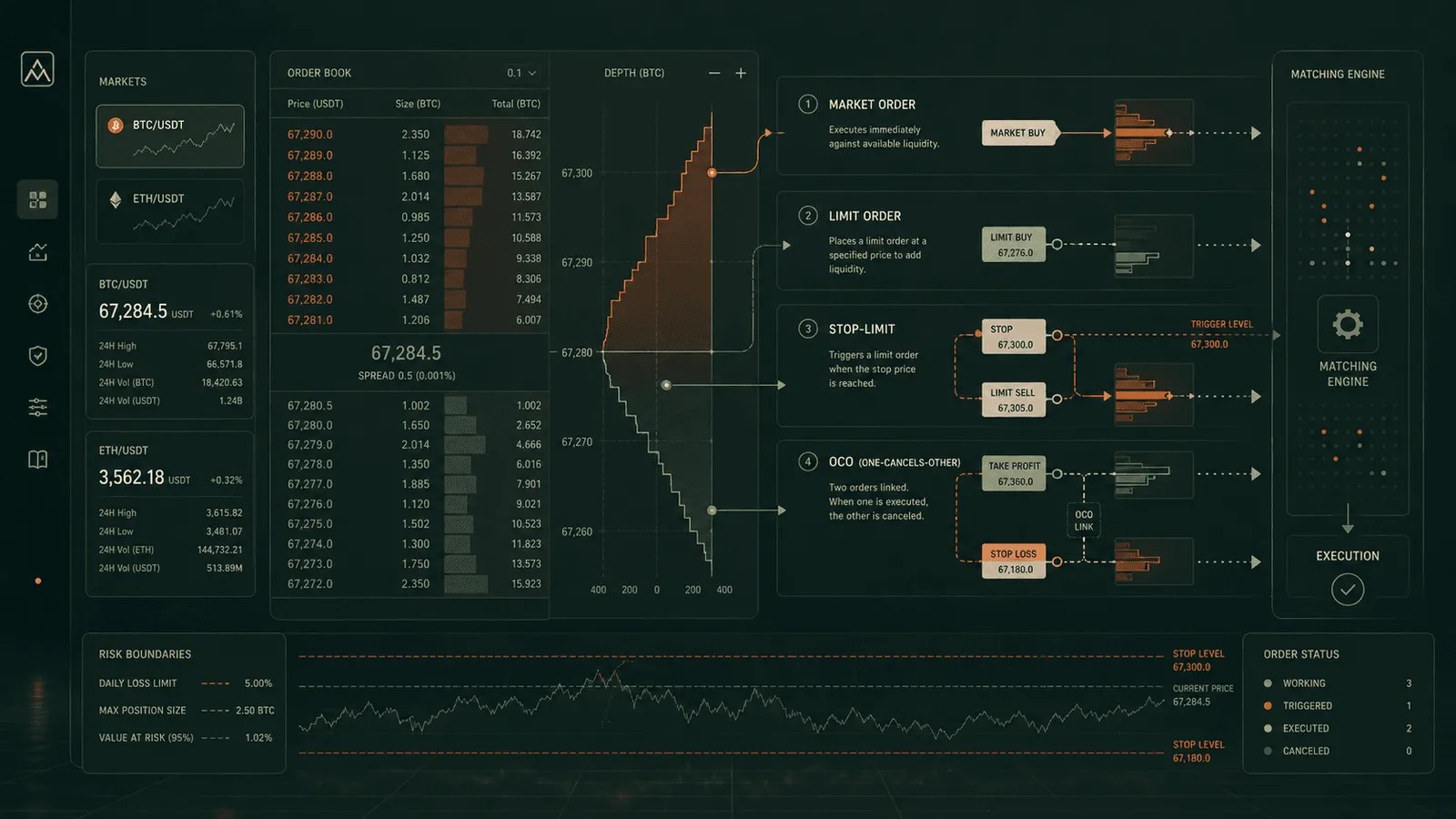
By Tommy Tietze, CEO of ArrowTrade AG
Most traders spend weeks thinking about what to buy.
Then they enter the trade with the first order button they see.
That is where a lot of performance disappears quietly. The chart may look the same, the signal may still be valid, and the asset may still be the right one. The actual fill can still be worse than expected because the trader used the wrong order type for the situation.
Order types are not a beginner topic. They decide how your trade interacts with the order book, how much control you keep over price, how quickly you get filled and how much risk you accept during execution.
This matters even more in crypto spot trading.
Crypto markets move quickly, liquidity changes by pair, spreads widen during stress, and automated systems can create many small orders. If the order logic is weak, the strategy pays for it again and again.
This guide explains the most important order types in crypto trading and how serious spot traders should think about them before they automate anything.
Why order types matter
A trading signal answers one question: what should happen?
The order type answers a different question: how should the trade enter the market?
That second question often gets less attention, even though it directly affects execution. A market order gives speed. A limit order gives price control. A stop-limit order adds conditional logic. An OCO order combines two possible exits and cancels the unused one after the other side is executed, according to Binance Academy.
For manual traders, this is already important.
For automated spot trading, it becomes part of the product architecture. A bot does not “feel” the market. It follows rules. If those rules are too aggressive, the system may take liquidity unnecessarily. If they are too passive, the system may miss trades that should have filled.
Good order logic does not make a bad strategy profitable.
It helps a good strategy survive contact with the real market.
Market order
A market order is used when the trader wants immediate execution.
The order fills against available liquidity in the order book. The trader accepts the best available prices at that moment. That makes market orders fast, but it also means the final average price can be worse than expected when liquidity is thin or the market moves quickly.
Binance Academy lists market orders as one of the basic order types available on Binance, designed for immediate trade execution rather than waiting for a specific price condition.
Market orders are useful when execution matters more than price precision.
That can happen when a trader wants to exit quickly, when a signal is time-sensitive, or when the traded pair is extremely liquid and the order size is small relative to the book.
The problem appears when traders use market orders casually.
On a major BTC pair, the difference may look small. On a less liquid altcoin pair, the same behavior can create visible slippage. The order fills, but the price is not the price the trader had in mind when clicking.
In spot trading, there is no liquidation mechanic from leverage. A poor entry can still create a long, uncomfortable position.
Limit order
A limit order lets a trader define the maximum price they are willing to pay when buying or the minimum price they are willing to accept when selling. Coinbase explains that a limit order only executes at the specified price or better, and there is no guarantee the order will be filled if the market does not reach that price.
This is the order type traders use when price control matters.
If BTC trades at 100,000 and a trader only wants to buy at 99,500 or lower, a limit buy order can express that condition. The trade waits. If the market reaches the price and enough liquidity is available, the order may fill. If the market moves away, it may remain open or expire depending on the settings.
Limit orders are useful because they bring discipline into the trade.
They also introduce a different problem. The trader may be right about direction and still miss the trade because the market never touches the limit price.
That trade-off matters.
A limit order can improve execution quality, but waiting has a cost. In fast crypto markets, the price may move without you. For automated strategies, the system needs rules for what happens when a limit order stays open too long, fills only partially or becomes irrelevant after the market changes.
Limit maker and post-only logic
A limit order can still execute immediately if it crosses the spread.
That detail surprises many traders. A trader may think they are placing a passive order, but if the price matches existing liquidity, the order can execute as a taker order.
This is why post-only logic exists.
Coinbase’s trading rules state that a limit order with post-only selected will be posted to the order book only if it would not be posted at the same price as an existing order, and that post-only orders are always maker orders.
Binance Academy also lists Limit Maker as a basic execution option alongside Market and Limit orders.
For active traders, this can be important because maker and taker fees can differ.
Post-only logic is useful when the trader wants to add liquidity and avoid immediate taker execution. It can help control costs, especially in strategies that trade frequently.
The cost is missed execution.
If the order would immediately match, the platform may reject it or prevent it from taking liquidity, depending on the exchange rules. That can be exactly what the trader wants. It can also mean the trade does not happen.
A good automated system needs to know which outcome is acceptable.
Stop-limit order
A stop-limit order combines a stop price and a limit price.
Coinbase explains that a stop-limit order automatically places a limit order when the asset reaches the stop price, and the resulting trade only goes through at the limit price or better.
Kraken describes the same basic structure: when the actual price reaches the stop price, the order becomes a limit order to buy or sell at the limit price or better.
This order type gives traders more control than a simple stop market order because the trader defines the worst acceptable execution price.
That control matters in crypto.
If the market drops quickly, a stop-market sell order may fill at a much lower price than expected. A stop-limit order can prevent execution below the limit price. The risk is that the order may not fill at all if the market moves through the limit too quickly.
That is the uncomfortable part.
A stop-limit order gives price protection, but it does not guarantee exit.
For spot traders, this can be acceptable in some situations and dangerous in others. A trader who wants to avoid selling into a temporary wick may prefer a stop-limit. A trader who must exit exposure quickly may care more about certainty than price control.
The order type should match the reason for the trade.
Stop-loss and take-profit orders
Stop-loss and take-profit orders are built around exit logic.
A stop-loss order helps define where the trader wants to reduce risk if the market moves against the position. Kraken explains that a stop-loss limit order seeks to limit losses by triggering an order when the asset reaches a stop price, after which the order becomes a limit order at the limit price or better.
A take-profit order does the other side of the job.
Kraken explains that a take-profit limit order is used to close a position when the asset reaches a certain price level, with the goal of locking in profits at a defined price or better.
These orders are useful because they reduce the need to make every decision live.
A trader can define the plan before emotion enters the trade. That is especially valuable in crypto, where price can move sharply while the trader is busy, asleep or simply not watching the screen.
For automated spot trading, take-profit and stop-loss logic must be designed carefully.
A stop placed too close can get triggered by normal volatility. A take-profit placed too aggressively may never execute. A take-profit placed too close may exit before the strategy has room to work.
The order is only as good as the logic behind it.
OCO order
OCO means One Cancels the Other.
Binance Academy explains that an OCO order combines two orders into one, usually a limit or take-profit order and a stop-loss order, and when one order is executed, the other is automatically canceled.
This is practical for traders who want both a target and a risk limit.
Imagine a trader buys ETH at 3,000. They may want to sell if ETH reaches 3,250, while also exiting if it drops to 2,880. An OCO setup can define both conditions. If the take-profit fills, the stop-loss is canceled. If the stop-loss fills, the take-profit is canceled.
That is cleaner than managing both orders manually.
It also reduces a common mistake: leaving a forgotten order open after the position has already closed.
For spot traders, OCO orders can support a more disciplined workflow. For bots, the same idea appears as structured exit logic. The system should know what to do when price moves in the preferred direction and what to do when the trade fails.
Without that logic, the trader is not running a system. They are reacting.
OTO and OTOCO orders
Some exchanges support more advanced order combinations.
Binance Academy explains that OTO means One Triggers the Other, where a second order is only placed after the first order is executed, and OTOCO combines an opening order with a later OCO structure for take-profit and stop-loss conditions.
This is useful when the trader wants to plan the full trade before entry.
The first order opens the position. After it fills, the system places the exit logic. That prevents the trader from entering first and thinking about risk later.
Advanced order types can be helpful, but they can also create false confidence.
A trader can build a complicated order structure around a weak idea. The order type improves workflow. It does not improve the signal by itself.
For professional traders and automated systems, the value comes from repeatability.
The same entry logic, exit logic and risk logic can be applied consistently. That gives the trader something to review afterwards. Did the entry work? Did the stop make sense? Did the take-profit sit too close? Did partial fills create problems?
Those questions matter more than the order type name.
Time in Force
Time in Force defines how long an order remains active.
Binance Academy explains that limit orders require a Time in Force setting, with common options including Good Til Canceled, Immediate Or Cancel and Fill or Kill.
Good Til Canceled means the order remains open until it is filled or manually canceled, according to Binance Academy.
Immediate Or Cancel tries to execute all or part of the order immediately and cancels the unfilled part, according to Binance Academy.
Fill or Kill only executes if the full order can be filled immediately, otherwise it is canceled, according to Binance Academy.
This sounds like a small setting.
It is not small when a strategy runs automatically.
An order that remains open too long can become stale. An order that cancels too quickly may never get enough time to fill. An order that demands a full immediate fill may fail in markets where partial execution would have been acceptable.
Time in Force decides how patient the system is allowed to be.
That is a strategy decision.
Partial fills
Partial fills are a normal part of trading.
Coinbase explains that a limit order may only be partly filled if there is not enough asset available within the specified price range to fill the entire order at once.
This matters more than many people think.
A trader may place an order for 1 ETH and get filled for 0.4 ETH. The remaining 0.6 ETH stays open, depending on the order settings. If the market moves away, the trader has a partial position that may not match the original plan.
For manual traders, this is annoying.
For automated systems, it must be handled with rules.
What happens to the unfilled part?
Does the system cancel it?
Does it wait?
Does it adjust the take-profit?
Does it calculate risk based on the filled size or the intended size?
These questions sound operational, which is exactly the point. Trading becomes serious when the boring details are handled properly.
Order types and fees
Order types also affect fees.
A market order usually removes liquidity from the order book. A passive limit order can add liquidity if it rests on the book and later gets filled. That is why order types are connected to maker and taker fees.
This connection matters for frequent spot trading.
A system that uses aggressive orders may execute more reliably, but it may also pay more in fees and suffer more spread cost. A system that uses passive orders may improve fee behavior, but it can miss trades or get partial fills.
There is no perfect choice.
There is only a trade-off that needs to be understood.
For unCoded, this is part of why execution logic matters. The product is built around automated crypto spot trading on Binance, with capital staying on the user’s own Binance account and API rights designed without withdrawal access. The trade may be automated, but the execution still needs to be visible and understandable.
A bot should not hide the order logic from the user.
The user should know how the system trades.
Common mistakes with order types
Using market orders because they feel simple
Market orders are useful when speed matters. They become expensive when traders use them in illiquid pairs or during volatile conditions without checking spread and order book depth.
Placing limit orders too far away
A limit order gives price control, but it may never fill. If the order sits far from the market and the strategy has no rule for stale orders, the system may wait for a trade that no longer makes sense.
Believing stop-limit orders guarantee exits
Stop-limit orders protect price, but they do not guarantee execution. If the market moves too quickly, the stop can trigger and the limit order can remain unfilled.
Forgetting open orders
Manual traders often leave old limit, stop or take-profit orders open. That can create unexpected trades later, especially after the original market context has changed.
Ignoring partial fills
Partial fills can change the position size, exit logic and risk calculation. Automated systems need to track what actually filled, not what was intended.
Copying order logic across all pairs
BTC, ETH and smaller altcoins do not behave the same way. Liquidity, spread and volatility differ by pair. The same order logic can work well on one pair and poorly on another.
Order types in automated spot trading
Automated spot trading needs order rules that match the market.
A bot can only execute what the logic tells it to execute. If the strategy uses market orders, it must accept the cost of speed. If it uses limit orders, it must accept missed fills. If it uses stop-limit orders, it must handle the risk that an exit does not complete.
This is why serious automation cannot stop at the signal.
The system needs entry rules, exit rules, fee awareness, partial-fill handling, stale-order handling, pair selection and reporting. Each trade should be visible afterwards, not only as a profit or loss number, but as an execution event.
That is where many trading tools become vague.
They show a result, but not enough context. A serious trader should be able to see how the trade entered, how it exited, what order type was used, what fees were paid and whether the execution matched the strategy.
This is also why spot-only trading fits the unCoded approach.
No futures. No leverage. No liquidation mechanics from leveraged products. The user keeps control of the Binance account, and the system trades through API permissions without withdrawal rights.
Order types still matter inside that setup.
Spot trading removes one category of risk, but it does not remove execution risk.
A practical order type framework
A trader does not need to memorize every exchange feature.
The useful framework is simpler.
Use market orders when speed matters more than price precision.
Use limit orders when price control matters more than immediate execution.
Use post-only or limit maker logic when fee behavior and liquidity provision matter.
Use stop-limit orders when you want conditional execution with a defined worst acceptable price.
Use OCO logic when a trade needs both a target and a risk boundary.
Use Time in Force settings when patience needs to be defined in the order itself.
Then review what actually happened.
The review is where the learning happens. Did the market order slip too much? Did the limit order miss too often? Did the stop-limit fail to exit? Did the OCO prevent an old order from staying open?
The best order type is not the most advanced one.
It is the one that fits the trade.
FAQ
What are the main order types in crypto trading?
The main crypto order types include market orders, limit orders, stop-limit orders, stop-loss orders, take-profit orders and OCO orders. Binance Academy lists Market, Limit and Limit Maker as basic order types and also explains advanced combinations such as OCO, OTO and OTOCO.
What is a market order in crypto?
A market order is designed for immediate execution against available liquidity in the order book. It prioritizes speed over exact price control.
What is a limit order in crypto?
A limit order lets a trader set the maximum price they will pay when buying or the minimum price they will accept when selling. Coinbase explains that a limit order only executes at the specified price or better, and it may not fill if the market does not reach that price.
What is a stop-limit order?
A stop-limit order places a limit order when the market reaches a defined stop price. Coinbase explains that the trade only goes through at the limit price or better after the stop price is reached.
What is an OCO order?
OCO means One Cancels the Other. Binance Academy explains that an OCO order combines two orders, usually a take-profit or limit order and a stop-loss order, and automatically cancels the unused order when the other one executes.
Why do order types matter for trading bots?
Order types matter for trading bots because bots execute rules repeatedly. Poor order logic can create unnecessary fees, slippage, missed fills, stale orders or partial positions.
Conclusion
Order types decide how a trading idea becomes a real trade.
That sounds technical, but the effect is very practical. A market order, limit order, stop-limit order and OCO order can all express a different relationship between speed, control and risk.
For crypto spot traders, that difference matters.
The market can move quickly. Liquidity changes by pair. Fees add up. Partial fills happen. Limit orders miss. Stop-limit orders can trigger without filling. A trader who understands this builds cleaner systems.
For automated spot trading, order types become even more important because the system executes them again and again. A weak rule does not stay isolated. It repeats.
Serious crypto trading needs more than signals.
It needs execution logic that can be understood, reviewed and improved.
This article is for educational purposes only and is not financial advice. Trading involves risk, and past performance does not guarantee future results.
Learn more about unCoded: https://uncoded.ch Built by ArrowTrade AG: https://arrowtrade.ch
Recommended Reading
MACD Explained for Crypto Spot Traders
By Tommy Tietze, CEO of ArrowTrade AG Most traders meet MACD very early. It is already there in almo...

Market Maker vs. Taker: Crypto Fees Explained
Market Maker vs. Taker: Crypto Fees Explained By Tommy Tietze, CEO of ArrowTrade AG Most traders spe...

Crypto Drawdown Explained
By Tommy Tietze, CEO of ArrowTrade AG Drawdown is one of the most honest risk metrics in trading. It...

Systematic vs. Emotional Trading
By Tommy Tietze, CEO of ArrowTrade AG Most traders do not lose control in calm markets. They lose co...

Crypto Volatility Explained
By Tommy Tietze, CEO of ArrowTrade AG Crypto volatility is usually discussed in the wrong tone. Some...

USDT, USDC and FDUSD Explained
By Tommy Tietze, CEO of ArrowTrade AG Stablecoins are often treated as if they were simply “digital ...

Position Sizing in Crypto Trading
By Tommy Tietze, CEO of ArrowTrade AG Many traders spend hours searching for the perfect entry. They...