What 10 Coins Down 90%+ from Their All-Time Highs Tell You About Crypto Trading Bot Strategy in 2026
 By Felix Götz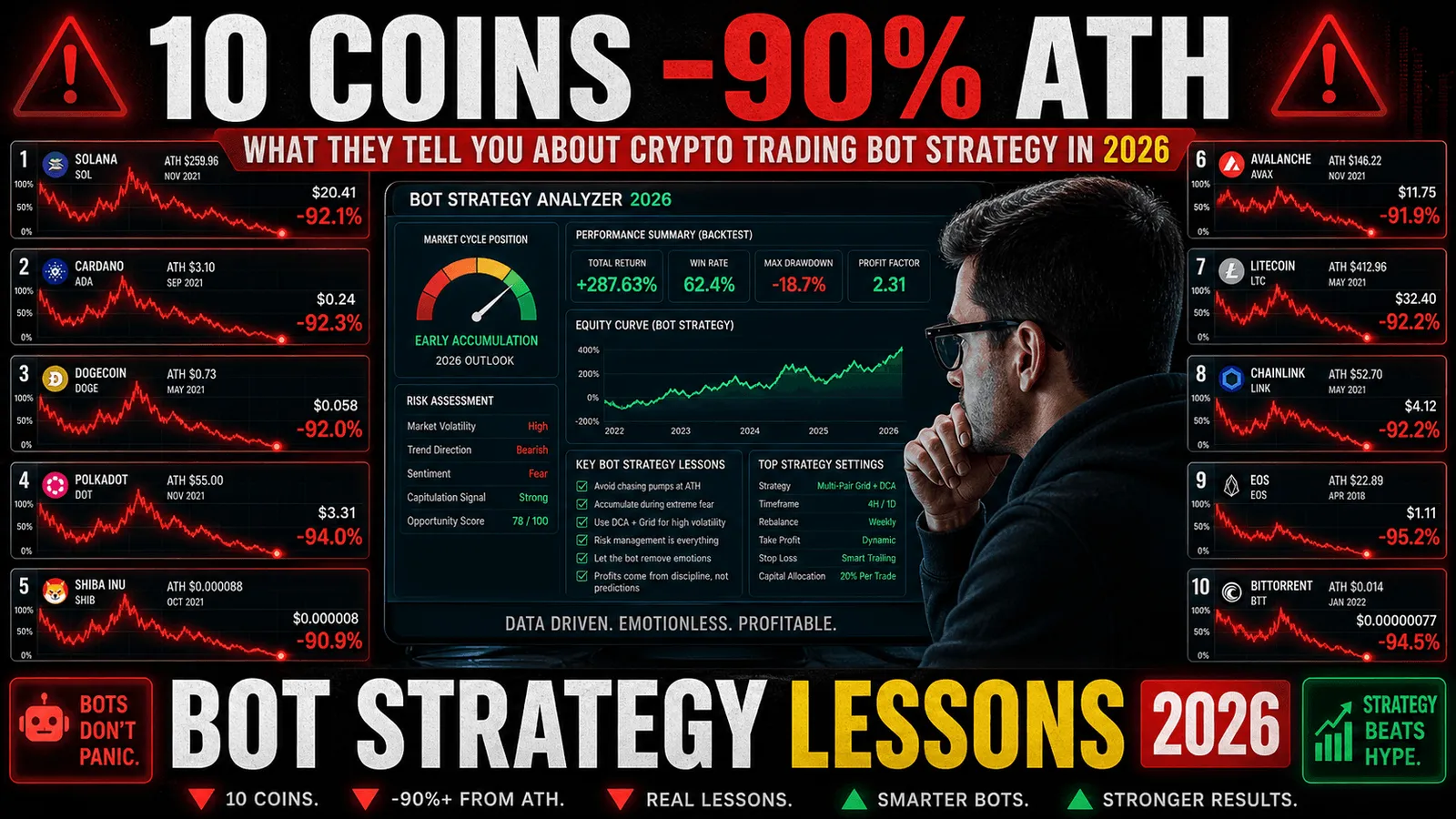
By Felix Götz – Co-Founder and CTO of ArrowTrade AG, building unCoded since 2016 in crypto trading.
Disclosure: I'm Co-Founder and CTO of ArrowTrade AG, the company behind unCoded. This article uses publicly available price data for educational purposes about bot strategy design. It is not financial advice and does not constitute a recommendation to buy, sell, or hold any specific cryptocurrency. Past performance and current price levels are not indicative of future results.
A viral Instagram slideshow making the rounds in 2026 shows a brutal lineup. Ten major altcoins, all from the top 50 by market cap at their peak, all down between 92% and 99.5% from their all-time highs.
Cardano (ADA): down 92%. Uniswap (UNI): down 93%. NEAR Protocol: down 93.5%. Avalanche (AVAX): down 94%. Fetch/Artificial Superintelligence Alliance (FET): down 94%. Arbitrum (ARB): down 95%. Cosmos (ATOM): down 95.6%. VeChain (VET): down 97.5%. Polkadot (DOT): down 98%. Internet Computer (ICP): down 99.5%.
The slideshow is correct on the numbers. It's also incomplete, in a way that matters enormously if you're running automated trading strategies on these or similar tokens.
Because here's what nobody talks about when these crash compilations go viral: most retail trading bots, deployed naively on tokens like these, behaved exactly the way the slideshow's caption suggests. They kept buying. All the way down. Until the capital was gone.
This is what those charts actually mean for bot strategy in 2026.
The data, presented honestly
Let's start with what we're actually looking at. These aren't penny stocks or scam tokens. Most of them are still in the top 100 by market cap. They have working products, active developers, real ecosystems.
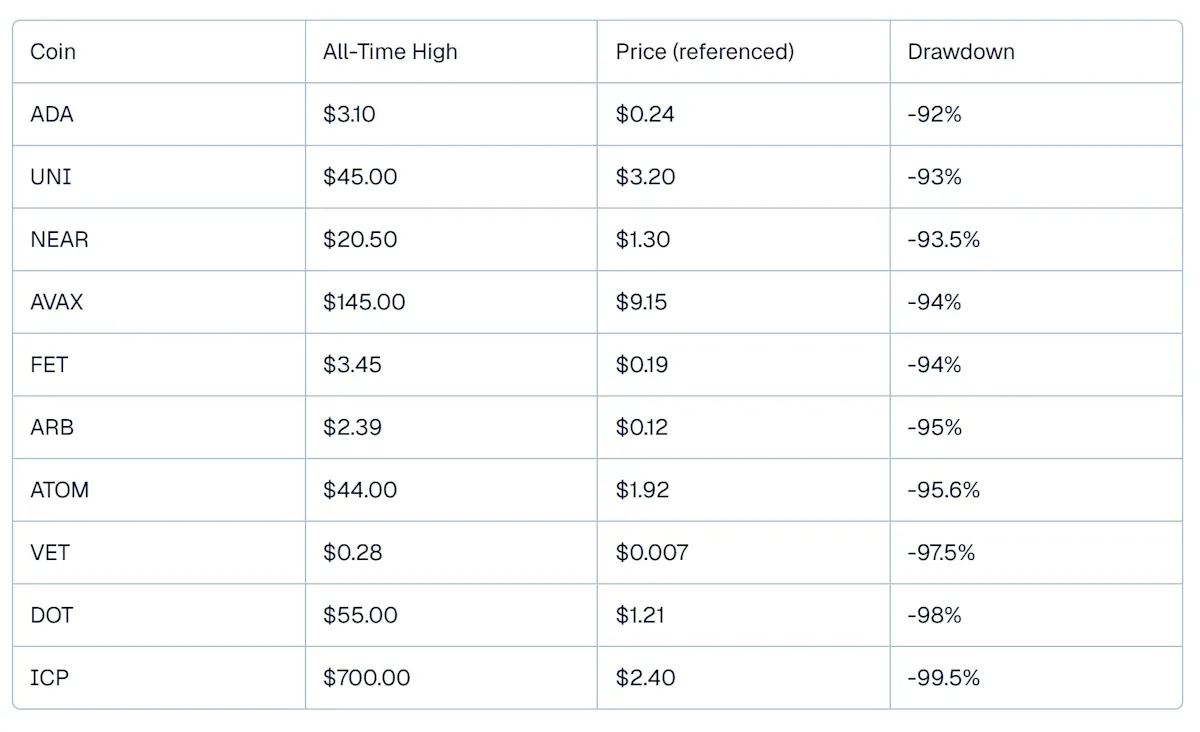
These are the publicly available price levels referenced in the source material. Verify them yourself before drawing any conclusions about your own positions.
Worth understanding: some of these all-time highs were set in 2021. Some in 2022. ICP's $700 was a brief launch-day spike that lasted hours, which makes the 99.5% figure technically correct but somewhat misleading. ARB launched at $2+ and has been in a slow grind down since.
The shape of these declines is not all the same. ICP collapsed and stayed flat. ATOM and DOT had several lower peaks on the way down. AVAX still trades in cycles. The "down 94%" number is identical, but what the strategy needs to handle is completely different.
This matters for what comes next.
⚠️ The survivorship bias the slideshow doesn't mention
The slideshow shows 10 coins down 90%+. It doesn't show the coins that didn't crash 90% during the same period.
Bitcoin is at all-time highs. Ethereum is within striking distance of its peak. BNB has held up. Several stablecoins are exactly where they're supposed to be. A handful of other top-100 coins are at single-digit drawdowns from their highs.
This is the entire point of survivorship bias and why it destroys retail investors.
If you only look at the crashes, you'll conclude crypto is universally a disaster. If you only look at the winners, you'll conclude crypto only goes up. The truth is the distribution: some coins maintained or grew their value, many coins lost catastrophic amounts, and the difference between them is mostly determined by what happens after the initial hype phase.
The slideshow shows you the bottom of the distribution. Marketing screenshots show you the top of the distribution. Real strategy work happens by looking at the entire distribution and designing systems that handle both ends.
This is the same principle that drives unCoded's multi-chart backtesting approach. Test against everything available, then look at how the strategy performs across the whole distribution, not just the cherry-picked examples.
Why your bot didn't save you on these coins
Here's the uncomfortable truth most retail bot users don't want to hear.
If you ran a standard DCA bot on ICP starting at $50 in 2021, you accumulated all the way down to $2.40. The bot did exactly what it was configured to do. It kept buying lower prices. The strategy never failed at the trade level. Every single buy executed correctly.
Your capital is just gone now, because the strategy was designed for assets that mean-revert, and ICP didn't mean-revert. It went down and stayed down.
This is the failure mode that almost no marketing material discusses. DCA strategies, grid strategies, and most "buy the dip" bot logic assume the asset will eventually trade higher than your average entry. When the asset trades lower than your average entry permanently, the strategy doesn't fail – the strategy works exactly as designed, while destroying your capital.
A grid bot deployed on AVAX from its $145 peak with a range expecting eventual recovery accumulated through the entire decline to $9.15. The grid worked correctly the whole way down. The strategy was correct. The bot executed perfectly. The position is at -94%.
A trailing buy strategy on DOT bought every retracement in the downtrend, expecting reversals that never came. Each individual trade was logical. Each accumulated entry was at a "lower price than the previous high." The combined position is at -98%.
The bots didn't fail. The configuration didn't account for the possibility that some of these tokens would not recover within any meaningful time horizon for a retail trader's capital.
What honest backtest data shows about this exact pattern
unCoded publishes the full distribution of backtest results across the entire Binance Spot market for multiple years. The 2025 BasicMode results across 373 token configurations show this exact pattern:
- 7.8% of tokens were profitable
- 92.2% of tokens were unprofitable
- Average return: -62.33%
- Median return: -73.83%
- Worst outcome: -97.03% on USUALUSDT
- 100% win rate across nearly all tokens (every closed trade cycle was profitable)
The 100% win rate is not a contradiction. It's the same mechanic as the altcoin crashes above. Every closed buy-and-sell cycle the strategy completed was profitable. The unrealized losses on accumulated positions that never closed at profit are what produced the -75% median.
This is the structural pattern. Strategies designed around mean reversion work brilliantly when mean reversion happens. They produce the kind of catastrophic drawdowns shown in the altcoin slideshow when mean reversion doesn't happen, because the strategy keeps accumulating into a falling price without ever realizing the loss.
You can verify all of this data at uncoded.ch/backtesting. The 2023 version of the same strategy showed 78.5% of tokens profitable. Same strategy. Different year. The market regime determined the outcome more than the strategy did.
The five lessons these charts teach about bot strategy
If you're running automated strategies on tokens like these, or considering it, the slideshow has more value than most retail trading content. Here's what to extract from it.
Lesson 1: Token survivability is part of strategy design
A strategy that works on Bitcoin doesn't necessarily work on smaller-cap altcoins. The base asset's probability of surviving long enough for mean reversion to occur is part of the strategy's expected value calculation.
Bitcoin and Ethereum have multi-year track records of recovering from severe drawdowns. ICP has a five-year track record of not recovering. Treating these as equivalent base assets for the same strategy is a category error that the slideshow makes vivid.
When configuring any DCA, grid, or accumulation-based bot, the question isn't just "what's the strategy?" but also "what's the asset's survival probability over my deployment timeframe?"
Lesson 2: canBuyDown defaults matter
unCoded ships with canBuyDown set to false by default. This isn't an arbitrary choice. It's the conservative configuration that protects users from exactly the scenario the slideshow illustrates.
With canBuyDown enabled, the bot keeps buying as price falls, accumulating progressively worse positions. This is the behavior that turns a 50% drawdown into capital exhaustion on tokens that don't recover.
With canBuyDown disabled, the bot waits for upward price movement before buying after a drop. This means the bot misses some recovery opportunities, but it also doesn't catch falling knives that never bounce.
The difference between these two settings, deployed on a token like ICP from 2021, is the difference between a managed loss and total capital exhaustion. Most retail bot platforms either don't expose this setting or default it aggressively. unCoded defaults it conservatively because the academic and empirical case for caution is overwhelming when the underlying asset's regime is uncertain.
Lesson 3: Maximum exposure limits aren't optional
A strategy with no maximum exposure limit can theoretically deploy unlimited capital into a falling position. A strategy with maximum exposure limits caps the worst-case loss to a defined fraction of available capital.
If you'd run any of the strategies on the slideshow coins with a 25% maximum exposure limit, your loss would have been capped at 25% of capital regardless of how far the token fell. Without that limit, the loss is bounded only by how much capital was available to deploy.
The slideshow makes a powerful argument for capital caps. The coins didn't go to zero. The bots that kept buying them did, structurally.
Lesson 4: Diversification across strategy types matters
A pure grid strategy on AVAX from $145 lost catastrophically. A pure trend-following strategy on AVAX during the same period would have shorted out of the position early and avoided most of the drawdown.
No single strategy type works in all market regimes. The slideshow coins are mostly examples of failed mean reversion. The same period had trending strategies that worked beautifully and momentum strategies that printed money. Diversifying across strategy types is one of the few genuine free lunches in retail bot trading.
This is also why unCoded provides multiple strategy modes (BasicMode, FullBullMarket, LongTimeLongMoreProfit) rather than locking users into a single approach. Different markets need different strategies. A platform that only does one thing is a platform whose users will eventually be deployed in the wrong regime.
Lesson 5: Honest backtest distributions reveal these patterns in advance
Every coin in the slideshow had warning signs in its backtest distribution before the catastrophic decline.
If you'd backtested a DCA strategy on ICP across multiple years before the 2021 launch, you couldn't have, because there was no data. That's a warning sign by itself – strategies on assets without sufficient historical data are deployed with elevated risk.
If you'd backtested any strategy on ATOM or DOT across 2022-2023 (after their initial peaks), you'd have seen the strategies struggling in declining markets. That information was available. Most retail users don't backtest in declining periods because the results are uncomfortable. The discomfort is exactly the information you need.
unCoded publishes 2025 BasicMode results showing 7.8% of tokens profitable not because we're proud of the year, but because the bad year is part of the honest distribution. You can't make good decisions about deployment risk without seeing the bad years next to the good ones.
What this means for your deployment
Practical takeaways if you're running bots in 2026:
Audit your token list against the survival question. For every token your bot trades, ask: what's the realistic probability this token still exists and trades meaningfully in three years? If you can't answer with confidence, the position size should reflect that uncertainty.
Check your canBuyDown and similar settings. If your platform allows unlimited downside accumulation, that's a configuration decision you should make consciously rather than accept as default. The slideshow coins are what unlimited accumulation produces in adverse scenarios.
Set maximum exposure caps. Even on tokens you trust, even on strategies you've validated, even in markets you understand. The cap protects you from being wrong about all three.
Diversify across strategy types when possible. A bot platform that gives you only DCA or only grid is a platform that will be wrong about the regime eventually. Multiple strategies running on different conditions hedge against any single approach failing.
Demand honest backtests from any platform you use. Multi-token, multi-year, with the bad years shown alongside the good ones. If a platform won't show you 2025 alongside 2023, they're hiding the information you most need.
Position sizing matters more than you think. Even with all of the above done correctly, the right answer for retail capital often isn't to be deeply exposed to the smallest-cap altcoins through automated strategies. The slideshow coins were all top-50 by market cap at their peak, and they still lost 90%+. Smaller-cap tokens have higher survival risk than these.
The honest summary
The viral slideshow showing altcoins down 90%+ is correct on the numbers. It's also incomplete, because it omits the survivorship side of the distribution and the bot-strategy implications of these specific decline patterns.
Most retail trading bots deployed on these tokens during their declines did exactly what they were configured to do, and most of them produced catastrophic losses anyway. The strategies didn't fail. The configurations assumed mean reversion that didn't happen, on assets where survival probability was lower than the strategy's design assumed.
The lessons aren't unique to these coins. They apply to any retail bot deployment on any token where the asset's long-term survival is uncertain. Token survivability matters. Conservative default settings matter. Maximum exposure caps matter. Strategy diversification matters. Honest backtest distributions reveal these patterns before deployment, when avoiding them is still possible.
unCoded is built specifically to handle the kind of regime variance these slideshows illustrate. Multi-chart backtesting against the entire Binance Spot market reveals which strategies generalize and which don't. Conservative canBuyDown defaults prevent the worst version of the falling-knife problem. Maximum exposure limits cap catastrophic positions before they exhaust capital. The 2025 BasicMode results showing 7.8% of tokens profitable are published openly because hiding the bad years would be inconsistent with profit-sharing pricing that only works when users actually profit.
The slideshow shows what happens when retail bots meet adverse market regimes without these protections. The coins didn't fail their holders alone. The strategies that kept buying them did the rest of the work.
If you're running bots in 2026, design for the slideshow scenario, not just the marketing scenario. The slideshow happens more often than the marketing materials suggest, and the coins that end up on it are not always predictable in advance.
Build the protections in from the start. Verify backtest distributions before deploying. Cap exposure conservatively. Diversify strategies. The traders whose capital survives the next slideshow are the ones who designed for it.
Felix Götz is Co-Founder and CTO of ArrowTrade AG, the company behind unCoded — a self-hosted, non-custodial crypto Spot trading bot with profit-sharing pricing. unCoded's full backtest distributions across all tested tokens and multiple years are publicly available at uncoded.ch/backtesting . Documentation at uncoded.ch/docs . ArrowTrade AG, Switzerland.
Recommended Reading
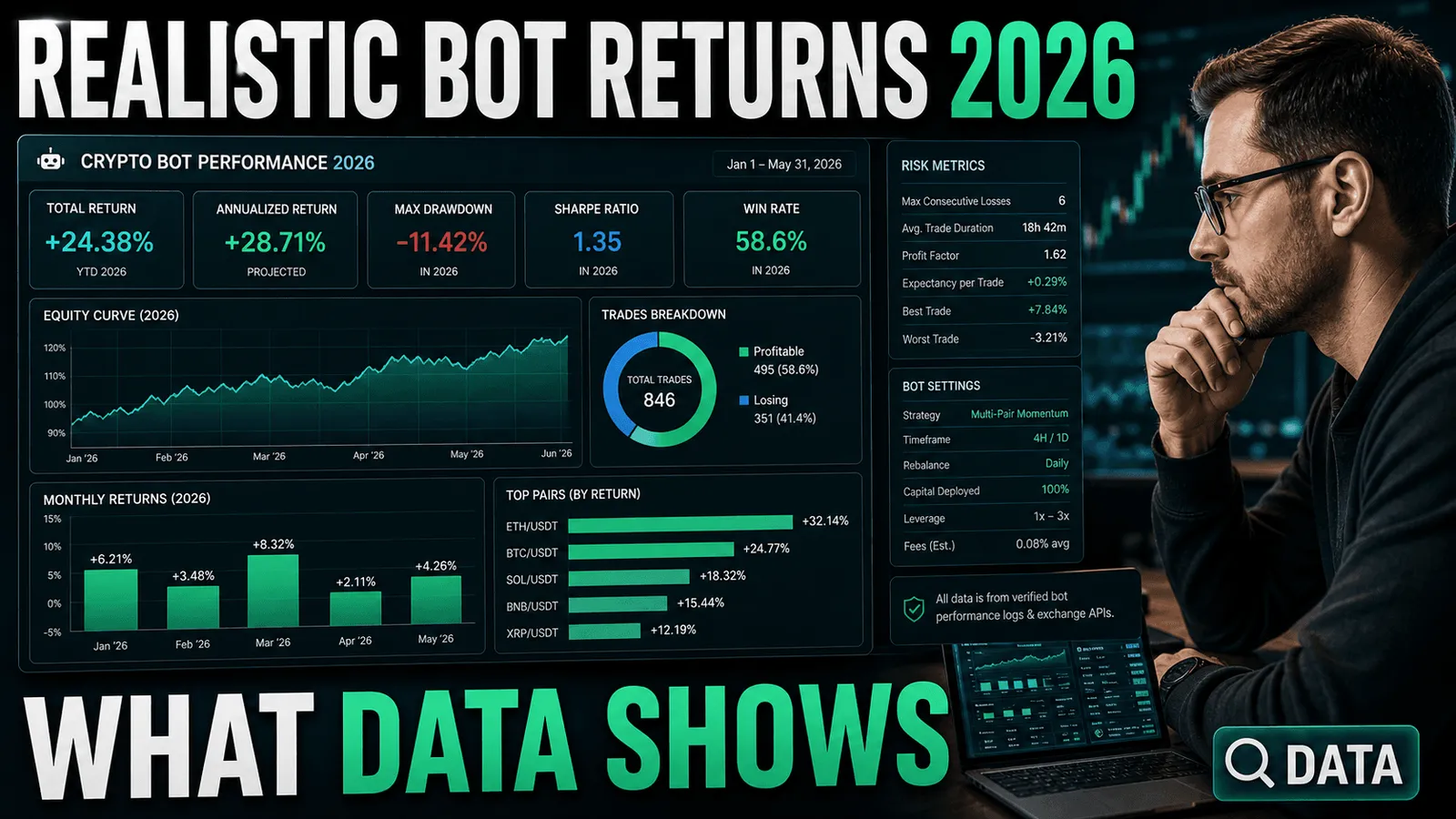
Realistic Returns from Crypto Trading Bots in 2026: What the Data Actually Shows
By Felix Götz – Co-Founder and CTO of ArrowTrade AG, building unCoded since 2016 in crypto trading. ...

How to Validate a Crypto Bot Strategy Out-of-Sample: Practical Rules and Minimum Sample Sizes
By Felix Götz – Co-Founder and CTO of ArrowTrade AG, building unCoded since 2016 in crypto trading. ...

MiCA Explained for Crypto Investors
By Tommy Tietze, CEO of ArrowTrade AG Crypto regulation used to feel like background noise. For many...

My Honest Experience with Crypto Trading Bots on a Normal Portfolio – Here’s What They Actually Cost Me
By Felix Götz – founder of unCoded, trading crypto since 2016. Before we start: What follows isn't f...

Are Crypto Trading Bots Profitable in 2026? An Honest Answer After Five Years of Running Them
By Felix – founder of unCoded, trading crypto since 2016. Before we start: What follows isn't financ...

How to Build a Crypto Trading Bot That Actually Works in Production
By Felix – founder of unCoded, trading crypto since 2016. I've had this conversation probably thirty...

unCoded Is an IQ Test. That's Not a Marketing Line.
By Felix – founder of unCoded, trading crypto since 2016. Most trading bot platforms optimize for th...