AI Crypto Trading Bots - Are Mostly Marketing. Here's What's Actually Going On.
 By Felix Götz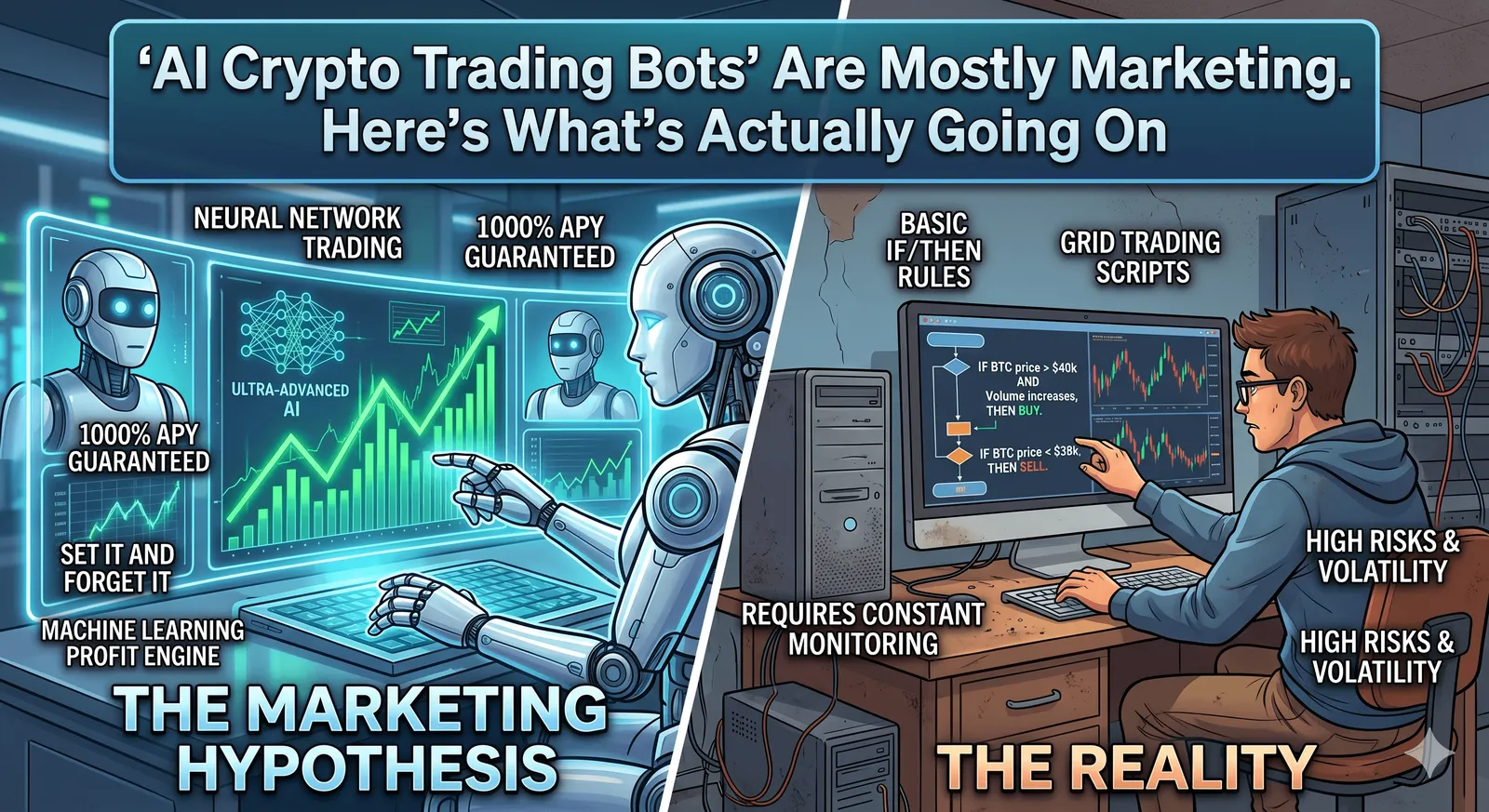
By Felix – founder of unCoded, trading crypto since 2016.
In 2026 the crypto trading bot market is flooded with products that call themselves AI-powered, machine-learning-driven, or neural-network-enhanced.
Most of them aren't. Most of what they actually do is rule-based logic with a GPT wrapper for strategy descriptions. The marketing budget went to "AI." The product did not.
There's actually a regulatory term for this now. The SEC has been actively prosecuting what it calls "AI-washing" – companies making misleading claims about AI capabilities in their products and disclosures. The EU AI Act, fully enforceable in 2026, imposes transparency requirements specifically because this category of misrepresentation has become widespread. When regulators have to invent a term for something, it usually means the problem is bigger than anyone wants to admit.
I'm going to break this down honestly because the gap between what AI marketing promises and what it delivers in retail trading bots is wide enough to lose real money in. And because – here's the part nobody wants to say out loud – for most retail crypto trading strategies, you don't actually want AI. You want something else entirely.
Let's work through it.
What "AI trading bot" actually means in the 2026 retail market
When a retail platform says "AI-powered trading," one of five things is almost always true:
1. It's a large language model wrapping rule-based execution. You type "buy BTC when RSI is under 30 with 2% take profit" into a chat interface. The LLM translates this into configuration parameters for a standard rule-based bot. The execution is the same rule-based logic that existed in 2017. The "AI" is a text-to-config layer.
This is useful – natural language is a legitimate interface for people who don't want to learn a configuration UI. But it's not AI trading. It's AI-assisted configuration of a non-AI bot.
2. It's sentiment analysis on news and social media feeds. The bot scrapes Twitter, Reddit, or news sources, scores sentiment with an LLM or classifier, and incorporates that score into trading decisions. This is genuinely AI. It's also genuinely limited. Sentiment analysis on crypto markets has a mixed track record – the signal is noisy, the data is manipulated by coordinated campaigns, and the lead-lag relationship between sentiment and price is unstable.
3. It's a pattern-matching model trained on historical data. Usually an LSTM or transformer that's been fed OHLCV data and tries to predict short-term price movements. This is legitimate machine learning. It's also where almost all retail "AI trading" goes to die – the models overfit to historical patterns that don't generalize, the crypto market regime shifts too quickly for static models, and the signal-to-noise ratio in price data makes accurate prediction genuinely hard.
4. It's reinforcement learning on a simulated trading environment. The bot trains by running simulated trades against historical data, rewarded for profitable outcomes. Academically interesting, rarely robust in live markets. The gap between the simulation and real execution – slippage, fees, market impact – typically destroys the learned policy the moment it's deployed.
5. It's marketing with no underlying AI at all. The platform uses "AI" as a keyword because it drives signups. The actual product is a grid bot or a DCA timer with a sleek interface. This is the category regulators are specifically targeting under "AI-washing" enforcement actions. You'd be surprised how common it is.
Most commercial platforms in 2026 fall into categories 1 or 5. A few have genuine sentiment analysis. Very few have production-grade pattern-matching models. Almost nobody at the retail level has reinforcement learning that works.
Why AI marketing works so well in this space
The appeal is obvious. AI has produced genuinely impressive results in other domains – language, images, code generation. If AI can write essays and generate photorealistic images, surely it can predict Bitcoin prices better than a human?
This intuition is wrong, but it's intuitive enough that the marketing works.
The specific problem is that the domains where AI has succeeded have three properties in common:
- Large, clean, labeled training data (text corpora, labeled images, code repositories)
- Stable underlying patterns (language rules, visual features, programming syntax)
- Low cost of individual errors (one bad translation doesn't matter much)
Crypto trading has none of these properties:
- Training data is noisy, manipulated, and subject to regime shifts. The pattern that produced returns in 2021 actively loses money in 2023. Bull market logic destroys portfolios in bear markets.
- Underlying dynamics change. Market microstructure evolves. Exchange behavior changes. New participants enter, old ones leave. A model trained on three years of historical data is predicting the past, not the future.
- Individual errors are expensive. One bad trade can represent days of profitable trading. Models that are right 52% of the time in academic benchmarks can be devastating in live markets because of how losses compound.
These aren't problems that will be "solved" by bigger models or more data. They're structural features of financial markets that have frustrated serious quantitative researchers for decades.
What the successful quantitative firms actually do
Firms that successfully run algorithmic trading at institutional scale – Renaissance, Two Sigma, DE Shaw, Jump – do use machine learning. But the public record of how they use it is instructive.
They don't use AI to predict prices. They use it for very specific, narrow problems where it measurably adds value.
The clearest example is execution optimization. JPMorgan's LOXM system reportedly reduced execution slippage by around 30% compared to traditional methods by using machine learning to intelligently fragment large orders across multiple venues, predict short-term liquidity, and execute in micro-batches that minimize market impact. This is advanced inventory management, not price prediction. It's the kind of problem AI is actually good at: clear inputs, measurable outputs, stable optimization objective.
Beyond execution, institutional firms use AI for feature engineering (extracting signals from alternative data sources like satellite imagery or corporate filings), signal combination (how to weight multiple weak signals into one composite), and derivatives pricing (deep learning models have been shown to outperform traditional Black-Scholes in certain volatility regimes).
What they don't do: give the AI a mandate to predict "will price go up tomorrow" and trust it with capital. That's not because they can't. It's because they've tried and learned it doesn't work reliably.
The signals themselves are mostly generated by human researchers using traditional statistical methods. The "AI" is applied to specific problems where it has measurable value, not to the core question of market direction.
If the largest and most sophisticated quant firms in the world don't primarily use AI to predict prices, a $49/month retail product is not doing something they haven't figured out. More likely, it's doing something much simpler and calling it AI.
Why you probably don't want AI in your trading bot anyway
Here's the counterintuitive point. Even if AI trading worked well at retail scale – which for most implementations it doesn't – you probably wouldn't want it in your bot.
The reason is explainability.
When a rule-based bot places a trade, you can explain exactly why. "The RSI crossed below 30 on the 4-hour chart while the MACD histogram was rising, which matches the configured entry condition." You can evaluate whether that logic was appropriate for the current market. You can adjust it when it stops working. You can backtest it and understand what the backtest tells you.
When an AI model places a trade, you often can't explain why. The model output a buy signal based on a complex weighted combination of inputs that aren't human-interpretable. If the model stops working, you don't know whether it's because the market regime changed, because the training data has become stale, because a new pattern has emerged that the model doesn't capture, or because the model was never actually good and you just got lucky.
This matters in multiple ways:
You can't tell when the model has stopped working. A rule-based bot that keeps losing money is obviously broken. An AI model that keeps losing money might be broken, might be temporarily underperforming in a regime it will eventually handle, or might be right and unlucky. You can't distinguish these cases without extensive statistical testing, and even then it's hard.
You can't adjust it intelligently. When a rule-based strategy fails, you can modify the rules. When an AI model fails, you can retrain – but retraining requires new data, and by the time you have enough new data to retrain, the regime may have shifted again.
You can't backtest it honestly. Backtesting a rule-based strategy on historical data tests the strategy. Backtesting an AI model on historical data tests whether the model fits data it was indirectly trained on. The distinction matters and it's often invisible.
You can't explain it to anyone, including yourself. If you're running a bot with real capital and something goes wrong, "the AI said to buy" is not an explanation that will satisfy you, your accountant, or anyone else who needs to understand what happened.
For retail traders, rule-based strategies built on understood technical indicators have a significant advantage over AI models. Not because the AI couldn't theoretically outperform, but because when things go wrong – and in trading, they always eventually do – you can actually figure out what happened and fix it.
The academic and institutional world has actually acknowledged this. There's a growing field called Explainable AI (XAI) focused specifically on making machine learning decisions interpretable by humans. Post-hoc interpretability tools like LIME and SHAP, sparse decision trees, and Generalized Additive Models are active areas of research precisely because opaque black-box models are a problem even in institutional contexts with PhD-level operators. These techniques are essentially absent from retail crypto trading bots. If you can't explain it at an institutional level with a dedicated research team, you definitely can't explain it on a retail subscription with no visibility into the model at all.
The systemic risk nobody is pricing in
There's another problem with the proliferation of AI trading bots that doesn't show up in individual product evaluations.
When too many trading systems are built on similar AI models or trained on overlapping data sources, their behavior becomes correlated. Academic researchers have identified a phenomenon called "model collapse" – when AI models are recursively trained on data generated by other AI models, the distribution narrows, variance collapses, and the models become blind to tail risks and edge cases.
In practical terms: if a critical mass of retail and institutional bots are using similar foundational LLMs, consuming the same sentiment feeds, or learning from the same aggregated market data, their trading behavior starts to synchronize. A minor market anomaly can trigger a cascade of correlated sell-offs. Standard corrections become flash crashes.
This is not a theoretical concern. As AI bot adoption grows, algorithmic monoculture grows with it. The 2022 Terra/Luna collapse and the 2023 Silicon Valley Bank liquidity cascade both had elements of correlated algorithmic response that amplified rather than absorbed shocks.
For a trader running a deterministic rule-based system, this systemic risk is manageable – you can hard-code maximum exposure limits, circuit breakers that pause trading during extreme volatility, and clear liquidation thresholds. For a trader running an opaque AI model, you're essentially a passenger. When the crash happens, you don't know why the model is doing what it's doing, and by the time you figure it out the losses are real.
What actually works at retail scale
The boring answer: rule-based strategies, properly tested, with honest risk management.
Multi-factor entry logic. Combine multiple technical indicators with boolean logic. RSI below 30 AND MACD histogram rising AND price above a longer-term moving average. Each condition has a clear rationale. The combination is more robust than any single condition.
Scaled position management. Don't place one entry and one exit. Split positions across multiple price levels. Scale out at multiple take-profit targets. Let part of a winning position run while banking partial profits on the rest. This is how professional traders actually manage positions and it's dramatically more effective than single-target logic.
Time-aware exit logic. Don't hold positions indefinitely just because they haven't hit target. After a certain amount of time flat, the opportunity cost of holding starts to matter. Adjust exit targets based on how long a position has been open.
Proper risk management. Stop losses that actually trigger at the stop price, not at candle close. Maximum exposure limits that prevent any single trade from being disastrous. Position sizing that accounts for the volatility of the specific pair you're trading.
Honest backtesting. Backtest on 1-second base candle data so intracandle events are caught. Use Sharpe annualization that's correct for your timeframe. Test across multiple market regimes including bear markets. Apply realistic fee and slippage assumptions.
None of this is AI. All of it is more likely to produce consistent results than an AI model that can't explain why it just bought a token at a local top.
The legitimate uses of AI in a trading workflow
To be fair: there are specific places where AI genuinely adds value to trading, even at retail scale. They're just not "predict the price."
Strategy description and configuration. LLMs are genuinely useful for translating natural language descriptions into bot configurations. "I want to accumulate Bitcoin slowly with stronger buying when it drops more than 5% in a week" is easier to express in English than in a config UI. This is a real use case where AI makes trading more accessible.
Code generation for custom indicators. If your strategy requires a custom technical indicator that isn't in the standard library, having an LLM write Python code for it is a legitimate productivity boost. The indicator itself is still rule-based; the AI just helped you build it faster.
Research assistance and pattern recognition. LLMs can help you explore historical data, identify patterns worth investigating, and summarize market conditions. They're not trading – they're helping you think about trading. That's valuable.
Sentiment tracking as one input among many. Sentiment analysis isn't a standalone signal, but it can be one factor in a multi-factor model. If you're already using eight technical indicators and want to add "current social sentiment" as a ninth weight, that's a reasonable use of NLP. It's not AI trading, it's AI-enhanced feature engineering.
Post-trade analytics. AI is useful for analyzing what went right and wrong after trades complete. Pattern recognition in your own trading history, identifying configurations that underperformed, comparing performance across market regimes – this is a legitimate AI use that doesn't require the model to predict anything.
These are all valuable. None of them are what "AI-powered trading bot" usually means in marketing copy.
How to evaluate an AI trading claim
When you see a platform advertising AI-powered trading, ask these questions:
What specifically is the AI doing? If the answer is vague or "proprietary," assume it's marketing. Real AI implementations can be described in technical terms – "we use sentiment analysis on Twitter feeds as one input to a rule-based entry filter" is a real answer. "Our neural network analyzes market conditions" is not.
What does the backtest show against a simple rule-based equivalent? If the AI-powered version doesn't significantly outperform a well-configured rule-based strategy on the same historical data, the AI isn't adding value. It's adding complexity.
How does the system behave in a market regime different from its training data? Almost every AI trading model performs worse in out-of-sample data than in-sample data. The question is how much worse. If the platform won't show you this, there's usually a reason.
Can you explain the logic of individual trades? If the platform can't tell you why a specific trade was placed, you can't evaluate whether the system is working or failing.
What's the pricing model? AI trading bots are usually sold on subscription. If the platform is charging you $60-$130/month regardless of performance, they have no financial incentive to make sure the AI actually works.
The honest conclusion
The AI marketing in retail crypto trading bots in 2026 is mostly noise. Regulators call it AI-washing. The product reality is usually rule-based logic with a GPT wrapper. Some products have legitimate AI components – sentiment analysis, natural language configuration, research assistance. Most products using the "AI" label in their marketing are running the same rule-based logic that existed five years ago with a slick interface added.
For retail traders, the honest path is:
- Use rule-based strategies you understand and can explain
- Apply proper multi-factor entry logic, scaled position management, and honest risk controls
- Backtest on realistic data with correct methodology
- Treat AI as one possible input among many, not as the core of your strategy
- Be deeply skeptical of any platform whose primary marketing angle is "AI-powered"
Automation has real value. Artificial intelligence has real value. Their intersection in retail crypto trading – so far – mostly has marketing value.
Run the rule-based version honestly. Beat the market with logic you can explain. Treat the "AI crypto trading bot" positioning for what it usually is: a keyword for ranking on Google, not a feature that makes you money.