Bitcoin Trading vs Holding: The Honest Math No One Wants to Show You
 By Felix Götz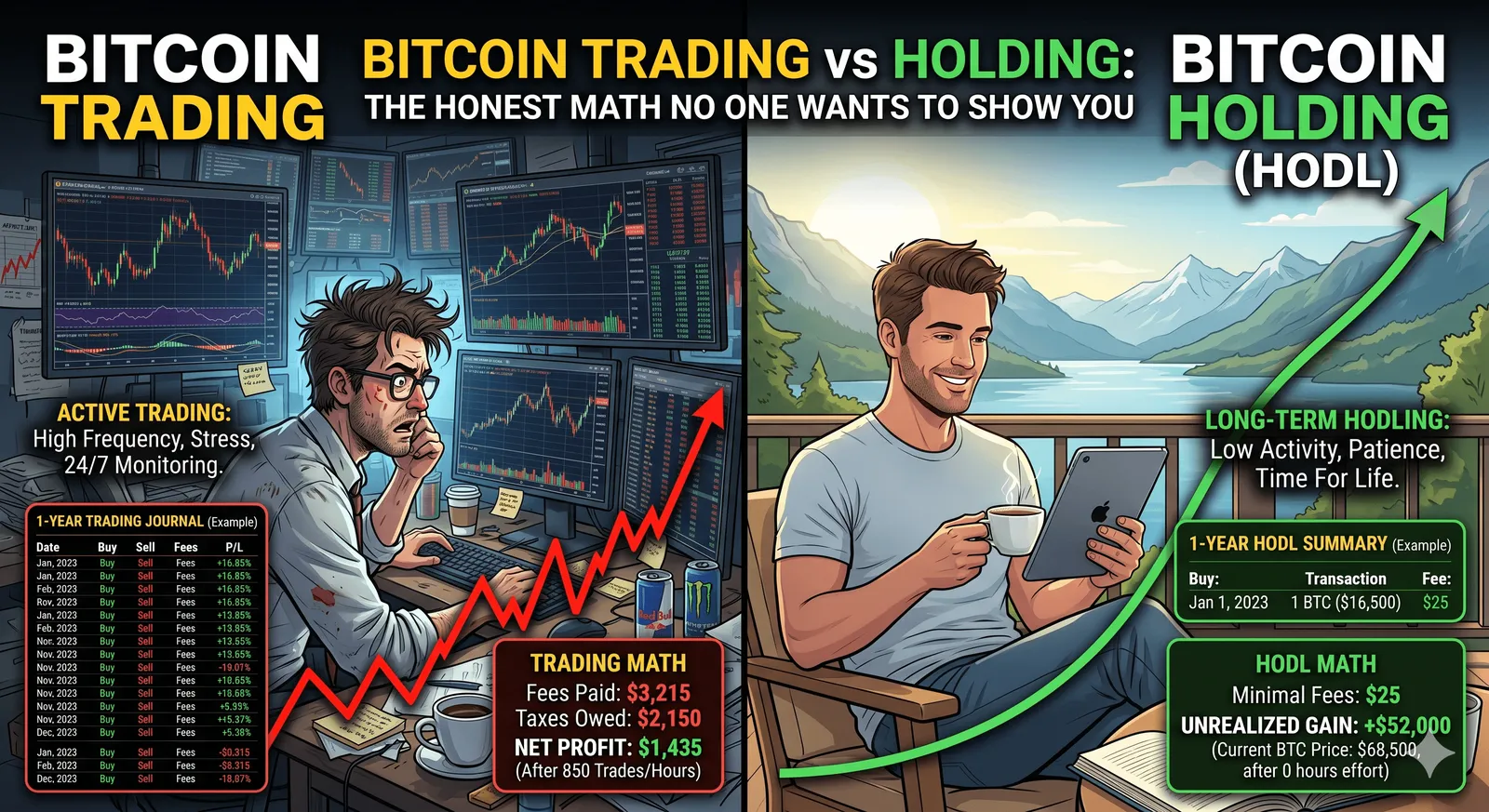
By Felix – founder of unCoded, trading crypto since 2016.
Let me start with the conclusion because it's going to bother some people: for most retail traders, simply holding Bitcoin has outperformed almost every active trading strategy over the past decade.
That includes me. I've run bots for years, across multiple market cycles, with increasingly sophisticated strategies. In most of those years, the simple act of holding would have produced better results. I'll show you why.
But this isn't the "just hold" article you've read a hundred times. The math is more interesting than that, and there's a specific situation where active trading genuinely beats holding – and another where holding genuinely beats trading. Most people who lose money trading Bitcoin lose it because they're on the wrong side of that distinction.
Let's work through it.
The ten-year baseline
Bitcoin at the start of 2016: approximately $430. Bitcoin in mid-April 2026: around $75,000.
That's roughly a 175x return over ten years. Compounded annually, that's approximately 66% per year.
There is no trading bot, no hedge fund, no active strategy that has consistently produced 66% annual returns over ten years. Nothing. Not Renaissance Technologies. Not the best quantitative trader alive. Not you. Not me.
The simple act of buying Bitcoin in 2016 and doing absolutely nothing with it outperformed every actively managed strategy available to retail traders during that same period.
This is the first thing anyone asking "should I trade Bitcoin or hold it" needs to sit with. The baseline is extraordinarily high. You are not competing against a 7% S&P 500 benchmark. You are competing against a 66% asset that has never required you to do anything.
The psychological trap
Despite that math, most traders actively trade Bitcoin. Why?
Because the ten-year chart is deceptive when you're living inside it.
Bitcoin dropped 84% from 2017 to 2018. It dropped 77% from 2021 to 2022. It had multiple 30-50% corrections during what we now call bull markets. In the moment, those drawdowns were terrifying. Holders panicked. Sold near the bottom. Missed the recovery. Promised themselves they'd trade more actively next time to "protect themselves."
The psychological experience of holding Bitcoin is not the smooth upward curve you see in retrospect. It's long periods of flat or declining price, punctuated by violent rallies that feel like they'll never come back, punctuated by crashes that feel terminal.
The active trading intuition emerges from exactly this. "If I could just avoid the crashes and buy the dips, I could do better than holding." This sounds reasonable. It's also what has caused more retail Bitcoin underperformance than any other belief.
The problem: timing markets requires you to be right twice. Right about when to sell. Right about when to buy back. The historical evidence is overwhelming that retail traders, professional traders, and even most algorithmic systems are wrong often enough that the transaction costs, tax implications, and missed upside destroy the theoretical benefit of avoiding drawdowns.
The clustering of returns makes this even harder. The ten best trading days in a given year often produce more than the entire year's return. Missing those ten days can turn a strong positive year into a flat or negative one. The problem is that these days tend to cluster around the worst days – sharp recoveries immediately after crashes. Traders who sell during a crash to "protect themselves" are statistically likely to miss the exact days that carry the annual return.
The tax reality in Germany
For German traders, the math has an additional layer that changes everything.
Under current German law (as of 2026), Bitcoin held for more than one year is completely tax-free when sold, treated as Private Veräußerungsgeschäft. Zero capital gains tax. Not reduced tax. No tax.
There are ongoing political discussions about whether this treatment will be adjusted in the longer term, with various proposals periodically surfacing around aligning crypto taxation more closely with securities taxation. As of April 2026, no change has been enacted, but the regulatory environment continues to evolve. The analysis below assumes current rules remain in place.
Under those current rules, Bitcoin traded within a year of acquisition is taxed at your full personal income tax rate, which for most traders means 30-45% of gains.
This single rule changes the entire calculation. A German trader holding Bitcoin for 13 months and selling captures 100% of the gain. A German trader actively trading Bitcoin within a year captures 55-70% of the gain.
Consider two traders in Germany who both start with €50,000 in January 2024:
Trader A holds Bitcoin for the full year. By January 2025, Bitcoin has appreciated 100%. Portfolio value: €100,000. Sells after the one-year holding period. Tax: €0. Net: €100,000.
Trader B actively trades Bitcoin throughout the year with a strategy that outperforms buy-and-hold by 20% on gross returns. By January 2025, portfolio value: €110,000 (nominal gain €60,000). Tax at 42%: approximately €25,200. Net: approximately €84,800.
Trader A outperforms Trader B by approximately €15,000 despite Trader B having the better trading strategy on a pre-tax basis. To match Trader A's €100,000 net outcome, Trader B would need to generate gross gains of approximately €86,000 instead of €60,000 – meaning Trader B's active strategy would need to produce roughly 43% more gross return than simple holding, just to end up with the same amount of money after tax.
Outperforming holding by 43% on gross returns, consistently, is not something active trading strategies reliably do over multi-year periods. This is why in Germany specifically, the default answer for Bitcoin is holding for over one year. The tax system is structured to reward exactly that behavior, and fighting that structure is mathematically expensive.
Other jurisdictions have their own specifics. The US has long-term capital gains rates that favor holding over one year but still tax both. The UK has a capital gains allowance that matters for smaller portfolios. Switzerland often treats individual crypto trading as tax-free for private investors, which can change the calculation significantly. Your specific situation matters more than any general rule, and the regulatory environment continues to evolve – what's true today may not be true in two years.
Where holding genuinely fails
Now let me steelman the trading side, because it's not all in favor of holding.
Holding fails in pure bear markets.
From November 2021 to November 2022, Bitcoin dropped from $69,000 to $15,500. A holder during that period lost 77% of their position value. Anyone who bought at the 2021 top and held through needed until March 2024 just to break even – a 28-month recovery. Anyone who sold anywhere in the bear and re-entered lower would have significantly outperformed the pure holder.
Timing the top and bottom perfectly is nearly impossible. But systematic strategies that reduce exposure during confirmed downtrends and re-accumulate during recoveries have, in specific bear cycles, beaten pure holding. Trend-following strategies applied to Bitcoin on weekly or monthly timeframes have historical evidence of outperforming buy-and-hold specifically by reducing drawdown depth.
Holding fails when capital efficiency matters.
A pure Bitcoin holder has dormant capital. If you hold $50,000 in Bitcoin and it goes sideways for two years, you've generated no income from that capital during those two years. An active strategy that trades the same Bitcoin can generate cash flow during sideways periods – not by predicting direction, but by harvesting volatility.
Grid trading strategies, for example, can produce 1-3% monthly returns in sideways markets by systematically buying lower and selling higher within a range. These strategies significantly underperform holding during strong uptrends, but they generate returns during the 60-70% of time when Bitcoin is not in a clear trend.
Holding fails for people who panic sell.
If you know you will panic sell during a 40% drawdown, then "just hold" is bad advice for you specifically. The best strategy in theory is worthless if you can't execute it emotionally. A strategy that produces 70% of Bitcoin's returns but that you can actually stick to through drawdowns is better than a strategy that produces 100% of Bitcoin's returns that you abandon at the worst moment.
Where active trading genuinely works
Active trading beats holding specifically in these situations:
Clear, sustained bear markets with confirmed trend structure. When Bitcoin is in a multi-month downtrend with lower highs and lower lows, systematic exit and re-entry can preserve capital meaningfully. The challenge is recognizing the bear market early enough to benefit and re-entering early enough to not miss the recovery.
Range-bound markets. When Bitcoin moves sideways for extended periods within a defined range, grid or DCA-style strategies can harvest that volatility in ways that holding cannot. The key constraint: you need to know you're in a range before the range breaks. Confirming a range in retrospect is easy. Trading it in real-time is harder.
Partial position management. Rather than full holding or full active trading, many successful traders use hybrid approaches. A core position held long-term for the tax benefit and trend exposure. A smaller active position traded around that core. This captures the long-term holding advantage while generating returns on the active portion during non-trending periods.
Portfolio rebalancing. Taking partial profits at extreme levels and redeploying into other assets or back into Bitcoin at lower prices can, over long periods, produce better risk-adjusted returns than pure holding. This requires discipline most retail traders don't have, but it's not theoretically impossible.
The strategy most people should actually consider
For traders with portfolios under $100,000 who don't want to spend significant time on active trading, here's the approach that matches the math best for most jurisdictions:
Hold a core position in Bitcoin for over one year. Accept the drawdowns. Don't trade this position. In Germany under current rules, this is tax-free after the 12-month holding period. In other jurisdictions, it qualifies for long-term capital gains treatment. This captures the bulk of Bitcoin's structural returns without the friction of active management.
Consider a smaller separate allocation for active strategies. 10-20% of total crypto exposure, held in a separate wallet or account, allocated to active trading. This is where you experiment with strategies, run bots, and try to generate returns from sideways markets or defined ranges. The size is small enough that even bad outcomes don't materially affect your long-term compound.
Use automation for the active portion. Manual trading is emotionally expensive and usually underperforms systematic approaches. If you're going to allocate capital to active trading, automate the execution through a bot. This removes emotion, enforces discipline, and produces better results than discretionary trading for most retail operators.
The specific bot you use matters less than the structural choice of separating long-term holding from active trading. Whatever platform you choose, its cost structure should make sense for the size of your active allocation. This is particularly relevant for smaller portfolios, where subscription fees on active bot platforms can consume most of the returns they generate. I wrote about this mismatch in detail in a separate article on retail bot economics – it's part of why I eventually built unCoded as a profit-sharing alternative.
What I actually do with my own Bitcoin
Since I'm writing about this, here's my honest approach. Not a recommendation – my specific choices based on my specific situation.
I hold a majority position in Bitcoin in cold storage, acquired over multiple years, all of it past the one-year holding threshold. I don't trade this position. I don't touch it for short-term opportunities. It's there to capture Bitcoin's long-term structural return with zero tax friction under current rules.
Separately, I run active strategies on a smaller percentage of my crypto allocation. This is where automated trading, multi-factor strategies, and experimentation happens. It's the portion I'm willing to treat as "actively managed" with the understanding that active management underperforms holding in most years and overperforms in some years. The point isn't to beat Bitcoin with this portion – it's to generate returns during periods when the holding portion is doing nothing.
The structural point: most retail traders try to actively trade their entire Bitcoin position. The math rarely supports this. Separating long-term holding from active trading captures the benefits of both approaches and matches how serious traders actually structure their capital.
The honest bottom line
Bitcoin has produced extraordinary long-term returns. Active trading has produced mixed results. For most retail traders in most jurisdictions, holding outperforms trading after accounting for fees, taxes, and behavioral errors.
The specific exceptions – bear markets, range-bound periods, people who can't emotionally hold through drawdowns – are real but narrower than most traders believe.
The optimal approach for most people is neither pure holding nor pure active trading. It's a hybrid where the majority of capital holds long-term for tax and trend capture, and a smaller allocation is actively managed for non-trending periods. This respects the math while acknowledging that capital sitting completely idle through multi-year sideways periods isn't psychologically or practically ideal either.
Don't trade Bitcoin because you saw a chart that said "BTC +30% this week" and thought you could beat it. Trade Bitcoin because you've done the math on your specific portfolio size, tax situation, and emotional capacity, and you've concluded that active management of a portion of your allocation makes sense within a framework where long-term holding does the heavy lifting.
Find the tools that match your specific situation. Run the numbers honestly. Don't fight the tax system. Don't panic sell. Don't trade with money you'd be emotionally devastated to lose.
And don't forget what the ten-year chart actually shows. The hardest Bitcoin strategy to beat is the one where you bought it and did nothing.