The Copy-Trading Trap
 By Tommy Tietze
By Tommy Tietze, CEO of ArrowTrade AG
The pitch for copy-trading is highly effective: find a profitable trader, click a button, mirror their setups, and collect the same returns. It promises the benefits of market experience without the years of screen time.
In reality, copying someone else's trading bot configuration is one of the fastest ways to damage your portfolio.
This failure has little to do with whether the original trader is skilled or if their indicator settings are correct. The breakdown occurs because copy-trading copies the execution signals while completely ignoring the underlying risk architecture.
This article explains the mathematical and psychological friction behind mirrored configurations, and why sustainable systematic trading requires you to own your risk parameters, not rent them.
The Problem with Fragmented Context
A trading bot configuration is not a standalone strategy. It is an extension of a specific trader's financial profile.
When you copy an aggressive setup that aims for 15% monthly returns, you are looking at the upside. What you do not see is the capital buffer behind it. The trader you are copying might be running that aggressive strategy with 5% of their net worth, treating it as a high-risk sandbox. If the market takes a severe hit and the bot faces a massive drawdown, that trader can comfortably absorb the paper loss.
If you copy those exact parameters with 50% or 100% of your available trading capital, the exact same market drop changes your financial reality entirely.
You cannot copy someone's performance without copying their balance sheet. If your capital constraints are different, a standard drawdown for them becomes a catastrophic event for you.
Risk Appetite Cannot Be Mirrored
In our analysis of systematic versus emotional trading, we established that discipline is easy when the market is quiet.
Internal link: systematic-vs-emotional-trading
The true test of a strategy happens during a drawdown. When a bot buys into falling prices and temporarily runs out of free stablecoin capital, the system stands still until the market structure shifts.
This is the exact moment where the copy-trading model collapses psychologically.
Because you did not build the system, you do not understand the mathematical boundaries of the current decline. You do not know if the current paper loss is an expected statistical variance or a structural failure. The original trader might look at the chart calmly, knowing their position sizing is built for this exact regime.
You, however, will experience intense emotional pressure.
Fearing a total wipeout, copy-traders almost always intervene manually at the worst possible moment—turning a temporary, calculated paper loss into a permanent, realized financial hit.
The Entry Timing Illusion
Even if you copy a bot with identical capital and matching risk parameters, your results will still deviate due to entry path dependency.
In the crypto spot market, timing is everything. If the original bot started its strategy 30 days ago during a structural low, it has already locked in profits and built a capital cushion. If you activate the exact same configuration today near a local high, your bot starts with zero cushion, directly exposed to the next market correction.
The same settings on the same pairs will produce completely different paths depending on the exact block you start trading. A setting that protected the original account during a mild pullback can easily choke your account if you enter right before a liquidation cascade.
Turning Automation Into a Copy Filter
At unCoded, we do not provide a "marketplace" for copy-trading or 1-click settings. This is a deliberate product decision.
Our architecture focuses on non-custodial, controlled spot execution on Binance, where your capital stays in your own hands and your API keys operate without withdrawal rights. The goal of this framework is to give you absolute control over your infrastructure.
If you use that premium infrastructure simply to paste settings you found on a forum or a social media channel, you are using a high-precision tool to execute guesswork. Automation should be used to eliminate human execution errors, not to automate someone else's risk tolerance.
The Professional Sequence
To build a setup that survives a full 12-month market cycle, your operational sequence must look like this:
- Define your own capital allocation and personal maximum drawdown limit.
- Determine your asset selection based on current market depth and liquidity. Internal link: slippage-and-market-depth-in-crypto-trading
- Build a position sizing rule that ensures no single correlated market event can breach your total portfolio heat limits. Internal link: portfolio-heat-correlation-the-illusion-of-diversification
- Use automation to execute these rules systematically, day and night.
Practical Checklist
Before applying any external setting:
- Do I know the exact maximum drawdown this configuration experienced in live data?
- What percentage of my net worth am I risking compared to the original trader?
- Does this configuration use limit orders (Maker) or aggressive market orders (Taker)?
- Is the asset liquidity deep enough to handle my position size without severe slippage?
- Am I prepared to let this bot run through a 25% market correction without manual intervention?
FAQ
Why do identical bot settings produce different results for different users? Results differ because of capital size, entry timing, asset pairs, and slippage. A bot activated at a market high faces different drawdown pressures than an identical bot activated during a market low.
Can I use copy-trading as a beginner to learn? Copying settings rarely teaches you how to trade. Because you do not understand why the parameters were chosen, you will not know how to react when the market conditions change or when the bot experiences a normal drawdown phase.
Does spot trading make copy-trading safer? Spot trading removes the risk of sudden margin liquidation, but it does not protect you from severe paper losses or holding illiquid assets if you copy an overly aggressive configuration.
How do I find the right settings for my bot? The right settings are derived from your own financial profile. You must define your risk per trade, check the market depth of the chosen pair, and test the strategy's baseline performance across various market cycles.
Conclusion
Copy-trading treats risk as if it were a generic template. It is not.
When you copy someone else's configuration, you are making a blind bet that their financial situation, emotional resilience, and entry timing perfectly match yours. They almost never do.
Serious Crypto means taking full ownership of your data, your infrastructure, and your risk rules. Use automation to free yourself from monitoring screens, but never use it to free yourself from understanding the math behind your capital.
Disclaimer: This article is for educational purposes only and is not financial advice. Crypto trading and automated strategies involve substantial risk. Past performance of other traders or configurations is no guarantee of future safety or results.
More about automated crypto spot trading: https://uncoded.ch/
More about ArrowTrade AG: https://arrowtrade.ch/
Recommended Reading

Slippage and Market Depth in Crypto Trading
By Tommy Tietze, CEO of ArrowTrade AG Most traders focus on the chart. They see a breakout, a crossi...

Crypto Portfolio Diversification Guide
By Tommy Tietze, CEO of ArrowTrade AG A portfolio with twelve coins can still be one trade. That sou...
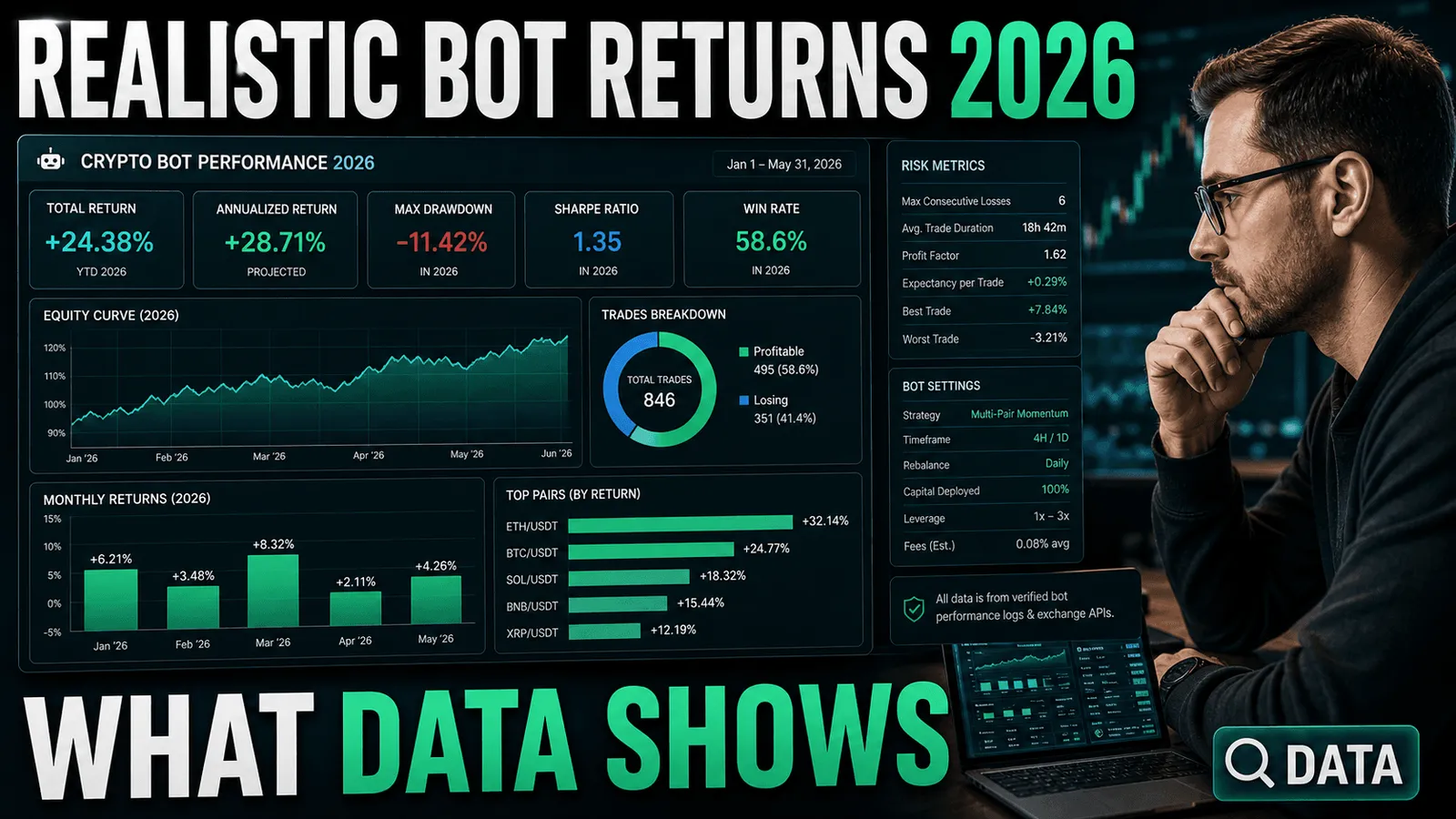
Realistic Returns from Crypto Trading Bots in 2026: What the Data Actually Shows
By Felix Götz – Co-Founder and CTO of ArrowTrade AG, building unCoded since 2016 in crypto trading. ...

Systematic vs. Emotional Trading
By Tommy Tietze, CEO of ArrowTrade AG Most traders do not lose control in calm markets. They lose co...