Binance bStocks: What Tokenized Stocks Mean for Automated Trading Bots Like unCoded
 By Felix Götz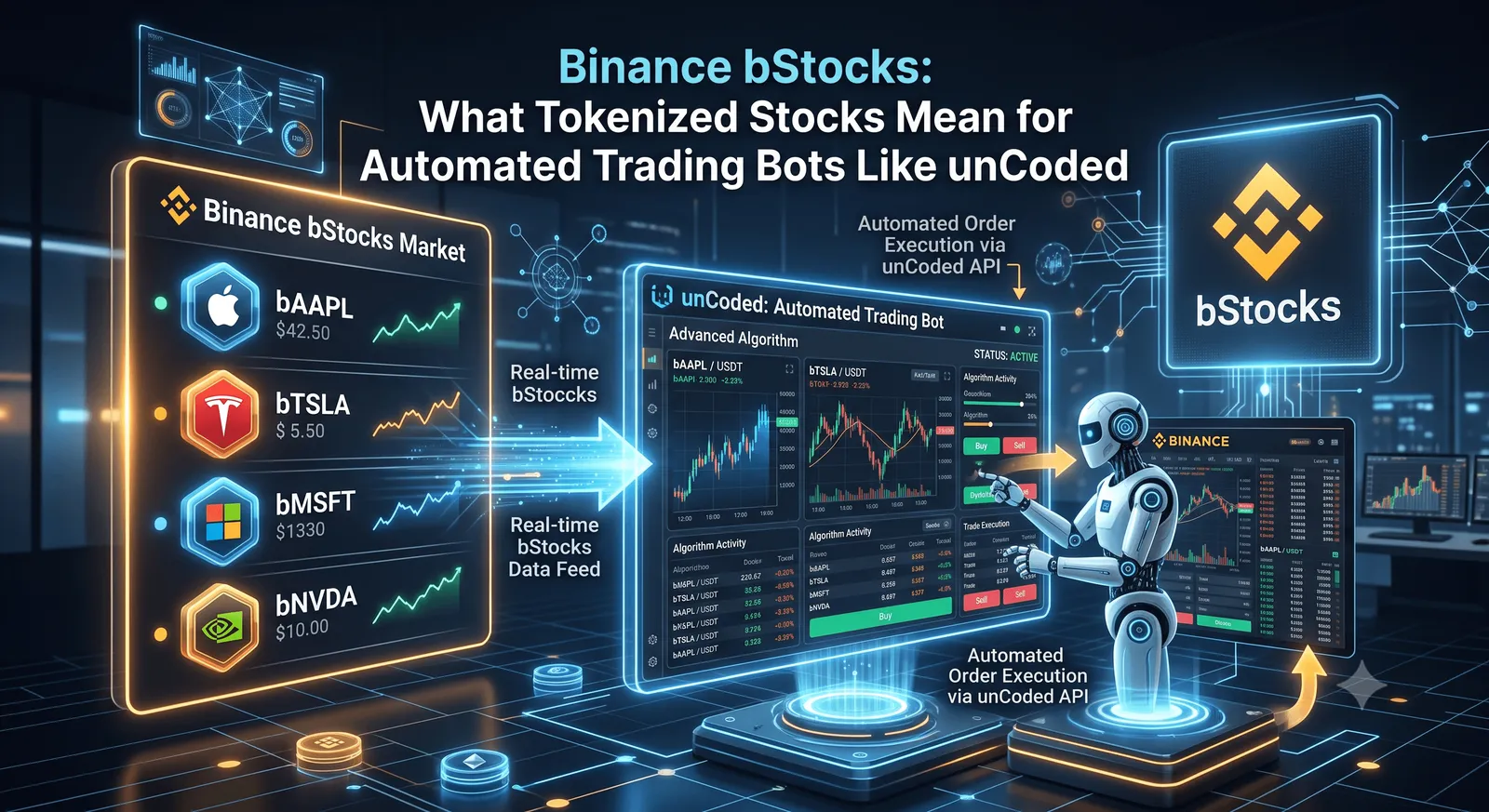
By Felix Götz, Co-Founder and CTO of ArrowTrade AG, in crypto trading since 2016 and the developer behind unCoded.
Disclosure: I'm Co-Founder and CTO of ArrowTrade AG, the company behind unCoded, the bot discussed throughout this article. I'm enthusiastic about this topic, so read the enthusiasm with that bias in mind. Just as relevant: this article touches real securities, not only crypto, and the tax and regulatory sections are complex and vary by country. Nothing here is financial, legal, or tax advice. Verify everything with qualified professionals before acting. Much of the technical detail below describes how these products are currently structured, and structures like these change. Sources for the central facts are listed at the end.
For as long as crypto trading bots have existed, they've been trapped in a single asset class. A bot connected to Binance could trade Bitcoin, Ethereum, Solana, and hundreds of altcoins, but the moment you wanted to apply the same logic to Apple, Tesla, or NVIDIA, you hit a wall. Stocks lived in a separate world with different APIs, different brokers, restricted trading hours, settlement delays, and a pile of regulatory friction that made automated stock trading a fundamentally different engineering problem.
That wall is starting to come down, and it's a bigger deal than most people in either camp have noticed.
Binance introduced bStocks, tokenized securities that trade directly on the Binance Spot market.[3] In plain terms: real US stocks, represented as tokens, tradable 24 hours a day, seven days a week, with instant settlement, on the same infrastructure a crypto bot already uses. For a self-hosted, non-custodial bot like unCoded, this quietly opens a door that was locked for the entire history of retail algorithmic trading.
I'll walk through what bStocks are, why the technical design matters for bots, which new strategies actually become possible, my opinion on why this is a significant future direction, and the risks that come with it. Including the risks that can hurt you if you ignore them. Some parts of this product sound smoother than they really are, and I'll take those smooth spots apart deliberately.
What bStocks are
The difference between a tokenized security and the synthetic garbage that blew up in earlier crypto cycles is large, so precision is worth it.
bStocks are not synthetic derivatives or CFDs. They're not the uncovered synthetic stocks that imploded with the Mirror Protocol on Terra. Each bStock is a fully 1:1 backed tokenized certificate.[1][2] For every token issued, a real share sits in a segregated account, and the backing is verified through a public proof of collateral.
The legal architecture sits inside the Abu Dhabi Global Market (ADGM) under its financial regulator, the FSRA, which approved the prospectuses. The issuer is BTech Holdings Limited, a special purpose vehicle that holds the underlying real US shares with a regulated custodian.[1][2] The tokens are legally certificates over shares that grant a claim on the economic value of the underlying, so you get the price exposure and dividend rights, but not the voting rights of a real shareholder. A separately licensed broker-dealer entity (Nest Trading Limited) handles conversion between real shares and tokens.
Technically, the tokens live on the BNB Smart Chain as standard BEP-20 tokens. That's the part that matters for automation, and I'll come back to it. Tickers follow a pattern, so NVIDIA becomes NVDAB and Tesla becomes TSLAB, both listed in the FSRA register, and they trade against USDT and USDC like any crypto pair.[1]
One structural point worth stating plainly: US persons are excluded, and access depends heavily on your jurisdiction.[3] More on that in the regulatory section, because it isn't optional reading.
And a note before the enthusiasm starts: a proof of collateral is useful, but it doesn't replace the hard questions. Who holds the assets? How often is it audited, and by whom? How is redemption legally enforceable when you need it? And above all: what happens on issuer insolvency, a trading suspension, or a sanctions event? A daily proof of collateral answers "does the share exist" reasonably well. It says nothing about "can I reach its value in a crisis." Per Binance, bStocks are also covered by neither SIPC nor FDIC, unlike a US brokerage account or a bank deposit.[3] In a worst case you have only the rights written into the bStocks terms. Keep that gap in mind while the rest of the article describes the technical upside.
The technical leap: why this matters for bots
Three things about bStocks fundamentally change what a trading bot can do. None of them is marketing. They're structural differences. But each has a downside that I'll place right next to it, because the pure upside version misleads.
24/7 trading. Traditional stock markets close. Nights, weekends, holidays. A stock algorithm has to be built around opening bells, closing bells, pre-market, post-market, and the dead zone in between. bStocks trade on the crypto market, which never closes. Your bot can trade a Tesla position at 3 a.m. on a Sunday, and that changes the whole rhythm of what's possible.
The downside: 24/7 trading doesn't remove gap risk, it relocates it. Instead of the classic weekend gap, you get a continuously traded product whose weekend price is formed by thinner, standalone crypto liquidity rather than the deep traditional market. The risk moves from the opening gap toward wrapper, liquidity, and issuer risk. More on that below.
T+0 settlement. In traditional stock markets, settlement takes a day or two. Capital from a sale isn't immediately available to redeploy unless you're running a complex margin account. On-chain settlement is instant and final. A bot can buy and sell the same tokenized stock hundreds of times in a single day and reuse the same capital in milliseconds. For any high-frequency or grid strategy, that raises capital efficiency substantially.
The important clarification, because "T+0" misleads without context: the instant settlement applies at the token and venue level. The real share behind the token still lives in a slower, regulated backing structure. On the blockchain your trade is final in milliseconds. The physical share behind it still moves at the pace of traditional finance with its custodians and clearing processes. For your trading on the venue it feels like T+0. For the question of what the token is at its core, the slow layer never disappeared, it's just hidden.
The same API. This is the point that surprised me. Because bStocks are regular trading pairs on Binance Spot, they're treated identically to crypto pairs by the infrastructure. For unCoded, that means not a single line of the existing code has to change to trade them. The bot pulls pair metadata from the standard endpoint, filters for actively trading pairs, and executes through the same REST and WebSocket connections it already uses for Bitcoin. A user picks NVDAB/USDT in the interface, picks a DCA or grid strategy, and the bot runs it.
And this sentence is the kind of smooth statement to be wary of: same API does not mean same risk. The integration is trivially easy. Market structure, compliance, tax logic, and failover are not. Just because your bot can address a bStock pair technically the same way it addresses Bitcoin doesn't mean the asset behind it behaves the same way, follows the same legal rules, has the same liquidity, or reacts the same way in a crisis. The technical ease of connection is real. It must not be confused with the ease of the whole product. Those are two different things, and confusing them is the most expensive mistake you can make here.
Despite that caveat, the core stays remarkable: the connection quietly turns a "crypto bot" into an asset-agnostic trading engine without the traditional stock-market overhead. No FIX protocol, no separate broker API. In the US, day-trading stocks under the Pattern Day Trader rule requires a 25,000 dollar minimum account. That restriction doesn't exist here.
This point is also almost too promotional if left uncommented: the absence of a US rule doesn't make the product regulatorily simple. The missing PDT rule is attractive. But it's the absence of one foreign rule, not a free pass. Other regulatory questions take its place, depending on your own jurisdiction, and they're often more complex than the rule that falls away here. The fractional minimums are tiny, from around 5 dollars, which enables micro-strategies that were impossible on traditional stock infrastructure.[3] A real advantage. It changes nothing about the overall regulatory picture.
The corporate actions problem, and how the token design solves it
Here's a piece of engineering that's cleverly solved, and that also creates a specific trap for bot operators. So pay attention in this section if you plan to trade bStocks with automation.
Real stocks have corporate actions. Splits, dividends, spin-offs. In traditional finance these require manual bookkeeping and days of delayed processing through central clearinghouses. Tokenized stocks need a way to handle this on-chain, and bStocks use a standard called BEP-677, which Binance describes as a "scaled UI amount" mechanism driven by a Multiplier.[3] Instead of minting and distributing new tokens or pushing cash to every wallet, the smart contract adjusts a single global multiplier.
When the underlying company pays a dividend, the net dividend value is reinvested into more real shares, and the contract raises the multiplier. At that step, a flat 30 percent US withholding tax is applied to dividends for non-US persons before reinvestment. Per Binance, this rate is uniform regardless of your country of residence.[3] Your overall tax burden in your home country is a separate matter and belongs with a tax advisor. If you held 10,000 raw tokens, your effective balance shown through the API might then read about 10,523, because a multiplier of roughly 1.0523 is applied. On a 2:1 stock split, the multiplier doubles from 1.0 to 2.0, your effective balance doubles, and the displayed price per token halves. All of it happens autonomously at the protocol level, so your portfolio tracks the real company value in real time without you doing anything.
For a bot's basic accounting, this is fine, because the exchange API returns the already-scaled effective balance, so profit and loss calculations stay consistent.
But here's the trap, and it's real. If you program a bot to liquidate a position once it reaches a fixed nominal token count, a stock split can trigger that condition artificially and prematurely. Imagine you told the bot to sell when you hold a specific number of NVDAB tokens, and then a 10:1 split multiplies your token count overnight. The bot sees the threshold crossed and dumps the position for the wrong reason.
The fix is simple but not obvious: when trading tokenized stocks, your risk parameters and exit signals should use relative price changes and percentage-based PnL, never fixed absolute token quantities. That separates someone who understands the mechanics from someone who copies a crypto config onto a stock and gets surprised. unCoded already works on percentage-based logic from the current price, which happens to be the right design for this, but it's worth configuring deliberately.
The new strategies
A few strategies that were technically impossible in traditional finance become straightforward. I'll describe the upside, with the necessary caveat right alongside each one.
Continuous, gap-free dollar-cost averaging. A DCA strategy on traditional stocks bunches up around market hours. You buy Friday evening, then nothing happens all weekend, then you run into Monday's opening gap. With bStocks, you can tell the bot to buy a small fixed amount, say 5 dollars, every single hour, around the clock, regardless of weekends or holidays. The result is a far smoother average entry price than manual or market-hours-only buying can achieve.
The caveat: that smoother average is formed against a price set on the weekend by the thinner crypto venue, not the traditional market. You average more cleanly, but you average against a price representation that can decouple from the real market when it's closed. Usually that's harmless. In stressed moments it's the divergence you have to understand.
Micro and grid trading with instant capital recycling. Because settlement is instant, a grid bot on a tokenized stock can recycle the same capital continuously instead of waiting a day or two for funds to clear. On traditional stock infrastructure, T+1 settlement caps how fast you can turn capital over. That cap is gone. For volatility-harvesting strategies, that raises capital velocity substantially.
The caveat: capital velocity is instant at the token level, but your real counterparty and the available liquidity on the venue are not necessarily. A grid bot can only trade as fast as there are real buyers and sellers on the other side. On a thinly traded bStock, the theoretical T+0 speed can fail against practical liquidity.
Weekend price discovery and gap avoidance. This is subtle and valuable, and also the point where I was too smooth in the earlier version, so I'll be more precise here. Traditional stock markets are closed on weekends, which creates gap risk. If a major event hits on a Saturday, traditional shareholders are frozen, their stop-loss orders sit uselessly until Monday's open, where the stock can gap down 15 percent and blow straight through those stops. With bStocks trading 24/7, news flows into the price continuously. There's no weekend gap of the same magnitude, because the market is always open to absorb it.
But: 24/7 trading doesn't remove gap risk, it transforms it. The classic opening gap shrinks. In its place comes a new risk, and that leads to the most important point in this article.
The biggest blind spot: price representation is not the same as real market access
This is the central point in this article, and it deserves its own section, because it pulls together and qualifies every smooth statement above.
When the underlying US name is closed but the token trades 24/7, a separate market forms with its own liquidity. That can be useful, or dangerous. The decisive sentence: a bot then isn't trading "the stock." It's trading the stock plus wrapper plus venue plus issuer plus available counterparty.
Let that sit for a moment, because it changes how you should read everything else here. When you select NVDAB in unCoded, you might think you're trading NVIDIA. Technically you're trading a certificate, issued by a specific special purpose vehicle, traded on a specific venue, backed by a specific custodian, against the counterparties available on that venue in that moment. The NVIDIA price is only one of the ingredients. The other ingredients (wrapper, venue, issuer, counterparty liquidity) are invisible until the moment one of them fails, and then they're suddenly the only thing that matters.
On the weekend, when the NASDAQ is closed, the bStock price is formed purely by supply and demand on Binance and can decouple from the stock's last close. That's stated in Binance's own product FAQ.[3] It functions in effect as a kind of prediction market for Monday's open, which can be useful. But it also means the token price can drift from the real share value precisely when the real market isn't there to anchor it. In those hours your bot trades a price representation, not anchored market access. As long as there's enough liquidity and a functioning issuer, that's an opportunity. If one of those supports drops away, you're suddenly trading a construct whose link to the underlying is weakest exactly when you need it most.
This isn't an argument against bStocks. It's the argument for seeing them as what they are: a multi-layered product, not the stock itself. A bot that doesn't account for this in its risk management is trading a risk it can't even see.
My opinion: why I think this is a significant future direction
Now my actual view, labeled as opinion, because the enthusiasm comes with a disclosed bias.
I think tokenized stocks are one of the most important developments for automated trading in years, and here's my reasoning. Over long horizons, broad equity markets have tended to rise more consistently than crypto, with lower volatility and without the brutal 80-plus-percent drawdowns crypto delivers routinely. An 80 percent crash on a broad index like the S&P 500 is, in the modern era, an unrealistic event. The index has had severe bear markets, roughly 50 percent peak to trough in 2008 and in the dotcom bust, but a sustained 80 percent wipeout of the whole index is a once-in-a-century event, not a normal cycle. Crypto, by contrast, hands you 80 percent drawdowns as a regular feature of the landscape.
That difference in downside behavior is what makes an equity position interesting for automated trading. When the asset you're trading has a shallower and more recoverable downside, the scenario of being permanently stuck on losses is less likely, and the whole risk profile of a DCA or grid approach shifts in your favor.
But the entire reason anyone reads my writing is that I don't sell the clean version. So here are the three caveats that keep this from becoming the message "stocks are safe, trade aggressively," which it is not.
First, the index is not the individual stock. The S&P 500 rarely falls 80 percent. Individual high-flyer stocks absolutely do. Tesla dropped roughly 70 percent peak to trough in the 2021 to 2023 window. Plenty of individual tech names have done worse. And the individual names (NVDAB, TSLAB) are the ones people are most tempted to trade aggressively. So the "shallower drawdown" argument applies to broad, diversified positions and gets much weaker the more concentrated and speculative your pick. Aggression on a single volatile stock is not meaningfully safer than aggression on a single volatile coin.
Second, lower volatility cuts both ways. Bots that harvest volatility make money from movement. What makes an index safer, its lower volatility, also means fewer and smaller grid profits. A calm asset generates less bot income. So there's a real tension: the safer the asset, the less lucrative it tends to be for a volatility-harvesting strategy. You don't get the shallow downside and the fat trading profits at the same time. That's not a flaw in the tools, it's how the tradeoff works.
Third, the safety is in the price behavior, not the structure. As the SpaceX story below shows, tokenized stocks carry counterparty and liquidity risks that native crypto doesn't. The underlying may behave more gently than Bitcoin, but the wrapper around it brings its own failure modes.
So my position is: tokenized stocks are an exciting expansion of what bots can trade, and the more favorable long-term behavior of broad equities is a real advantage for certain strategies. But "stocks fall less, so trade aggressively and safely" is a half-truth that becomes dangerous the moment you apply it to a single speculative name or forget the wrapper risk. The opportunity is real. The word "safe" needs an asterisk every time.
The risks: the SpaceX cautionary tale
If you want to understand the actual limits of this technology, you don't look at the marketing. You look at what broke. And in early 2026, something broke instructively.
According to contemporary market reporting, several major crypto exchanges, together with a tokenization issuer, tried to offer tokenized pre-IPO shares of SpaceX. Because SpaceX wasn't publicly listed, this was a pre-IPO allocation. Demand was enormous. On one platform alone, a reported 557 million dollars in stablecoins was locked by nearly 27,700 addresses, and across platforms the aggregated orders reportedly exceeded a billion dollars. These figures come from the reporting of those weeks and should be read as orders of magnitude, not as audited balances.
Then it collapsed, days before listing, for a reason that exposes the deepest structural limit of this entire category. The issuers couldn't source enough underlying SpaceX shares to come anywhere near the volume crypto demand had aggregated, given how limited the private, pre-IPO share availability already was. The tokenized demand vastly exceeded the available real-world supply.
That's the fundamental bottleneck of real-world-asset tokenization, and every bot operator should internalize it: as long as strict 1:1 backing with real assets is required, the liquidity and scalability of the token can never exceed the physical liquidity and availability of the underlying. The blockchain settles instantly, but the real shares behind it are still constrained by the slow, gated, sometimes illiquid world of traditional finance.
The aftermath is instructive too. Some platforms simply cancelled and refunded. One took a more aggressive route, cancelled the undercovered campaign, refunded the locked stablecoins, and created a new, properly backed token product for SpaceX (SPCXB), which is listed in the FSRA register as its own approved prospectus.[1] Out of that came a fresh, 24/7 traded spot market for a highly sought asset, which is an opportunity. But it emerged directly out of a failure.
A prominent exchange CEO summed up the underlying warning: tokenized stocks still depend on centralized issuers, custodians, and opaque allocation pipelines from the old financial world. The decentralization exists in the settlement layer, on the blockchain, but not in the backing layer. A bot developer has to build counterparty risk and the possibility of sudden illiquidity directly into risk management. This is not a place to trade blindly.
The alternatives worth knowing
bStocks isn't the only game. A diversified ecosystem of tokenized securities is emerging, each with a different regulatory and technical approach, and that matters if you ever want to build cross-platform strategies.
One issuer operates under a Liechtenstein prospectus across Solana, Ethereum, and Base, distributed through certain exchanges. A German project regulated by BaFin takes a completely different technical route, using an automated market maker based on a Balancer fork, so instead of order-book trading, you swap tokenized shares against USDC in decentralized liquidity pools. That's a fundamentally different thing to automate, because your bot would interact with smart-contract price curves rather than an order book. For US actors specifically, an SEC-registered option exists for accredited investors, currently described as the only clearly legal route in that jurisdiction. And a FINRA-registered broker launched an instant tokenization network for institutional participants, allowing authorized parties to convert real shares to tokens and back through API calls, which could eventually enable real millisecond arbitrage between on-chain markets and traditional exchanges.[4]
The takeaway isn't which specific names are relevant today, because those will shift. It's that this is a fragmented, fast-moving landscape, and the right platform depends entirely on your jurisdiction, your technical setup, and whether you're order-book or AMM oriented.
Regulation and taxes: read this before you get excited
This is the part that's least fun and matters most, and I'll keep it appropriately cautious, because it's complex and I'm neither your lawyer nor your tax advisor.
On the regulatory side, the key fact is that Europe's MiCA regulation, on the prevailing reading, carves out financial instruments like tokenized stocks. They fall under the older, stricter securities regime instead. Germany's BaFin, by its prior administrative practice, treats tokenized stocks as regular securities, which means actively marketing them to German retail investors can trigger a requirement for an approved securities prospectus. A prospectus approved elsewhere doesn't automatically carry into the EU. The practical result is geoblocking and legal gray zones, with various platforms excluding users from specific jurisdictions entirely. Binance's terms state clearly that bStocks aren't offered in restricted jurisdictions and that violations can lead to account suspension and cancelled trades.[3] So before you point a bot at bStocks, you have to confirm your account is authorized to trade them where you are. This isn't a formality you can wave away. The exact regulatory classification depends on the individual case and keeps evolving, so expert advice is warranted here.
On the tax side, the German example is stark, and I describe it deliberately as a general pattern, not binding guidance. Native crypto gains typically fall under a part of the tax code where a one-year holding period can make them tax-free. Tokenized stock gains fall, on the likely classification, under a different part, taxed at a flat rate regardless of how long you held, with no tax-free holding period. And importantly, losses from tokenized stock trading may, depending on classification, not be offsettable against native crypto gains, because they can sit in different tax categories. That means a bot trading both has to cleanly separate the two in its tax export, or you risk problems at filing time. unCoded's tax export is built to produce clean, categorized data, because bot trading generates hundreds or thousands of taxable events that can't be reconstructed by hand. But which category applies to what, and what you owe, is a question for a tax professional in your country, not for me and not for a blog.
I can't stress this enough: the tax treatment can quietly turn a profitable strategy into a losing one, and it varies enormously by jurisdiction. Get proper advice before you scale.
What this means for unCoded specifically
Pulling it together for the platform I build. unCoded is a self-hosted, non-custodial bot for Binance Spot, operated by ArrowTrade AG in Switzerland, with profit-sharing pricing instead of a subscription. Because bStocks trade as normal Binance Spot pairs, unCoded can trade them with no code changes, using the same tick-based execution, the same 150-plus indicators, the same Buy Splits and Sell Time Curves and per-split trailing stops, and the same conservative defaults that keep it from buying endlessly into a falling market.
The percentage-based, current-price logic that unCoded already uses is the right design for the corporate-actions trap I described, because it never keys exit signals to fixed token counts. The self-hosted, non-custodial architecture means your API keys stay on your own server, whether you trade Bitcoin or a tokenized stock. And the clean tax export matters more here than ever, given the separate tax categories.
None of that changes the disqualifiers. This is still not for leverage traders, not for complete beginners, not for set-and-forget users, and it still requires you to run your own server and understand what you're doing. Adding tokenized stocks to the menu doesn't make bot trading easier or safer. It makes the menu bigger.
Summary
Binance bStocks represent a structural shift, not a marketing footnote. By wrapping real US shares in blockchain tokens that trade 24/7 with instant settlement on the same infrastructure crypto bots already use, they dissolve the wall that always separated automated crypto trading from automated stock trading. For a bot like unCoded, the multi-trillion-dollar equity market becomes reachable through the same technical language as Bitcoin, with no PDT rule, tiny fractional minimums, and no traditional weekend gap risk.
But the ease of connection is not the ease of the product. Same API does not mean same risk. T+0 applies at the token level, not in the slow backing structure behind it. 24/7 trading doesn't remove gap risk, it relocates it into wrapper, liquidity, and issuer risk. And the central point: price representation is not the same as real market access. Your bot doesn't trade the stock, it trades the stock plus wrapper plus venue plus issuer plus available counterparty.
My opinion is that this is one of the most promising directions in years, largely because broad equities behave more gently on the downside than crypto, and an 80 percent index crash is a tail event rather than a normal cycle. But that advantage lives in broad, diversified positions and in price behavior, not in single speculative names and not in the token wrapper. Single stocks still crash hard. Lower volatility still means thinner bot profits. And the SpaceX collapse showed that tokenized assets carry counterparty and liquidity risks native crypto doesn't, because the real shares behind the tokens are still trapped in the slow machinery of traditional finance. Add the fragmented regulation and the sharply different tax treatment, and you have an opportunity that is real, large, and no place to deploy capital blindly.
The future I see is bots becoming asset-agnostic, trading the whole global market through one blockchain-based technical layer. That future is exciting. It's also one where the word "safe" always needs an asterisk, where you confirm your jurisdiction before you trade, and where you talk to a tax advisor before you scale.
The technology just made the entire stock market tradable by your bot. Whether that's an opportunity or a trap depends, as always, on whether you did the work to understand it. The engine got more powerful. The responsibility got bigger too.
Sources
Primary and official references:
[1] ADGM Financial Services Regulatory Authority (FSRA), Approved Prospectuses (public register): BTech Holdings Limited as issuer, bStocks as "Certificates over Shares", including NVIDIA (NVDAB), Tesla (TSLAB), and SpaceX (SPCXB). https://www.adgm.com/financial-services-regulatory-authority/listing-authority/approved-prospectuses
[2] Gibson Dunn, "Gibson Dunn Advises on Landmark Admission of Binance Tokenized Securities to ADGM Official List" (independent legal confirmation of the admission, naming BTech Holdings, FSRA, Nest Exchange, Certificates over Shares). https://www.gibsondunn.com/gibson-dunn-advises-on-landmark-admission-of-binance-tokenized-securities-to-adgm-official-list/
[3] Binance Support, "Frequently Asked Questions on bStocks" (official product FAQ: Multiplier mechanic, 30% US withholding, price formation while the US market is closed, no SIPC/FDIC protection, jurisdiction restrictions). https://www.binance.com/en/support/faq/detail/f0c03cd6509a4085b4cce1636f16be38
[4] Alpaca, "US Stock Market Ready for Instant Tokenization with Alpaca's Newly Launched Network" (for the ITN infrastructure in the alternatives section). https://alpaca.markets/blog/us-stock-market-ready-for-instant-tokenization-with-alpacas-newly-launched-network/
Further reading: Binance Academy, "What Are bStocks?" (product overview), and Chainlink, "What Are Tokenized Stocks?" (general background).
Felix Götz is Co-Founder and CTO of ArrowTrade AG, the company behind unCoded. A self-hosted, non-custodial crypto trading bot with profit-sharing pricing, operating from Switzerland under the Swiss DLT legal framework. The "unCoded" trademark is registered through EUIPO. Documentation at uncoded.ch/docs. Public backtest data at uncoded.ch/backtesting. This article reflects personal opinion and is not financial, legal, or tax advice. Tokenized securities carry regulatory, tax, counterparty, and liquidity risks that vary by jurisdiction. Verify your eligibility and obligations with qualified professionals before trading.
Recommended Reading

Exchange Insolvency: Infrastructure for the Unthinkable
By Tommy Tietze, CEO of ArrowTrade AG "Not your keys, not your coins." It is the oldest and most rep...

Alpha Decay: The Half-Life of a Trading Strategy
By Tommy Tietze, CEO of ArrowTrade AG There is a dangerous myth in retail quantitative finance: the ...
The Best Swiss Crypto Trading Bot? An Honest Guide to unCoded
By Felix Götz, Co-Founder and CTO of ArrowTrade AG, building unCoded since 2016 in crypto trading. D...
Why a 90% Win Rate Crypto Trading Bot Can Still Lose You Money (And What to Ask Instead)
By Felix Götz, Co-Founder and CTO of ArrowTrade AG, building unCoded since 2016 in crypto trading. D...
Binance Grid Bots vs unCoded: Smarter Trading, or Just Extra Steps?
By Felix Götz, Co-Founder and CTO of ArrowTrade AG, building unCoded since 2016 in crypto trading. D...
Bitcoin 2030: An Honest Look at the $1 Million Hype, the Real Risks, and Why Hodl-and-Pray Isn't a Strategy
By Felix Götz, Co-Founder and CTO of ArrowTrade AG, building unCoded since 2016 in crypto trading. D...

Binance API Security: A Masterclass in Asset Protection
By Tommy Tietze, CEO of ArrowTrade AG The architecture of modern cryptocurrency trading relies entir...

Automating TradingView Alerts: Secure Webhook Guide
By Tommy Tietze, CEO of ArrowTrade AG TradingView is the gold standard for market analysis. Millions...