Binance Grid Bots vs unCoded: Smarter Trading, or Just Extra Steps?
 By Felix Götz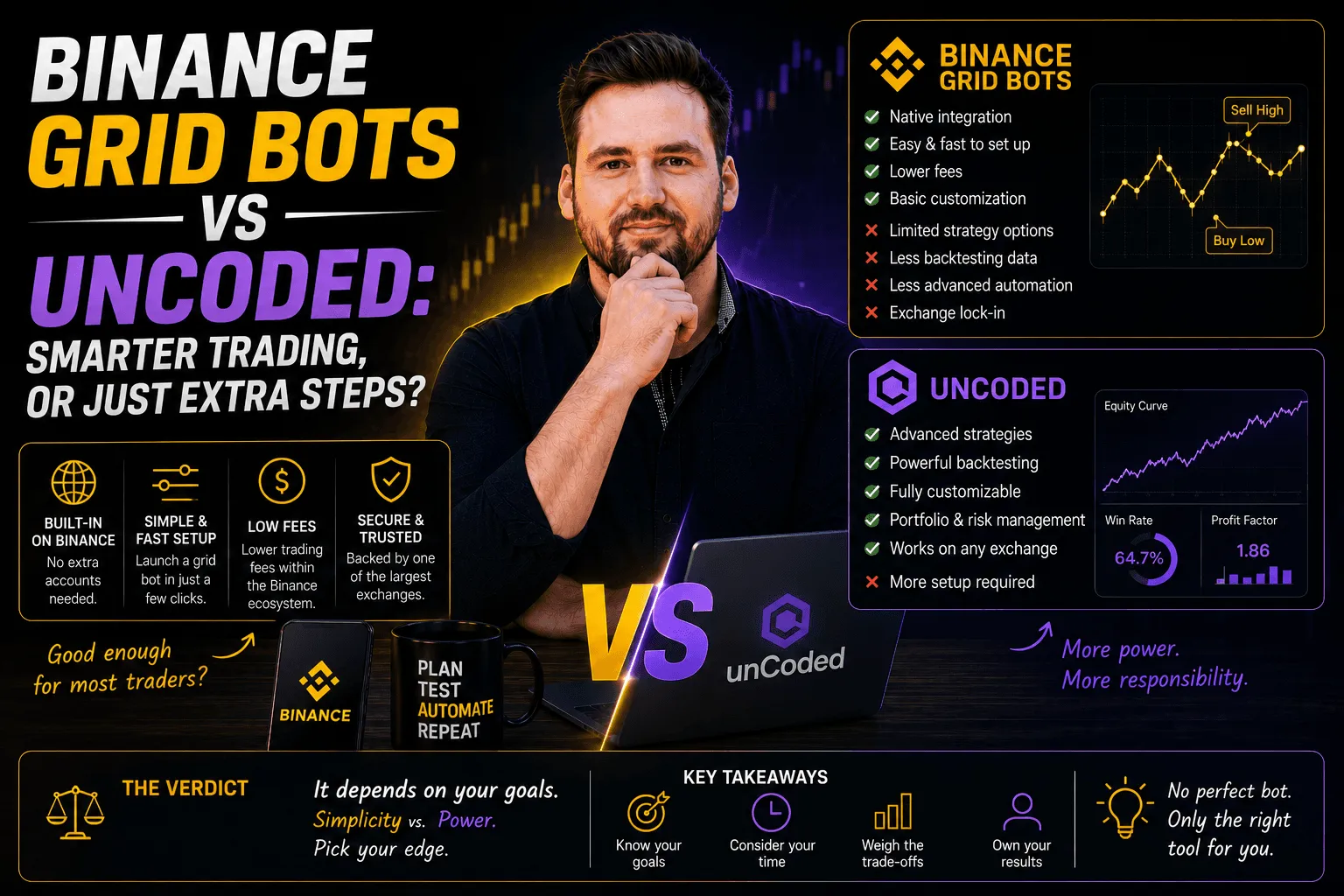
By Felix Götz, Co-Founder and CTO of ArrowTrade AG, building unCoded since 2016 in crypto trading.
Disclosure: I'm Co-Founder and CTO of ArrowTrade AG, the company behind unCoded, one of the two options compared in this article. I tried to keep this as neutral as possible, because the honest answer here is not "always use unCoded." For a lot of people, Binance's built-in bots are the better starting point. This is not financial advice.
Binance has its own trading bots. They're built directly into the exchange. No API fiddling, no external tool, no server to rent. You log in, set a few numbers, click create, and the bot runs.
So let's be honest with each other. Why the hell would you use an external crypto trading bot like unCoded at all? Is it actually smarter, or is it just trading with extra steps?
That's a fair question, and it deserves a fair answer. I'm going to walk through what Binance's native Spot Grid bot actually does, where unCoded differs, what each one costs, and who should pick which. If you came here expecting a hit piece on Binance so I can sell you my own product, you'll be disappointed. Binance's built-in bots are genuinely good at what they do. The honest answer depends entirely on what you need.
Here's the comparison.
What a Binance Spot Grid bot actually is
Let's start with the basics, because the concept is simpler than it sounds.
A grid bot is a bot that automatically trades inside a price range you define. You set an upper bound and a lower bound, say 68,000 and 72,000 on Bitcoin, and the bot does one thing: when the price drops inside that range, it buys. When the price rises, it sells. That's the entire idea. Buy low, sell high, repeated automatically inside a band you chose.
You configure three core things:
The price range. The lower and upper bound where the bot is allowed to trade. Below your lower bound or above your upper bound, the bot stops doing its job.
The number of grids. This is how many buy and sell levels exist inside your range. Set 4 grids and you get a handful of buy zones. Set 8 and you get more zones packed into the same range. More grids means you buy more often, but it also means you sell again sooner, so the profit per individual trade gets smaller. It's a tradeoff between frequency and size per trade.
The investment amount. How much you put in, for example 50 dollars per trade level inside the range.
Once those three are set, you accept the terms, click create, and the bot starts. That's genuinely all it takes.
Binance also gives you Advanced Options if you want them. A trailing stop loss, which I'd only recommend if you actually understand it. A hard stop loss, where you might say "sell everything if the price hits 67,000," which protects you from deeper losses but also locks in a real loss when it triggers. A take profit, the opposite, where you exit all gains at a set level. And a grid trigger.
There's one more setting worth understanding: arithmetic versus geometric grids. Arithmetic means the spacing between your buy and sell levels stays equal the whole way through. Geometric means the spacing is based on percentages, so the gaps can get wider or narrower depending on how the price develops. Neither is universally better. They just behave differently.
That's a Binance Spot Grid bot. If you've watched any unCoded content, you already know the core goal is the same: buy as low as possible, sell higher. The differences are in how far you can take it.
What Binance native grid bots do well
I want to be clear about this, because it's the honest part most competitor comparisons skip.
For beginners, for people who don't want to mess with infrastructure, for anyone who just wants to get started, Binance's native bots are the more convenient solution by a wide margin.
You don't build an API key. You don't set up a server. You don't run an external dashboard. Everything happens inside Binance itself. Yes, Binance as a platform can feel complicated at first, but for many newcomers the built-in bots are still simpler to reach and more approachable than the alternative of provisioning a server and deploying something themselves.
And there's a cost angle here that I won't hide: the native bots don't charge a platform fee. You pay Binance's normal trading fees on your buys and sells, and that's essentially it. No subscription, no profit share, no server bill. For a small account that's getting started, that lower cost plus the zero setup friction is a genuinely strong combination.
If you are brand new to bot trading and you want to understand how grid logic feels with real money before committing to anything heavier, Binance's built-in Spot Grid bot is a perfectly reasonable place to begin. I'd rather tell you that honestly than pretend you need my product on day one.
Where unCoded differs
So if Binance's bots are free and convenient, what does unCoded actually add?
When you look at only the basics, the two are very similar. Set an investment, define how the bot buys and sells, let it run. But there are real differences in depth, and a few in mechanics.
unCoded always works from the current price. This is a genuine difference, and it cuts both ways. On Binance, you explicitly define a price range like 68,000 to 72,000. On unCoded, the bot always starts from wherever the price is right now. I can't tell it "start trading when Bitcoin reaches 75,000." It works relative to the current state, using percentage-based logic, rather than a fixed band I draw in advance. For some strategies that's a limitation. For others it's exactly what you want.
Buy Splits. Instead of just putting 50 dollars into a level, I can take that 50 dollars and split it further into percentage-based tranches that I define myself. This lets me build a position in stages with much more granularity than a simple grid level allows.
Sell Configuration. I can set the exact profit I want per trade, configured the way I want it, rather than relying purely on the grid spacing.
A free capital reserve. I can tell the bot to keep a defined percentage of capital uninvested, held back for new opportunities or to avoid being fully deployed into a falling market.
More individual risk management. Microtrading logic, stop loss functions, and exposure control that I can shape more precisely than the native grid options.
Transparent reports. unCoded's trading report can be switched to US dollars and gives you clean, readable output. Binance gives you reports too, but in my opinion they're a bit awkward because everything gets denominated in the base currency of the pair rather than a clean dollar figure.
A ready-to-trade API setup with no withdrawal rights. You create an API key, it goes straight to work, and the key has no permission to withdraw your funds.
The honest summary of this section is simple: unCoded gives you a larger selection of functions and settings, which means you can make the whole thing more precise. Binance can do percentage-based buy and sell logic too, by the way. It's just that overall you have fewer options to work with.
The mechanical difference that actually matters
If I had to compress the whole comparison into one sentence, it's this. A Binance grid bot is a bet on a range. unCoded is a percentage-based system that works from wherever the price is now.
On Binance, you draw a box (68,000 to 72,000) and the bot trades inside it. If the price leaves your box, the strategy stops working as intended. On unCoded, there is no fixed box. The buy and sell mechanics are percentage-driven from the current price, which means the system adapts to where the market actually is rather than where you guessed it would stay.
This is the core of why I built unCoded the way I did. Fixed ranges are easy to understand and perfectly fine for many situations. But markets don't stay in the box you drew, and percentage-based logic that travels with the price gives you a different kind of flexibility. Whether you need that flexibility depends entirely on how you trade.
The cost comparison, honestly
This is where I have to be fair rather than flattering.
Binance native grid bots charge you trading fees on your buys and your sells, depending on the pair you trade. There is no platform fee on top. No subscription, no profit share, no server. In pure cost terms, this is the cheaper option. Worth noting: Binance currently runs zero-fee promotions on certain pairs, like FDUSD pairs, which can drop your trading fees to zero entirely while the promo lasts. That benefit applies whether you use the native bot or unCoded, since both execute on Binance.
unCoded uses a license model, but not a subscription. I'm not charging you 20, 30, 40, or 50 a month regardless of results. Instead, you share a portion of your actual profit with the developers. It starts at 30% and drops to 20% over time. Everyone begins with 25 dollars of free license credit, so you can see how it runs before paying anything, and in the early phase you pay nothing except your server cost. As a developer, I find that fairer, because it lets anyone get in the door, and we only earn when you actually make money.
But let me state the obvious comparison plainly. In pure fee terms, Binance's native bot is cheaper, because it doesn't add a profit share or a server bill on top of trading fees. unCoded costs more when you're profitable. The question is whether the added depth, control, risk management, and transparency justify that cost for your specific situation. For some traders it clearly does. For others, especially small accounts running simple strategies, it clearly doesn't. That's not a weakness in either product. It's just the honest tradeoff.
The risk reality for both
I try to be as honest as possible about this, because almost nobody else is.
Both Binance native grid bots and unCoded are Spot trading bots. That's an important safety property. You cannot be liquidated the way you can with futures or perpetual trading. There is no margin call that wipes your account in a sharp move.
But Spot does not mean safe. If a coin falls hard, you sit on unrealized losses for as long as that token fails to recover. The bot bought at higher prices, the market dropped, and those positions are underwater until and unless the price comes back. Neither platform changes that reality, because it's a property of Spot trading itself, not of the bot.
This is something we say openly at unCoded, and it's worth repeating here. You will never hear from us that profits are guaranteed. Any bot, native or external, that implies guaranteed returns is lying to you. Both of these tools can lose money. The honest framing is that they automate a strategy, and the strategy can be right or wrong depending on the market.
The decision framework
Here's the clean version of who should pick what.
Choose Binance native grid bots if:
- You're a beginner or relatively new to bot trading
- You want zero setup, no API configuration, and no server to manage
- You prefer everything running inside the exchange with nothing external
- You want the lowest cost option, since there's no platform fee on top of trading fees
- You want a simple grid strategy and don't need deep customization
- You want to understand how grid logic feels with real money before committing to anything heavier
Choose unCoded if:
- You want more strategy depth, more control, and more transparency than native bots offer
- You value percentage-based logic that works from the current price rather than a fixed range
- You want Buy Splits, configurable sell logic, capital reserves, and microtrading with stop losses
- You want cleaner, dollar-denominated reporting
- You want pricing that costs nothing in losing months, since the profit share only applies when you actually profit
- You're willing to do the one-time setup work and genuinely understand the risk behind your configuration
The honest dividing line: Binance native bots are better for a faster, easier entry. unCoded is more interesting for people who want more strategy, more control, and more transparency, but who are also willing to put in the work to understand the setup and the risk behind it. That work is mostly a one-time cost. You get deeper into it over time. But you have to be ready for it going in.
The honest summary
Binance gives you trading bots built right into the exchange, free of any platform fee, with zero setup. That is a real advantage, and for a lot of people it's the right choice. A native Spot Grid bot lets you define a price range, set your grids, set your investment, and start in minutes. For beginners and for anyone who wants convenience over depth, that's hard to beat.
unCoded is built for the other kind of trader. The one who wants percentage-based logic that travels with the price instead of a fixed box, Buy Splits and configurable sell mechanics, real risk management, clean reporting, and pricing that only costs something when the bot actually makes money. The price for all that is a profit share, a server, and a one-time investment of effort to understand what you're running.
Neither is universally smarter. Binance native bots are not "worse." unCoded is not "trading with extra steps" for the people whose strategy actually benefits from the extra control. The right answer depends on whether you want the convenient default or the deeper toolkit, and on whether you're willing to do the work the deeper toolkit requires.
Be honest with yourself about which trader you are. If you want to start simple and free, start on Binance. If you outgrow it and want more, the deeper option is there when you're ready.
The grid is the same idea on both. What differs is how far you can take it, and how much you want to.
Felix Götz is Co-Founder and CTO of ArrowTrade AG, the company behind unCoded. A self-hosted, non-custodial crypto trading bot with profit-sharing pricing, operating from Switzerland under the Swiss DLT regulatory framework. Documentation at uncoded.ch/docs. Public backtest data at uncoded.ch/backtesting. This article reflects personal experience and is not financial advice.
Recommended Reading

Bitcoin 2030: An Honest Look at the $1 Million Hype, the Real Risks, and Why Hodl-and-Pray Isn't a Strategy
By Felix Götz, Co-Founder and CTO of ArrowTrade AG, building unCoded since 2016 in crypto trading. D...
Automating TradingView Alerts: Secure Webhook Guide
By Tommy Tietze, CEO of ArrowTrade AG TradingView is the gold standard for market analysis. Millions...

The Set and Forget Myth in Bot Trading
By Tommy Tietze, CEO of ArrowTrade AG The most profitable lie in the crypto industry is "passive inc...

What is the unCoded Crypto Trading Bot? A Complete Guide to the Self-Hosted Platform Built on Profit-Sharing Pricing
·Subheading By Felix Götz , Co-Founder and CTO of ArrowTrade AG, building unCoded since 2016 in cryp...
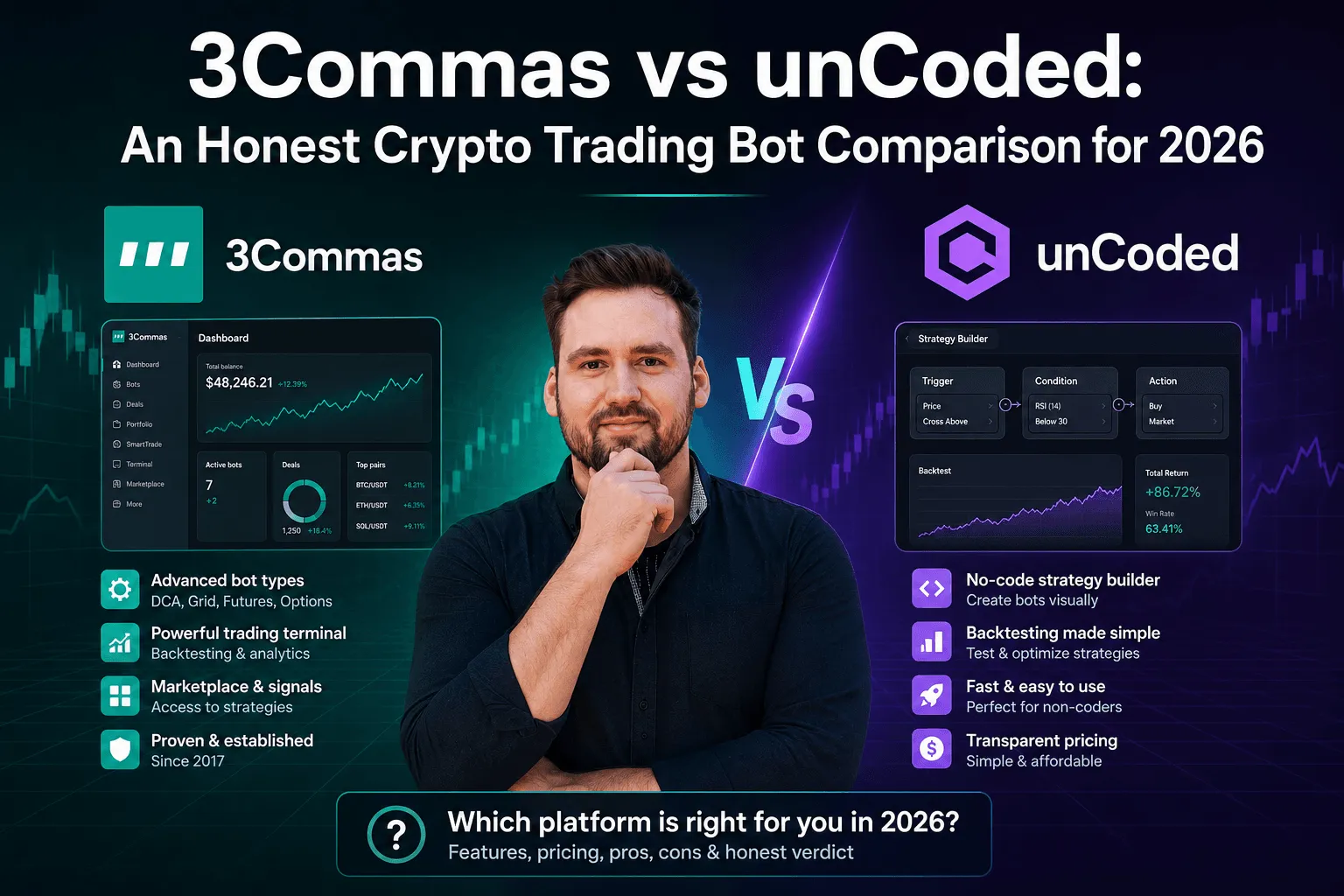
3Commas vs unCoded: An Honest Crypto Trading Bot Comparison for 2026
By Felix Götz – Co-Founder and CTO of ArrowTrade AG, building unCoded since 2016 in crypto trading. ...

What 4 Days of Real Crypto Trading Bot Results Actually Look Like: A Live Account Case Study
By Felix Götz, Co-Founder and CTO of ArrowTrade AG, building unCoded since 2016 in crypto trading. D...

The Win Rate Illusion in Crypto Bots
By Tommy Tietze, CEO of ArrowTrade AG If you look at the marketing pages of retail crypto bots, you ...

When Germany's Crypto Tax Holiday Ends: What the Proposed Repeal of the One-Year Holding Period Means for Trading Bots
By Felix Götz – Co-Founder and CTO of ArrowTrade AG, building unCoded since 2016 in crypto trading. ...