Bitcoin 2030: An Honest Look at the $1 Million Hype, the Real Risks, and Why Hodl-and-Pray Isn't a Strategy
 By Felix Götz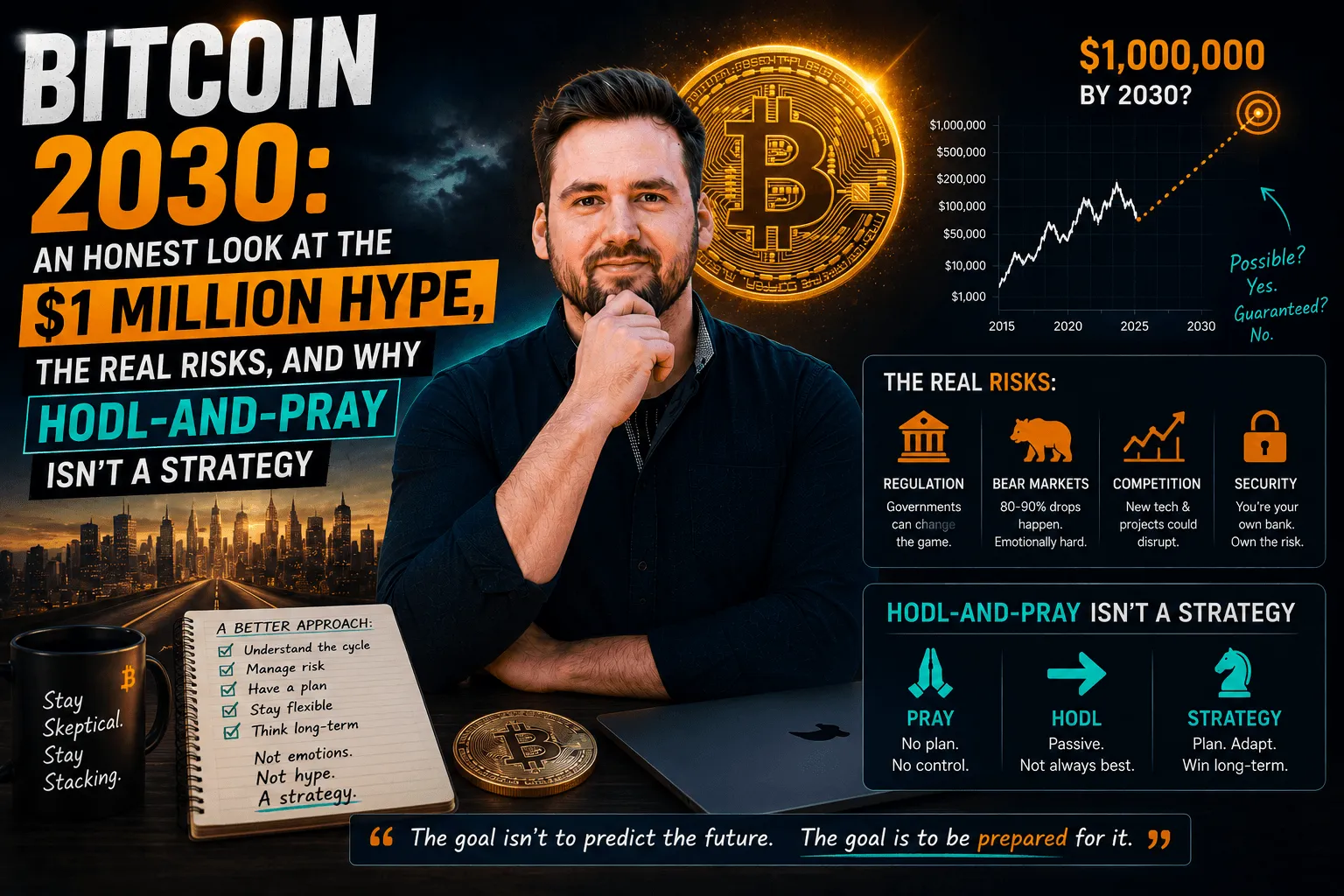
By Felix Götz, Co-Founder and CTO of ArrowTrade AG, building unCoded since 2016 in crypto trading.
Disclosure: I'm Co-Founder and CTO of ArrowTrade AG, the company behind unCoded. This article shares my personal analysis of Bitcoin's path toward 2030 and the structural risks I think matter. It contains my opinions, not predictions, and definitely not financial advice. Nobody can tell you where Bitcoin goes. Anyone who claims they can is selling you something.
Every news portal, every influencer, every YouTube thumbnail tells you the same thing. Bitcoin hits one million dollars by 2030. The cycle repeats, the halving does its magic, the institutions pile in, and you retire rich.
Or maybe we get a reality check and revisit thirty thousand dollars instead.
I've been in crypto since 2016, and I want to walk through the decisions and risks that actually shape Bitcoin's path toward 2030. Some of these get talked about constantly. Others get ignored because they don't fit the bullish narrative people want to hear. I'll cover both, and then I'll tell you what I actually think the price does, even though that number is a guess like everyone else's.
The honest version is less exciting than the million-dollar fantasy. It's also more useful for your money.
The halving everyone overweights
Let's start with the thing the entire bull case is built on: the Bitcoin halving.
In 2028, the next halving cuts the block reward in half. Every ten minutes, the network goes from issuing 3.125 Bitcoin down to 1.5625 Bitcoin. The standard narrative says less new supply means higher prices, and historically each halving has preceded a bull run.
There's truth in that. But there's a part people skip.
A lot of people say Bitcoin has no inflation. That's not quite right. New coins get created every block, and here's the thing nobody wants to think about: miners have to sell. If it costs me sixty thousand dollars in electricity, hardware, and wages to produce a Bitcoin, and I can sell it for seventy thousand, I made ten thousand. But to realize that, I have to throw the coin onto the market to cover my costs. That selling is real inflationary pressure on the price.
And the amounts aren't small. In the current epoch, roughly 164,000 new Bitcoin hit the market every year. At current prices, that's an enormous amount of fresh capital that buyers have to absorb just to keep the price flat. Think of it like a scale. Every new coin added to one side pushes the price down unless an equal amount of money gets added to the other side.
This is exactly why the halving matters. After 2028, annual new issuance drops to roughly 82,000 Bitcoin. That halving of the sell pressure from miners is a genuine relief for the buyers who have to soak up the supply.
But here's my contrarian take: the halving has been overweighted since 2016. Back then, after that halving, the network was issuing around 657,000 new Bitcoin per year onto a tiny bubble of a market. That was real, constant pressure on a much smaller ecosystem. The market has grown every year since, thankfully, but the obsessive focus on the halving as a guaranteed price trigger ignores how much else is going on.
In my view, the moment you can honestly say Bitcoin has no meaningful inflation is much later, around 2044 and beyond, when issuance falls to roughly 0.1 Bitcoin every ten minutes, somewhere near 5,100 coins per epoch. That's when you genuinely have many buyers chasing very little new supply. Right now we have a middling pool of uncertain buyers and a constant stream of new coins pushing, pushing, pushing on the price. When the pressure builds, buyers retreat.
You know the meme by now. Everyone wants to buy when Bitcoin is at two or three hundred thousand. Nobody wants the same coin when it's back at twenty thousand. That psychology creates real downward pressure that the clean halving charts never show you.
Miner capitulation and the hash rate wobble
The halving creates a second-order problem that gets even less attention: miner capitulation.
Picture the miner I described earlier. Before the halving, they spend sixty thousand to produce a coin worth seventy thousand. After the halving, the block reward is cut in half, so suddenly they need to spend something closer to double to produce that same coin at the same price. The economics flip from marginally profitable to underwater.
So what happens? A lot of miners shut their machines off. Some sell their hardware to hobby miners who turn it into solo-mining setups. Others try to hold their coins and hope to sell in two years at a higher price, which is brutally hard because you still have to pre-pay the electricity bill every month while you wait.
The result is that every halving comes with what I'd call a wobble. A short peak downward as weaker miners capitulate. Usually it stabilizes, and the reason it stabilizes is mostly the hash rate recovering as newer, more efficient miners come online.
But notice what's actually driving that recovery. It's not Bitcoin magic. It's general technological progress. The same reason your phone got better, the same reason we went from Windows XP to Windows 11, the same reason the top car went from something slow to a McLaren. Hardware improves across the entire IT world, and Bitcoin mining rides that wave like everything else. The hash rate recovers because chips get better, not because Bitcoin has some special property.
That matters for 2030, because the technological progress that saves the network in one way is also the thing that creates the next big risk.
The quantum question
Here's a risk that gets either ignored or wildly overdramatized: the post-quantum upgrade.
At some point, very probably between 2028 and 2040, the encryption that secures Bitcoin will become crackable by sufficiently advanced computers. This is a known issue. There are already proposals for quantum-resistant upgrades that essentially just need to be pushed through.
And that's where I see the actual problem. Not the quantum computers themselves. The community consensus required to upgrade.
Bitcoin has two camps. One camp believes Bitcoin is perfect exactly as it is. No updates, no changes, Bitcoin is only Bitcoin if it stays frozen forever. The other camp points out the obvious truth: Bitcoin is software, and software can be changed. In principle you could decide to have 50 million coins instead of 21 million, or one-minute blocks, or one-second blocks, or to adopt token standards from other chains. All of that is technically possible today. You just need 51% of the network to agree that the new version is the real Bitcoin.
Most people only know about the bad 51%, the attack vector. But there's also a good 51%, where the network coordinates to upgrade itself. The problem is that once you've proven an upgrade can pass, what stops a second, a third, a fourth? That tension, especially around the quantum upgrade, is going to produce a genuine conflict in the coming years.
Now, here's where I part ways with the doom crowd. I don't think the quantum threat to Bitcoin is the existential disaster it gets painted as. The world doesn't revolve around Bitcoin. If someone can break the encryption that secures Bitcoin, they can also break into essentially any bank account, any military communication system, and any frequency or standard that isn't quantum-safe. If Bitcoin gets destroyed by quantum computing, we have far bigger problems than our portfolios, because the entire digital infrastructure of civilization breaks at the same time.
This is the kind of capability that functions like the nuclear weapon of the 21st century, on steroids. I'm fairly certain China would love to use it against the US and the US against China. So when people ask me if I worry about quantum killing Bitcoin, my honest answer is that I worry far more about my bank account and the general future of humanity than I worry about my Bitcoin specifically.
DAC8 and the regulation double-edge
Now we get to the thing that actually keeps me up at night, and it has nothing to do with price charts.
DAC8 is coming into force in the EU. It means 100% tax transparency and effectively zero privacy on your crypto trades and transactions. Who you are, where your money goes, who sent it, who received it. Both the buyer and the seller have to be able to prove all of it, transparently, at any time. Where did it go, who was involved, and did everyone pay their taxes.
Spin that thread a little further and you arrive at something close to a Chinese-style social scoring system. A world where you're told you may not accept Bitcoin from a particular person, or you become liable yourself, or you face an extreme penalty. That kind of framework quietly removes the ability to fund political opposition, or to support a free press that uncovers things the people controlling the legal framework would prefer stayed hidden.
I see this as both the single biggest opportunity and the single biggest disgrace heading toward Bitcoin. States will either use this level of transparency to maximize tax revenue and control, or to build a genuinely free and democratic system. I'll be honest about which way I think we're drifting: toward technocracy, more control, and more surveillance. In that world, cash might quietly become the better choice again than crypto, with the exception of something like Monero or other currently-uncracked privacy technology where truly anonymous transactions still exist.
But the same regulation that scares me also opens real doors. If you run a crypto firm, do market making, want to start an exchange, or just want to accept Bitcoin in a supermarket, these rules and standards actually make your life easier. Accept Bitcoin, owe a defined tax, report it automatically through software that works identically on every terminal. Standardization brings a lot of momentum back into the system. It's a huge boost for something like Lightning, and for general adoption.
Imagine your parents or grandparents paying with Bitcoin in the future without ever actively managing it, because it's simply built into something like a Revolut cashback feature. That brings small, constant drops of demand into Bitcoin from people who don't even know they're buying it and aren't speculating at all. It has to become a completely normal payment system. You don't sit around thinking the Euro is 1.2% cheaper against the dollar today so you'll wait until tomorrow to spend it. You just use it. Bitcoin has to reach that same invisibility to truly scale.
The systemic risk nobody wants to discuss
Here's where I get genuinely cautious, and where I disagree with most of the bullish crowd.
That same ease of investing in Bitcoin can become a massive danger to the price. Specifically when companies like Strategy (formerly MicroStrategy) accumulate enormous amounts of Bitcoin, when companies like Tesla and SpaceX use it for short-term pumps on their own stock, and when a US President talks it up for short-term political gain.
And notice the timing. The President of the United States publicly championed Bitcoin, bought heavily through his media company, and passed a stack of extremely Bitcoin-friendly laws. And yet, at the time of my video, we had still fallen roughly 50% or more from the all-time high. We went above one hundred thousand, and then back down under seventy thousand.
So ask yourself the uncomfortable question. If the most powerful person on the planet championing Bitcoin couldn't sustain the price, what exactly is the next catalyst? Who is more important than the President of the United States to provide the next leg up? I think we may already be at the zenith of attention, the point where even your grandmother has heard of Bitcoin because Trump said something about it. My own parents, who looked at me like I was crazy when I started in 2016, now occasionally ask me whether they should buy some, usually right when it's dropped.
But the bigger structural danger is concentration. At the time of my video, Strategy held more than 3% of all the Bitcoin that will ever exist. When a single player, or a handful of players, accumulate more and more of one asset, you get the kind of bubble that has happened before with silver, with other commodities. Prices rise, the holders celebrate, and then the state shows up with hard regulation and says enough. The system either collapses on its own first, or it collapses because of the regulation the concentration provoked.
There's a more specific concern with Strategy too. The convertible bonds. A significant tranche comes due around 2028, exactly when Bitcoin is already under the stress of the halving and tightening regulation. If the company can't generate income another way, through price appreciation or another product, the worry is that funds get used to pay dividends, or dividends get suspended, or new money pays the dividends of earlier investors. That last scenario is what fuels the Ponzi and snowball-scheme suspicions that follow the company around.
Now imagine Strategy gets excluded from a major index. That forces selling to pay people out. The price drops, the market cap drops, which can trigger further index exclusions, and the snowball starts rolling. Investors withdraw, more payouts are forced, the regulation is still there, and you get something that rhymes with the FTX or Luna collapse. Something that could hit the whole market much faster than people expect.
I always prefer to plan for the worst case rather than the best. I assume Strategy cracks at some point, so I keep dry powder to buy the dip and I make sure I never get liquidated. If Strategy keeps running fine, great, I made money and the planning cost me nothing. If it goes down, I'm protected. The upside doesn't need defending. The downside does.
And the market is already leaning this way. There's growing comparison of Strategy's risk profile to junk-bond territory. A meaningful chunk of the market, independent of the Bitcoin bubble itself, increasingly thinks Strategy is a junk bond that eventually cracks, and they're shorting it accordingly. The lesson here is to be extremely careful about thinking you understand Bitcoin and are therefore smarter than the market. We aren't rational, and the market isn't rational either, but there are a very large number of participants forming a baseline you ignore at your peril.
So where does Bitcoin actually go?
Did we land at one million dollars? Of course we did. Where else would we go.
That's a joke. Nobody can tell you where Bitcoin goes, including me.
The realistic estimates I've actually read land somewhere between 120,000 and 250,000 dollars. And to be honest, even those feel too optimistic to me, because they tend to confirm exactly what the audience wants to hear. If you're reading this, you very probably already hold some Bitcoin, and you want to hear that it'll be worth more than it is now, that you made the right call. The people producing that content won't tell you the harder truth, which is "it's difficult, and maybe you should have bought an index fund or a chip stock instead."
My personal take, and it's only a take: I think we're more likely heading toward something around 200,000 dollars in the medium term, with one million becoming realistic more around 2040 than 2030. And I genuinely think we might revisit 40,000 or 50,000 again along the way.
The reason I'm cautious is everything above. The President already played his card. Strategy is a risk, and as long as that risk exists, the Bitcoin price gets discounted for it because big players hold back capital in case it cracks. The regulation is unclear, and it's genuinely uncertain whether it breaks positive or negative over the next few years. And the miner-and-quantum questions are still open. Can the Bitcoin community actually agree on the upgrades it needs? Those are the big questions that have to resolve before Bitcoin can credibly run to a million.
I do think we'll see one million dollars eventually, within my lifetime. I also think we'll see some painful numbers on the way there. Both can be true.
What this actually means for you
So should you go all-in, take on debt, and buy Bitcoin to maybe be rich someday? No. Absolutely not.
What actually matters for you as an investor is understanding why markets move. Why they go up and down, what the real news events are, and how to handle capital responsibly. If you buy Bitcoin at 40,000, it runs to a million, and you did nothing in between, you learned no financial skill at all. You got lucky once, and luck is not a strategy you can repeat.
You should understand the difference between stocks, bonds, options, and futures. What they are, how they work, and where you can put money so that you don't simply lose it again. Because here's the uncomfortable truth that lottery winners prove over and over: just having a million in your account doesn't make you happy, doesn't make you independent, and very often ends with you losing all of it. Money without the knowledge to manage it evaporates.
This is the part of the bull-market story nobody sells you, and it's the most important part.
Where bots fit, honestly
This is why I personally use trading bots, and it's the reason I built one.
In the kind of market I just described, a market that might chop between 40,000 and 200,000 with enormous volatility and constant uncertainty, sitting on a single directional bet and praying is not a strategy. A bot that buys when price dips and sells when price rises extracts value from exactly the oscillation that this environment produces. On Bitcoin, on Ethereum, on the assets with real liquidity, that approach works well during ranging and volatile conditions, which is precisely what the path to 2030 looks like to me.
I want to be honest about the limits, because that's the whole point of how I write. A bot is not a money printer. It underperforms a pure hold during a clean parabolic run, because it takes profits on the way up instead of riding to the peak. It can lose money in the wrong regime. It requires you to actually understand what it's doing. And self-hosted tools like unCoded are not for everyone. They're not for leverage traders, not for complete beginners, and not for people who want to deploy once and never look again. If that's you, the honest move is to start somewhere simpler.
But for someone who has done the work, a bot is one tool in a broader approach. You pair it with boring, durable things. Dividend stocks where you get paid to wait. A simple S&P 500 ETF, the most boring instrument there is, to build a financial cushion underneath everything else. The bot handles the volatility, the boring assets handle the stability, and your own education handles the decisions.
That combination is far more robust than any single bet on Bitcoin reaching a specific number by a specific year.
The honest summary
Bitcoin to one million by 2030 is a story that sells thumbnails. The reality is messier. The halving in 2028 genuinely reduces sell pressure, but it's been overweighted as a guaranteed trigger since 2016. Miner capitulation creates a wobble each cycle. The quantum question is real but probably overdramatized, while the community-consensus problem behind it is underrated. DAC8 brings surveillance risk and adoption opportunity at the same time. And the concentration risk around a single large corporate holder, with convertible bonds maturing right into the 2028 stress window, is the systemic danger almost nobody wants to discuss.
My honest guess is something near 200,000 in the medium term, one million closer to 2040 than 2030, and a real chance we revisit 40,000 to 50,000 first. But it's a guess, and so is everyone else's.
Here's the part that actually matters. Bitcoin doesn't need to hit a million for you to come out ahead. You need a strategy that works whether it hits 40,000 or 400,000. The price is a guess. The strategy is a choice. Spend your energy on the choice.
Felix Götz is Co-Founder and CTO of ArrowTrade AG, the company behind unCoded. A self-hosted, non-custodial crypto trading bot with profit-sharing pricing, operating from Switzerland under the Swiss DLT regulatory framework. Documentation at uncoded.ch/docs. Public backtest data at uncoded.ch/backtesting. This article reflects personal opinion and is not financial advice.
Recommended Reading

What is the unCoded Crypto Trading Bot? A Complete Guide to the Self-Hosted Platform Built on Profit-Sharing Pricing
·Subheading By Felix Götz , Co-Founder and CTO of ArrowTrade AG, building unCoded since 2016 in cryp...

The Exit is More Important Than the Entry: Take-Profit Mechanics
By Tommy Tietze, CEO of ArrowTrade AG In crypto trading, entries are for your ego. Exits are for you...
3Commas vs unCoded: An Honest Crypto Trading Bot Comparison for 2026
By Felix Götz – Co-Founder and CTO of ArrowTrade AG, building unCoded since 2016 in crypto trading. ...

What 4 Days of Real Crypto Trading Bot Results Actually Look Like: A Live Account Case Study
By Felix Götz, Co-Founder and CTO of ArrowTrade AG, building unCoded since 2016 in crypto trading. D...
3Commas vs Bitsgap: An Honest 2026 Comparison (And When Neither Is the Right Choice)
By Felix Götz – Co-Founder and CTO of ArrowTrade AG, building unCoded since 2016 in crypto trading. ...

Why Choose unCoded Trading Bot
We only make money when you do. Self-hosted, non-custodial crypto bot trading with profit-sharing pr...

When Germany's Crypto Tax Holiday Ends: What the Proposed Repeal of the One-Year Holding Period Means for Trading Bots
By Felix Götz – Co-Founder and CTO of ArrowTrade AG, building unCoded since 2016 in crypto trading. ...