The Swarm Intelligence: Why unCoded Is Built Different
 By Felix Götz
By Felix – founder of unCoded, trading crypto since 2016.
Most trading bots work on an implicit assumption: that one company with one team can design strategies better than what thousands of traders with the same tools would produce together.
I used to believe this. I spent years building strategies in isolation, testing alone, refining based on my own results. Some worked. Most didn't. Even the ones that worked had a narrow band of conditions where they performed – outside that band, they fell apart in ways I couldn't always diagnose.
Then I spent more time around family offices and the quieter end of institutional crypto, and something shifted in how I thought about building unCoded.
The best operators in this space don't trust any single strategy. They trust networks. Strategies emerge, get tested, get combined, get discarded. The intelligence isn't in any one head. It's in the connections.
Germans have a word for this: Schwarmintelligenz – swarm intelligence. And it's the foundation unCoded is being built around.
The problem with the single-source model
Traditional bot platforms work one way: the company builds the strategies, users pick from the menu.
This has a built-in ceiling.
No team has complete market coverage. The person who understands range-bound BTC perfectly might have zero intuition for how LINK behaves in low-volume periods. The quant who built an excellent trend-follower for majors produces mediocre strategies for mid-cap altcoins. The trader who thrives in bull markets has no clue how to configure for a sideways accumulation phase.
When a team tries to cover everything, they produce strategies that work adequately in most cases and excellently in none. The "pre-built templates" you see on bot platforms are usually the average of what the team could manage – filtered through what marketing thought would sound good.
Meanwhile, out in the wild, thousands of individual traders have developed deep expertise in very specific niches. The one who trades Ethereum during NFT cycles and knows exactly how that pair breathes. The operator who's done three years of stablecoin DCA and understands the microstructure cold. The algo developer with one signal for detecting accumulation on smaller caps, validated across hundreds of cycles.
None of that expertise ends up in commercial bot platforms. It lives in private spreadsheets, personal notes, and small Telegram groups. The knowledge exists. It just has no way to reach the traders who'd benefit from it.
What institutional capital actually does
Hollywood gave people the wrong picture. The single brilliant trader in a glass office making huge decisions alone exists, but it's not how most institutional capital works day-to-day.
What I've seen is closer to distributed intelligence. A family office might have one head strategist, but that strategist is networked – external researchers, specialized consultants, signal providers, trusted relationships with other operators. When a new market condition shows up, the response isn't "let me think alone for a week." It's "let me check what my network is seeing, what my signal providers are producing, what other offices in my circle are doing, and combine that with my own analysis."
The edge is networked, not solo. It comes from better access to more perspectives and better judgment about how to combine them.
Retail bot platforms do the exact opposite. They try to centralize everything into small in-house teams. The people who actually make money at scale deliberately distribute their intelligence. That gap is the opportunity.
What if a retail platform structurally mirrored how institutional capital actually operates, instead of copying the playbook of subscription SaaS companies?
The Strategy Store: putting the swarm to work
The upcoming Strategy Store is the first concrete piece of this.
The concept is simple. Users who build profitable strategies can publish them. Other users subscribe, run them on their own capital, share in the results. The creator earns a portion of the performance their strategy generates across all users running it. The platform takes a smaller share for infrastructure.
What this produces – structurally – is a self-improving library. The best strategies rise because they generate real returns for real users. The worst disappear because nobody subscribes to strategies that don't work.
Three things this gets right that top-down platforms can't:
The incentives are clean. A creator only earns when the strategy actually performs. They can't fake it with a pretty backtest and disappear. Revenue depends on ongoing performance, which means ongoing optimization, which means strategies stay current as markets evolve.
Specialization gets preserved. A trader with exceptional insight into one narrow niche can publish for that niche without being a full-stack expert. The person who only knows BTC/USDT during Asian session can contribute exactly that. The quant with one good altcoin breakout signal can offer exactly that. Niche expertise becomes accessible at scale.
Verification is automatic. Every strategy runs on real capital for real users. Performance data isn't a marketing claim – it's what actually happened. You see which strategies generated profit over time and which didn't. Transparency that backtests can fake and marketing can distort gets replaced with lived results.
Why this only works under profit-sharing
Here's the part that ties back to the economic structure.
The Strategy Store can't function cleanly under subscription pricing. Under subscription, the platform earns whether users pick good or bad strategies. Bad strategies can proliferate because they still generate subscription revenue. Creators can sell mediocre systems because their income doesn't depend on ongoing performance – collect upfront, move on.
Under profit-sharing, the whole system is forced toward quality. The platform only earns when users earn. Creators only earn when their strategies work. Users only pay when they're actually profiting. Every participant is aligned because the money only flows when real trading is real successful.
This is what I mean when I say pricing is the product philosophy made concrete. The Strategy Store isn't possible under subscription. It requires a system where success is shared and failure is absorbed at infrastructure level, not passed through as mandatory fees.
Platforms vs. actual communities
Most bot platforms have Telegram groups and call them communities. They're not. They're support channels. Users ask questions, occasionally share screenshots, mostly interact with support staff rather than each other.
A real community is different. Traders who help each other improve. Someone with a clever approach sharing it. Someone struggling with a specific token's behavior getting advice from someone who's traded it for years. The best practitioners emerging through demonstrated results, not self-promotion.
This doesn't happen on subscription platforms because the economics fight against it. If users sharing strategies makes the platform's own strategies less essential, the platform has no reason to encourage it. If creators can't earn from contributions, they have no reason to contribute. If successful users can't be identified and connected to users who'd benefit from their expertise, the knowledge stays siloed.
Under the right structure, these dynamics flip. Users sharing strategies makes the platform more valuable because outcomes improve across the user base. Creators earning from expertise incentivizes contribution. Success becomes visible because performance data is real. Community forms around actual value exchange instead of marketing-driven engagement.
This is the direction we're building. It won't happen overnight – it needs critical mass, mature tooling, and trust that takes years to earn. But the foundation has to be right from the start, because you can't retrofit this onto a platform built around extracting subscription revenue.
What this looks like in practice
Let me make it concrete.
A new user signs up with a modest portfolio. Instead of a blank config screen or a short menu of pre-built strategies, they see a marketplace. Strategies organized by market conditions, token types, timeframes, risk profiles. Each one shows real performance data from users running it – not backtests, not marketing, actual live results across a population of traders.
They find a strategy that fits: moderate-risk multi-token, designed for the current market, created by a trader with a strong track record in similar conditions. They subscribe. Their bot configures automatically. It runs. The creator earns a share of profits. The platform earns a smaller share. Nobody pays during drawdowns.
Six months later, the user has built their own expertise – maybe they've figured out a configuration that works well during low-volatility periods on stablecoin pairs. They publish it. If it works for others, they start earning. If it doesn't, nobody uses it. The system self-corrects without needing a central authority to approve or promote anything.
Meanwhile, a trader at a family office running a large portfolio notices a specific strategy outperforming in current conditions. They subscribe with a portion of their capital. The creator – who might be a retail trader working from their living room – suddenly earns substantially more because the subscriber's portfolio is larger. Expertise that would have gone uncompensated on any traditional platform is now generating meaningful income.
That's the vision. Intelligence distributed across thousands of specialized operators. Economics aligned to reward genuine contribution. Retail users accessing institutional-quality strategy depth without paying institutional fees.
The thesis, stated plainly
Most platforms want to be the smartest entity in their ecosystem. The source of the strategies. The gatekeeper of the features. The central authority users subscribe to.
unCoded is being built on the opposite bet. The platform itself should be as thin as possible. The intelligence should live in the network – users, creators, community. Our job is to provide the infrastructure, enforce alignment through profit-sharing, and get out of the way.
Because the truth is this: no single team is smarter than the swarm. Not us. Not anyone.
The platforms that forgot this will keep extracting subscription revenue from users who don't know any better. The platforms that remembered it will build something those users eventually find – and once they do, they don't go back.
That's the bet. Not because it's easier. Because it's the only version of this business worth building.
Recommended Reading

Crypto Trading Bots Won't Make You Rich – But They Can Pay Your Bills
By Felix – founder of unCoded, trading crypto since 2016. Every time I see an ad for a crypto tradin...
Why Your Crypto Trading Bot Backtest Fails: Test Against 100 Charts, Not One
By Felix – founder of unCoded, trading crypto since 2016. Every backtest you've ever run lies to you...

Why Crypto Trading Bot Subscriptions Are More Expensive Than They Look
By Felix – founder of unCoded, trading crypto since 2016. Most retail traders evaluate trading bot p...
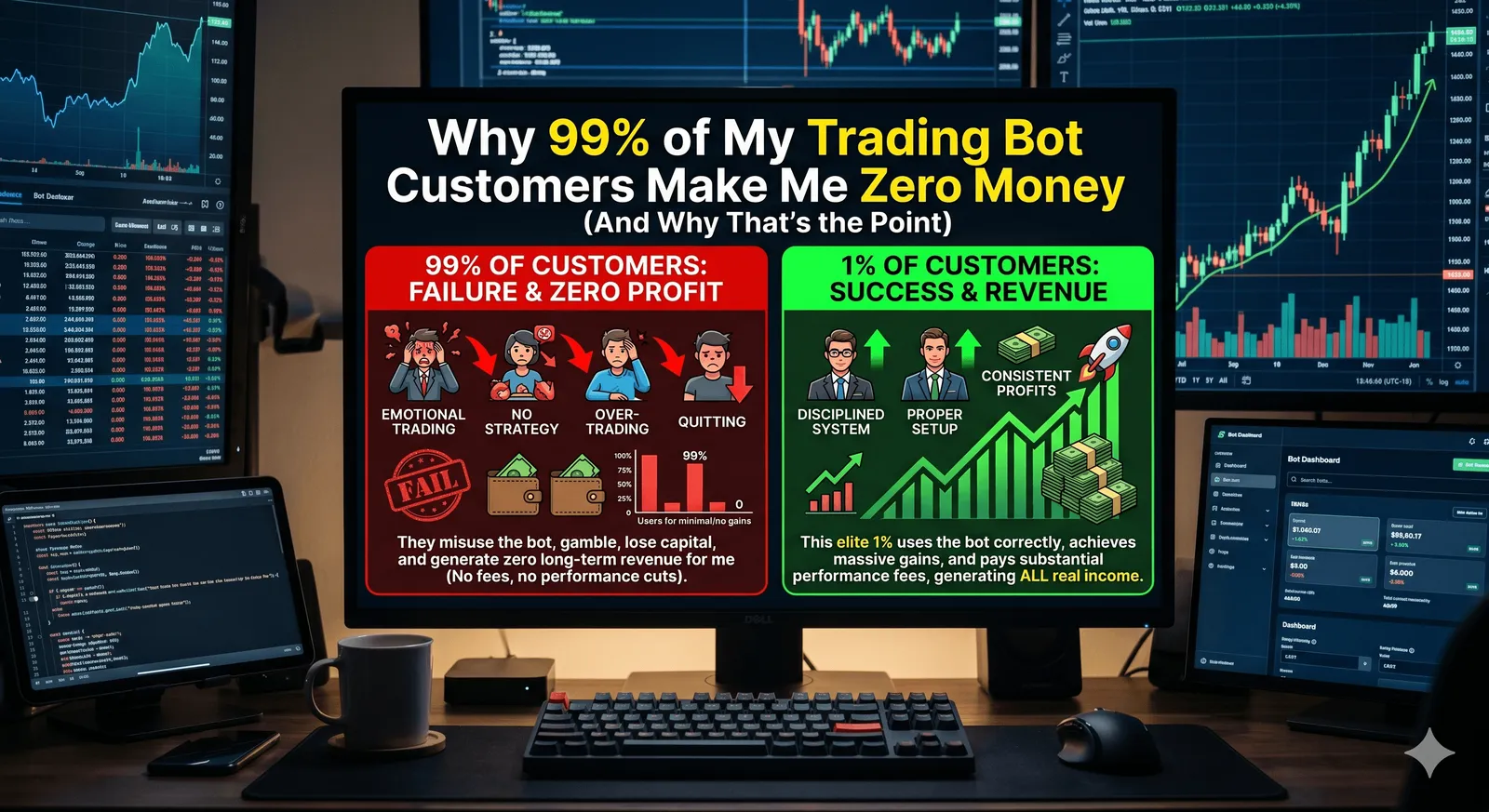
Why 99% of My Trading Bot Customers Make Me Zero Money (And Why That's the Point)
By Felix – founder of unCoded, trading crypto since 2016. Here's something most founders wouldn't wr...
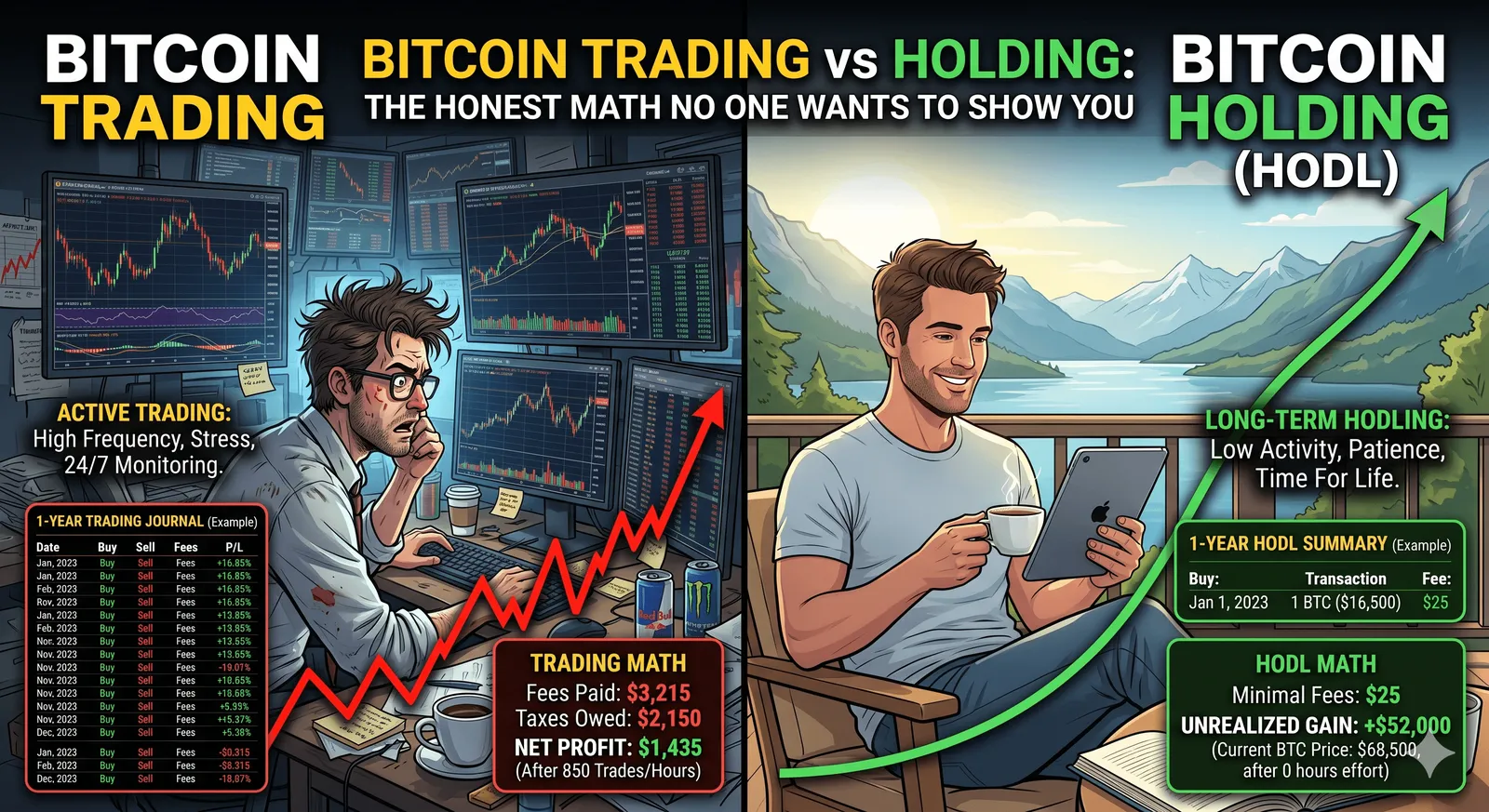
Bitcoin Trading vs Holding: The Honest Math No One Wants to Show You
By Felix – founder of unCoded, trading crypto since 2016. Let me start with the conclusion because i...