Why 99% of My Trading Bot Customers Make Me Zero Money (And Why That's the Point)
 By Felix Götz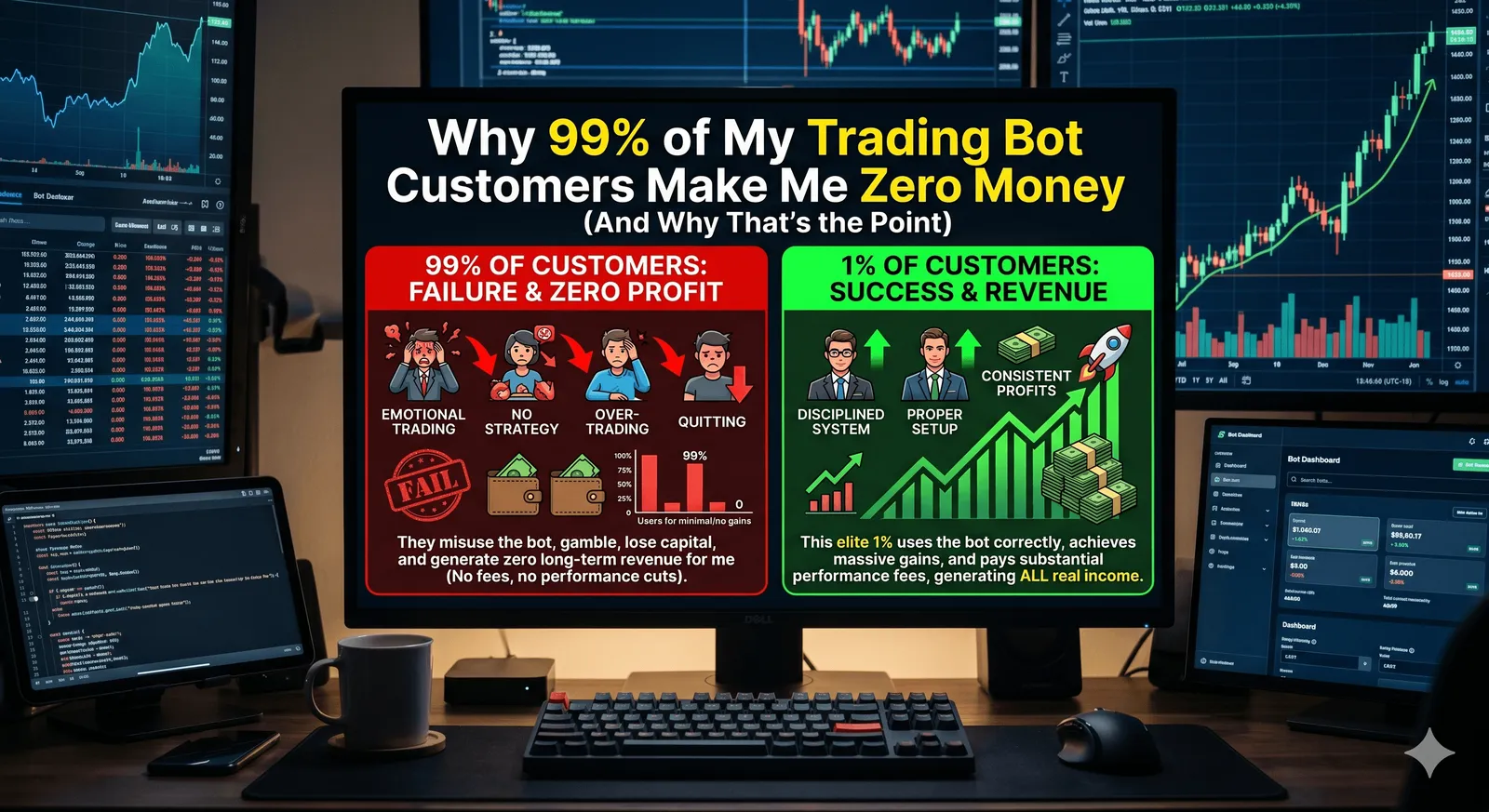
By Felix – founder of unCoded, trading crypto since 2016.
Here's something most founders wouldn't write publicly: unCoded is structured so that around 99% of our customers generate almost no revenue for us. The 1% at the top carries the business.
That sounds like a bug. It's actually the thesis.
And once you understand why, you'll see something uncomfortable about how most retail crypto bot platforms actually work – and why the pricing model you choose says more about a product's honesty than any feature list ever could.
Let me walk through it.
The math on a normal retail trader
Start with the concrete case, because the abstraction doesn't land without it.
Imagine a typical unCoded user. They have €5,000 to €10,000 in capital on Binance. They set up a reasonable strategy, let it run for a year, and it performs well – let's say 20% annual returns. By any honest measure, that's a strong result. Most strategies don't produce that consistently.
On €10,000 with 20% returns, that's €2,000 in gross profit for the user. Our profit share at that size is 30%, so we earn around €600 from a full year of successful trading.
That €600 has to cover our share of everything it takes to keep the platform running for that user – server infrastructure and license validation, development time, support answering Telegram and dashboard questions, payment processing fees, documentation and update hosting, and the $25 starting credit every new user receives. After all of that, our net from the user is close to zero. In a year where their capital went sideways or drew down, we made less than zero – the starting credit and support time cost more than we recouped.
Now multiply that across most of our users. Small portfolios. Modest returns. A meaningful percentage who break even or lose money in any given year, during which we charge them nothing because nothing is exactly what the profit-sharing model charges during losses.
This isn't a flaw in how we priced the product. It's the point.
What the same user looks like on a subscription platform
Consider the same user on a typical subscription-based bot.
At €60/month, they're paying €720 per year. Whether they make money or lose it. Whether the bot is working for their specific strategy or not. Whether the market is trending or dead sideways.
€720 is 7.2% of their entire portfolio, drained annually before any trading happens. On the same 20% gross return, their net becomes 12.8% – the platform captured 36% of their gross profit through fixed fees alone.
In a year where their strategy loses 5%, they still pay €720. Now they're down 12.2% instead of 5%. Most of that additional loss isn't from bad trading. It's the subscription fee extracting value from capital that was already shrinking.
The platform is profitable on this user no matter what happens. Good year, they pay. Bad year, they pay. Sideways year, they pay. Platform revenue is completely disconnected from whether the product is working for the user.
And this is the part that's harder to say out loud: when your revenue doesn't depend on whether your product works, you don't really need it to work. You need it to feel like it works long enough that the user doesn't cancel. Those are fundamentally different goals.
Two different questions, two different products
There's a question underneath every retail product, and it's usually invisible to users but it shapes everything.
Most retail crypto platforms are built around the question: "How do we extract maximum recurring revenue from retail users?" The answer leads to specific design choices. Subscriptions that auto-renew. Dashboards optimized to emphasize wins and obscure costs. Engagement loops that create psychological stickiness. Features that sound impressive even when they don't measurably help. Marketing that sells transformation but delivers tools.
I don't think this is malicious. It's just what happens when you ask that question. Everything downstream optimizes for the answer.
unCoded is built around a different question: "How do we align the platform's success with the user's success, and what does the pricing structure need to look like for that alignment to actually hold – not just in the pitch deck, but in the math?"
When you ask that question instead, you end up with a different product. Pricing that's visible and proportional. Nothing charged when the user is losing. Costs that scale with performance rather than running independently of it. Fewer users who stay out of inertia, more users who stay because the thing works.
The engagement-optimized model is more profitable per user and much easier to scale with marketing. The alignment-optimized model is slower, harder to forecast, and unfriendly to the kind of venture capital that wants clean SaaS multiples. But it produces something the other model can't: a trust structure where the user doesn't have to take the platform's word for anything. The incentives do the work.
That's the philosophical core. Everything else is mechanics.
The 1% that makes the business viable
So how does a business like this stay alive if the typical user generates near-zero revenue?
The 1% at the top.
A small percentage of our users have larger portfolios – five figures, sometimes six, occasionally beyond. Family offices. Experienced traders graduating from manual to automated execution. Long-time crypto holders finally putting capital to work. Operators running strategies at serious scale.
A user with €200,000 generating 20% returns produces €40,000 in annual gross profit. Our share is €8,000 to €12,000 depending on the fee tier (30% drops to 20% once cumulative performance fees reach €2,000). One of those users covers the infrastructure cost of dozens of smaller users. Ten of them make the business viable. A hundred make it comfortably profitable.
This is deliberate. The pricing is designed so that smaller portfolios can access the product without paying disproportionate fees that would destroy their returns, while larger portfolios pay meaningful amounts that fund the platform's development and support. The 1% effectively subsidizes access for the other 99%.
If you've ever wondered why most good trading platforms gate their product behind high minimum portfolio requirements or expensive subscription tiers, this is why. They can't afford to serve smaller users without charging disproportionately. Our answer is different: we accept that we won't be very profitable on smaller users, and we rely on larger users to make the economics work. Choosing to serve smaller users at near-zero margin rather than excluding them entirely tells you more about the business philosophy than any marketing page could.
What this actually means for you
Concretely, where does this leave you as a user?
If your portfolio is under €5,000, you're economically close to "free" for us. We make very little from you directly. We provide the product because covering small users is part of how the platform is designed, and because some of today's small users become tomorrow's large users as their capital grows. We genuinely want you to succeed – not because we're being nice, but because your success is the only way the model works.
If your portfolio is €5,000 to €50,000, you're the core user base. Our profit share on your trading generates modest but meaningful revenue. The relationship is balanced – we earn enough to justify supporting you, you pay fees proportional to actual performance rather than fixed regardless of outcome.
If your portfolio is €50,000 or more, you're the user type that makes the platform viable. Your profit share funds the development that benefits everyone on the platform. The alignment is strongest at this level: you pay more than subscription pricing would cost, but only when you're actually making money, and the platform is structurally motivated to keep making you more successful because our revenue depends entirely on yours growing.
None of these tiers pay anything during drawdowns. None of them are locked into subscriptions. None of them are being optimized for retention through psychological pressure.
The trade-off I made as a founder
Building this way means accepting specific trade-offs, and I want to be direct about them.
Subscription platforms can forecast revenue to the dollar. They can model customer lifetime value on a spreadsheet. They can raise venture capital because the numbers tell a clean story. They can outspend competitors on marketing because every new subscriber has a predictable lifetime payment stream attached.
Profit-sharing businesses can't forecast the same way. Revenue depends on user outcomes, market conditions, and the genuine performance of the product across thousands of individual accounts. Some months are great. Some months are slow. You can't raise growth capital as easily because investors can't model your cash flows as cleanly.
I took those constraints because the alternative was building the kind of platform I spent five years being a customer of before concluding it wasn't acceptable. The subscription platform I ran for a full year did what it was designed to do. The strategy returned 17% gross on my capital. Everyone delivered on their promises. But by the time I added up platform fees, tax software, and taxes on the diminished gross, I was break-even to slightly negative for the year. The math had been working against me from the start, and I hadn't realized until I tabulated the damage.
When I started designing unCoded, the first decision was pricing. Not features, not architecture, not tech stack. Pricing. Because the pricing model is the product philosophy made concrete. Everything that gets built on top of it inherits the question it answers.
The business model is the product differentiation. Slower growth, messier forecasting, harder fundraising – all accepted trade-offs, because the alternative was building something I couldn't personally stand behind.
The bottom line
Most of our users generate near-zero revenue for us in any given year. Not because the product isn't working, but because we priced it specifically so small portfolios wouldn't be punished for being small.
The users who do generate meaningful revenue are also, mechanically, the users for whom the product is working best – larger portfolios compounding real returns at scale. That's not a coincidence. It's the exact outcome the pricing structure was designed to produce.
The 99% who generate almost no revenue aren't an accident. They're the feature – the visible proof that the model does what it claims to do. Most bot platforms can't afford to think this way, because their pricing wasn't designed to align their success with yours. Ours was.
That's the whole story, and honestly, that's the entire reason this business exists in the form it does.
Recommended Reading
Crypto Trading Bots Won't Make You Rich – But They Can Pay Your Bills
By Felix – founder of unCoded, trading crypto since 2016. Every time I see an ad for a crypto tradin...
Why Your Crypto Trading Bot Backtest Fails: Test Against 100 Charts, Not One
By Felix – founder of unCoded, trading crypto since 2016. Every backtest you've ever run lies to you...

Why Crypto Trading Bot Subscriptions Are More Expensive Than They Look
By Felix – founder of unCoded, trading crypto since 2016. Most retail traders evaluate trading bot p...

The Swarm Intelligence: Why unCoded Is Built Different
By Felix – founder of unCoded, trading crypto since 2016. Most trading bots work on an implicit assu...
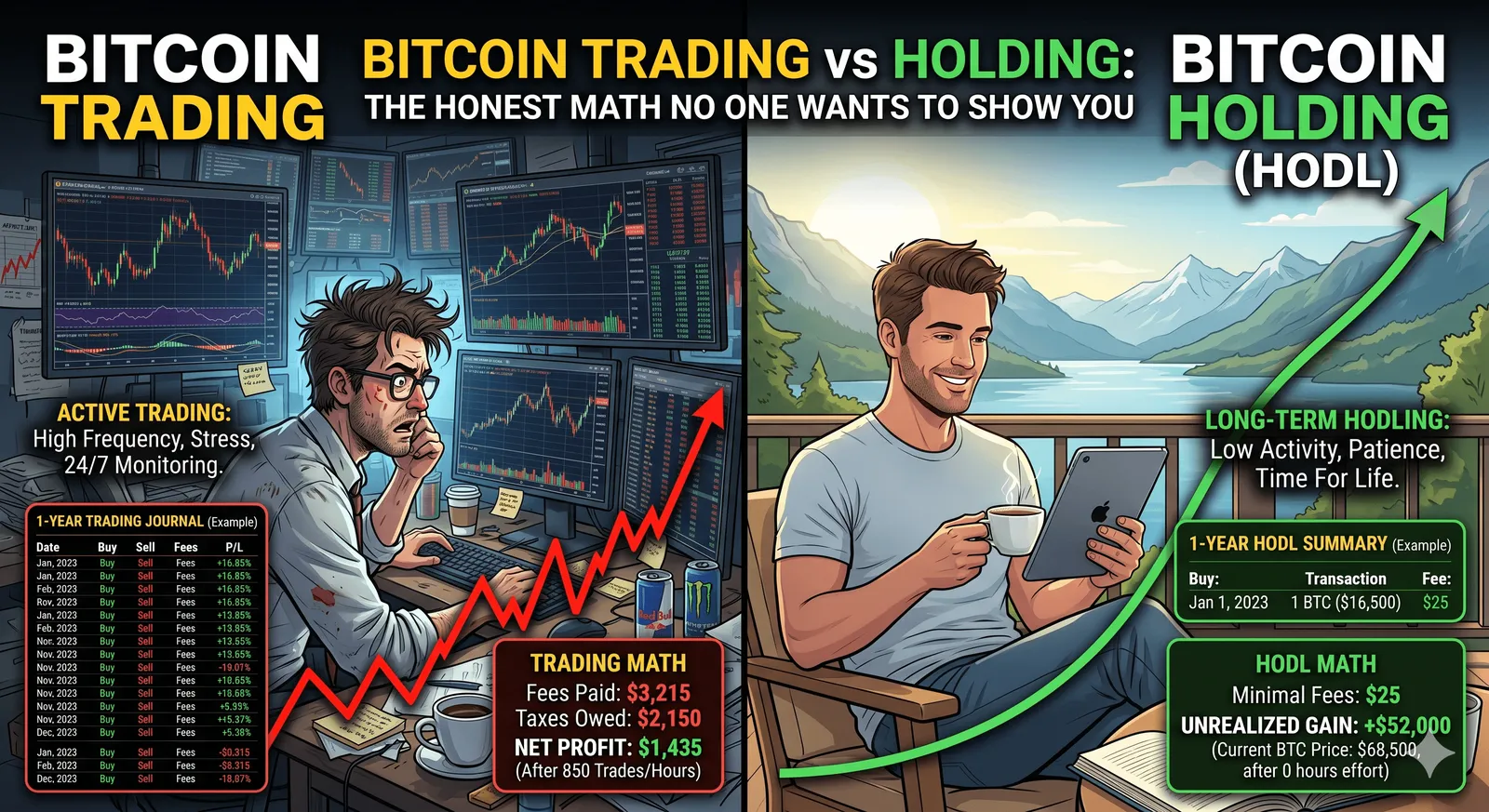
Bitcoin Trading vs Holding: The Honest Math No One Wants to Show You
By Felix – founder of unCoded, trading crypto since 2016. Let me start with the conclusion because i...