Crypto Trading Bots: The Complete Guide for 2026
 By Felix Götz
By Felix Götz, Co-Founder and CTO of ArrowTrade AG, building unCoded since 2016 in crypto trading.
Disclosure: I'm Co-Founder and CTO of ArrowTrade AG, the company behind unCoded, which is one of the bots discussed in this guide. So I'm not neutral. What I can offer is a decade of doing this with real money, and a guide written to tell you how crypto trading bots actually work rather than how they're marketed. This is not financial advice.
Most guides about crypto trading bots are written to sell you one. They describe a world where you deploy a bot, walk away, and watch the money compound while you sleep. That world does not exist, and anyone describing it is either selling you something or has never run a bot through a real bear market.
This guide is the honest version. I've been trading crypto since 2016 and building automated trading tools for years, including five years as a paying customer of commercial bot platforms before I built my own. I'm going to explain what crypto trading bots actually are, the real strategy types, how they work under the hood, what returns you can realistically expect, how to tell a good strategy from a dressed-up bad one, and how to choose the right tool for your situation, including when the right tool is no bot at all.
It's long, because doing this properly is the entire point. Let's go.
What a crypto trading bot actually is
Strip away the marketing and a crypto trading bot is simple. It's software that connects to your exchange account through an API and places buy and sell orders automatically, based on rules you configure.
That's it. It is not artificial intelligence reading the market's mind. It is not a money printer. It is automated execution of a strategy. The bot watches price data, checks it against the rules you set, and when the conditions are met, it sends an order to the exchange. The quality of the outcome depends almost entirely on the quality of the strategy and the discipline of the person running it, not on the bot itself.
This matters because the single biggest misconception in this space is that the bot is the edge. The bot is not the edge. The strategy is the edge, and the bot is just the thing that executes it without sleeping, without emotion, and without missing the 3 a.m. move while you're in bed. A great strategy with a mediocre bot beats a mediocre strategy with a great bot every time.
Once you internalize that, the rest of this guide makes sense.
The main strategy types
Crypto trading bots are usually organized by the strategy they run. Here are the ones that actually matter in 2026, with honest notes on what each is good and bad at.
Dollar-cost averaging (DCA) bots. These buy at intervals or on dips to build a position at an average price, then sell when the price recovers above that average. Good for accumulation and for ranging or recovering markets. The danger is the naive version that keeps buying down forever into a falling asset until your capital is exhausted. A DCA bot without a cap on how far it buys down is one of the fastest ways to lose money in a real crash.
Grid bots. These define a price range and place a ladder of buy and sell orders inside it, profiting from oscillation. When the price drops a level, they buy. When it rises a level, they sell. Excellent in sideways, choppy markets with no clear trend. They underperform badly in strong directional trends, because a grid bot in a market that only goes up will sell its position far too early, and a grid bot in a market that only goes down keeps buying into the decline. Binance has these built directly into the exchange, which makes them a reasonable free starting point.
Signal and TradingView bots. These execute trades based on external signals, most commonly TradingView alerts or Pine Script output sent via webhook. They turn the bot into an execution layer for a strategy you develop elsewhere. Powerful if you already have a tested strategy on TradingView. Useless if your underlying signal is bad, because automating a losing strategy just lets you lose money faster and more reliably.
Arbitrage bots. These exploit price differences for the same asset across exchanges or markets. In theory, low risk. In practice, the easy arbitrage was competed away years ago by faster, better-capitalized players, and what remains is thin, latency-sensitive, and eaten by fees and transfer times for retail traders. Be very skeptical of anyone selling retail arbitrage as easy money.
Market-making bots. These place both buy and sell orders around the current price to profit from the spread. This is a professional activity that requires serious capital, infrastructure, and risk management. Not a retail strategy, despite what some platforms imply.
Copy-trading bots. These mirror the trades of another trader automatically. Attractive because they require no strategy knowledge, which is also exactly why they're dangerous. You take on all the risk of a strategy you don't understand, can't validate, and can't adjust when it stops working. The track records shown are often cherry-picked, and survivorship bias means you mostly see the traders who got lucky, not the ones who blew up.
High-frequency and micro-trading bots. These execute many small trades to capture tiny price movements, multiplied across high frequency. They depend heavily on low fees and fast execution. They can work well on volatile assets with good fee structures, but they're sensitive to every cost in the chain, and a small change in trading fees can flip them from profitable to unprofitable.
Most serious bots combine several of these rather than being purely one type. The point is to understand the building blocks so you can see what a given platform is actually doing under its marketing language.
How a crypto trading bot works under the hood
The mechanics are the same across almost every bot, and understanding them helps you evaluate quality.
Market data comes in. The bot receives price data from the exchange, ideally through a WebSocket connection that streams live order book updates in real time. It then evaluates that data against your configured strategy.
Signals get computed. Based on the incoming data and your rules (indicators, thresholds, grid levels, DCA intervals, take-profit targets), the bot decides whether to buy, sell, or wait. This computation runs wherever the bot runs, on a cloud server or your own machine.
Orders get executed. When the bot decides to trade, it sends a signed API request to the exchange. The exchange checks the request and executes the order. The bot logs it, and you see it in both the bot's dashboard and your exchange account.
There's one technical distinction here that separates serious execution from sloppy execution, and almost nobody markets it because most platforms are on the wrong side of it: polling versus tick-based execution.
Most retail bots poll the exchange at intervals, somewhere between every 30 seconds and every 5 minutes. Between those checks, the bot is blind. A stop loss can miss a wick that spikes down and recovers between polls. A take profit can trigger late, after the price has already moved past your target. For slow strategies this is tolerable. For anything that depends on precise execution, it's a real problem.
Tick-based execution evaluates every order book movement as it happens, in real time, instead of sampling at intervals. It's significantly harder to build, because it requires WebSocket infrastructure that stays stable under stress with proper reconnection and reconciliation logic. But it's what lets precise strategies actually work the way they're supposed to. When you evaluate a bot, asking whether it's tick-based or polling tells you a lot about how seriously it was engineered.
The custody question: who controls your money while the bot trades
This is the dimension most comparisons skip entirely, and it's important enough that my colleague Tommy Tietze wrote a full dedicated guide to it ("Non-Custodial Crypto Trading Bots: The Complete Guide for 2026") that I'd point you to for the deep version. Here's the essential summary.
When a bot trades for you, something has to connect to your exchange account. The question is how much access that connection has, and where your credentials live.
Custodial setups take control of your funds or grant access beyond pure trading. You're trusting a third party with your capital. This is the FTX, Celsius, and Voyager pattern, and the lesson from those collapses was brutal and clear: if you hand over your money, you depend entirely on the recipient handling it responsibly.
Non-custodial setups keep your capital in your own exchange account. The bot connects via an API key restricted to trading only, with withdrawals disabled at the exchange level. It can buy and sell but it cannot remove your money. This isn't a marketing promise, it's a technical restriction you set when you create the API key.
Within non-custodial, there's a further split that matters. Cloud-hosted bots store your API key on the provider's servers, so even though they can't withdraw your funds, your exchange security now depends on their infrastructure security. Self-hosted bots keep the API key on your own server, so even a complete compromise of the bot company couldn't touch your exchange account, because your credentials were never there. The tradeoff is that self-hosting means running your own server, which is more work.
One more safety layer worth mentioning: spot versus futures. Spot trading means you own the actual asset. The worst case is the asset loses value. Futures trading with leverage adds liquidation risk, where a move against your position can wipe it out entirely in minutes. Many serious self-hosted bots deliberately stay spot-only as a design choice, removing liquidation risk from the equation. unCoded is one of them.
Pricing models, and the honest math
How a bot charges you matters more over the years than almost any feature, and this is where I have direct, expensive experience.
Subscription. A fixed monthly fee, typically 25 to 130 dollars depending on the plan. This is the dominant model (3Commas, Cryptohopper, Bitsgap). The problem is structural: you pay the same in a losing year as a winning one. On a retail-sized portfolio, a subscription becomes a 7 to 8 percent annual drag before you account for anything else. I know this because I paid roughly 7,800 dollars over five years on Cryptohopper's Hero tier, plus around 2,000 euros in tax software, and my net return after all of it was consistently worse than just holding Bitcoin over the same period. The strategies worked. The pricing model quietly ate the returns.
Profit-sharing. You pay a percentage of the profit the bot actually generates, and nothing in a losing month. This aligns the platform with you, because it only earns when you earn. unCoded uses this model: 30% of profit, dropping permanently to 20% after 2,000 dollars in cumulative fees. The honest tradeoff is that in a very good year you pay more in absolute terms than a flat subscription would cost, but in flat or bad years you pay little or nothing, and the incentives are aligned over the long run.
Lifetime license. A one-time payment for permanent access (Gunbot is the established example, on the market since 2016). Good if you'll use it for years and want predictable cost. The risk is that "lifetime" depends on the company continuing to maintain the software.
Free and open-source. Projects like Freqtrade and Hummingbot cost nothing for the software itself. You pay in time and technical skill instead. Maximum control and transparency, but you need Linux, Docker, Python, and the patience to maintain everything yourself, with no support beyond community forums.
The key insight: compute the total cost of ownership over twelve months, including the bad scenarios, not just the monthly sticker price. A subscription that looks cheap at 49 a month costs you 588 a year whether you made money or not, and in a bad year where you earned 500 dollars, that subscription puts you net negative on the entire endeavor.
What returns to actually expect
This is the section most guides won't write honestly, so here it is.
There is no fixed return for bot trading. Anyone quoting you a guaranteed monthly percentage is lying. The actual result depends on four things: the market regime during your deployment, your cost structure, your trading pair selection, and how well your strategy fits the regime you're in.
With those caveats stated clearly, here's the honest range from years of observation. For disciplined operation across mixed market conditions, with reasonable pairs and costs, sustainable results tend to land around 1 to 3 percent per month when averaged over good and bad periods. Genuinely favorable conditions with good strategy-regime fit can produce 4 to 6 percent in a given month. Peak bull market phases occasionally produce more, but those are rare and not sustainable over a full year. And hostile regimes that don't match your strategy produce negative returns. Bad months are part of the deal, not a malfunction.
Let me show you why regime dependence is so brutal with real numbers from our own public backtests. Our BasicMode strategy in 2023 was profitable on 78.5% of 191 tested tokens. The exact same configuration in 2025 was profitable on only 7.8% of 373 tested tokens. Same strategy, same settings, wildly different outcome, purely because the market regime changed. This is published at uncoded.ch/backtesting including the bad year, because hiding it would be dishonest. Most platforms show you the 2023-style number and quietly never mention the 2025-style one.
If you take one thing from this section: treat any short-term result, good or bad, as a sample from a specific regime, not as a forecast. A great first week proves nothing, and neither does a bad one.
How to evaluate a strategy beyond the win rate
The most abused number in this entire industry is win rate, and learning to see past it is the most valuable evaluation skill you can develop.
Win rate only tells you how often trades close in profit. It tells you nothing about how much you lose when they don't. You can have a 90% win rate and still lose money if your few losers are large enough, and you can have a 40% win rate and be highly profitable if your winners dwarf your losers. Worse, a 100% win rate can be manufactured by simply never closing losing positions, holding them in unrealized red and bagholding while the dashboard shows nothing but green.
So instead of win rate, run any strategy through this small framework:
Expectancy. Your average profit per trade, accounting for both frequency and size: (win rate times average win) minus (loss rate times average loss). A positive expectancy means the system makes money per trade on average. A negative expectancy means it loses, no matter how pretty the win rate looks. This single number cuts through almost all the marketing.
Profit factor. Gross profit divided by gross loss. Below 1.0 loses money, above 1.5 is decent, above 2.0 is strong. It tells you the magnitude story that win rate hides.
Maximum drawdown. The largest peak-to-trough drop in your account. This is your survival metric, because the recovery math is unforgiving. A 10% loss needs an 11.1% gain to recover. A 20% loss needs 25%. A 50% loss needs a 100% gain, a full double, just to get back to even. Accounts don't die from one bad trade, they die from a deep drawdown that was baked into an ugly loss structure the win rate concealed.
When these metrics disagree with a shiny win rate, believe the metrics. The market doesn't pay you for being right often. It pays you for keeping your mistakes cheap.
Backtesting, honestly
A backtest simulates a strategy against historical data. It's an essential sanity check and a terrible oracle, and knowing the difference matters.
Good backtesting uses high-resolution data (ideally evaluating intracandle movement rather than just candle closes, which systematically overstates results for strategies that depend on intracandle price action), calculates fees realistically, and crucially tests across many assets and multiple market regimes rather than a single cherry-picked chart in a single favorable period. A strategy that looks brilliant on one token in one bull year is almost certainly overfit.
The regulators have warned about this for years. The SEC, NFA, and CFTC have all cautioned against reading backtests uncritically, because they're built with hindsight, they don't capture the psychological pressure of real losses, and real costs like spreads, fees, and slippage can distort them. They're right. Use backtests to rule strategies out and to understand behavior, not to predict your future returns. And test across the bad regimes too, not just the good ones.
The most common mistakes
From watching a lot of people do this, these are the errors that recur:
Deploying too much capital too soon, before validating the configuration with real conditions. Start small. Creating API keys with excessive permissions instead of trade-only. Skipping the IP whitelist that restricts the key to your server. Chasing a high win rate instead of positive expectancy. Believing a favorable short-term result is a baseline rather than a regime sample. Running a strategy that's mismatched to the current market (a grid bot in a strong trend, a trend bot in chop). And the classic: deploying a bot and forgetting about it. "Set and forget forever" is not a strategy. The people who monitor and adjust consistently outperform the ones who walk away.
Who should use a crypto trading bot, and who shouldn't
Honest disqualifiers, because matching the wrong person to a bot helps nobody.
A bot makes sense if you have at least basic trading understanding, want to automate a strategy you actually comprehend, are willing to monitor and adjust it, and have realistic expectations about returns and drawdowns.
A bot is the wrong choice if you're a complete beginner with no trading experience, because automating a strategy you don't understand just lets you lose money more efficiently. Learn the markets first, trade manually, then automate. It's also wrong if you want guaranteed returns or passive autopilot wealth, because that doesn't exist. And it's wrong if you want leverage and can't stomach liquidation risk, in which case spot-only tools are the safer path and leverage is best avoided entirely until you deeply understand it.
For genuine beginners specifically, I recommend starting with Pionex's free exchange-native bots. They let you experiment with grid and DCA strategies at no platform cost while you build the understanding that makes serious bot trading work. I'd rather send you there than take you as a customer who isn't ready.
How to choose: the major platforms, honestly
A quick honest map of the landscape in 2026.
Cloud-hosted subscription platforms (3Commas, Cryptohopper, Bitsgap, Coinrule). Easy, fast, no server required, with marketplaces and polished mobile apps. The tradeoffs are subscription pricing regardless of performance and your API key living on their servers. 3Commas is strong for multi-exchange and TradingView signals, Cryptohopper for its marketplace, Bitsgap for grid trading specifically.
Open-source self-hosted frameworks (Freqtrade, Hummingbot, OctoBot, Jesse). Free, fully transparent, maximum control, your keys never leave your server. The cost is a steep technical barrier and no real support. Best for developers who want to build and maintain everything themselves.
Commercial self-hosted bots (Gunbot, unCoded). Professional software you run on your own infrastructure, combining self-hosted custody with support and updates. Gunbot uses a lifetime license and has been around since 2016. unCoded uses profit-sharing, is built by ArrowTrade AG in Switzerland, runs tick-based execution, is spot-only on Binance for now, and publishes its full backtest distribution including bad years. The tradeoff for this category is that you need your own server.
Copy-trading platforms (Wundertrading and others). Best if you specifically want to follow other traders, with the heavy caveat about taking on risk you don't control or understand.
No platform is best for everyone. The honest choice depends on your technical comfort, how much you value custody control, your portfolio size, and whether you want convenience or control.
The decision framework
Choose a cloud subscription bot if you want zero infrastructure work, fast setup, broad exchange coverage, or marketplace strategies, and you don't mind paying regardless of performance and storing your key on their servers.
Choose an open-source framework if you're technical, want maximum control and transparency, and are happy to build and maintain everything yourself with no support.
Choose a commercial self-hosted bot if you want professional software with support but want your keys on your own server, you value pricing aligned with outcomes, and you're willing to run a server.
Choose no bot yet if you're a beginner. Learn the basics first on something free and simple, then come back when you've outgrown it.
The honest summary
A crypto trading bot is automated execution of a strategy. It is not magic, not passive income, and not an edge in itself. The edge is the strategy and the discipline behind it. The bot just executes without sleeping or panicking.
The decisions that actually matter are these. Pick a strategy type that fits how markets behave and how much you understand. Understand whether your bot polls or executes tick-by-tick, and whether your keys sit on someone else's server or your own. Choose a pricing model that doesn't quietly drain you in bad years. Set realistic return expectations, somewhere in the low single digits per month on average, with full awareness that regime change can turn a 78% success rate into an 8% one with no change to your settings. Evaluate strategies on expectancy, profit factor, and drawdown rather than the seductive win rate. And monitor what you deploy, because nobody who walks away forever does well.
Do that, and a bot becomes a genuinely useful tool in a broader approach. Skip it, and you become one more person who confused a dashboard for a strategy.
For the deeper dive on the custody dimension specifically, read Tommy Tietze's non-custodial guide. For our full backtest distribution including the bad years, see uncoded.ch/backtesting. For the documentation, uncoded.ch/docs. And there's an active community on Telegram alongside the Aureum Victoria YouTube channel and the "Let's Talk Crypto" and "Crypto Stammtisch" streams with Robin from Kryptowölfe.
The bot is a tool. The strategy is yours. Spend your energy on the part that actually decides the outcome.
Felix Götz is Co-Founder and CTO of ArrowTrade AG, the company behind unCoded. A self-hosted, non-custodial crypto trading bot with profit-sharing pricing, operating from Switzerland under the Swiss DLT legal framework. The "unCoded" trademark is registered through EUIPO. Documentation at uncoded.ch/docs. Public backtest data at uncoded.ch/backtesting. This article reflects personal experience and is not financial advice.
Recommended Reading

When Germany's Crypto Tax Holiday Ends: What the Proposed Repeal of the One-Year Holding Period Means for Trading Bots
By Felix Götz – Co-Founder and CTO of ArrowTrade AG, building unCoded since 2016 in crypto trading. ...
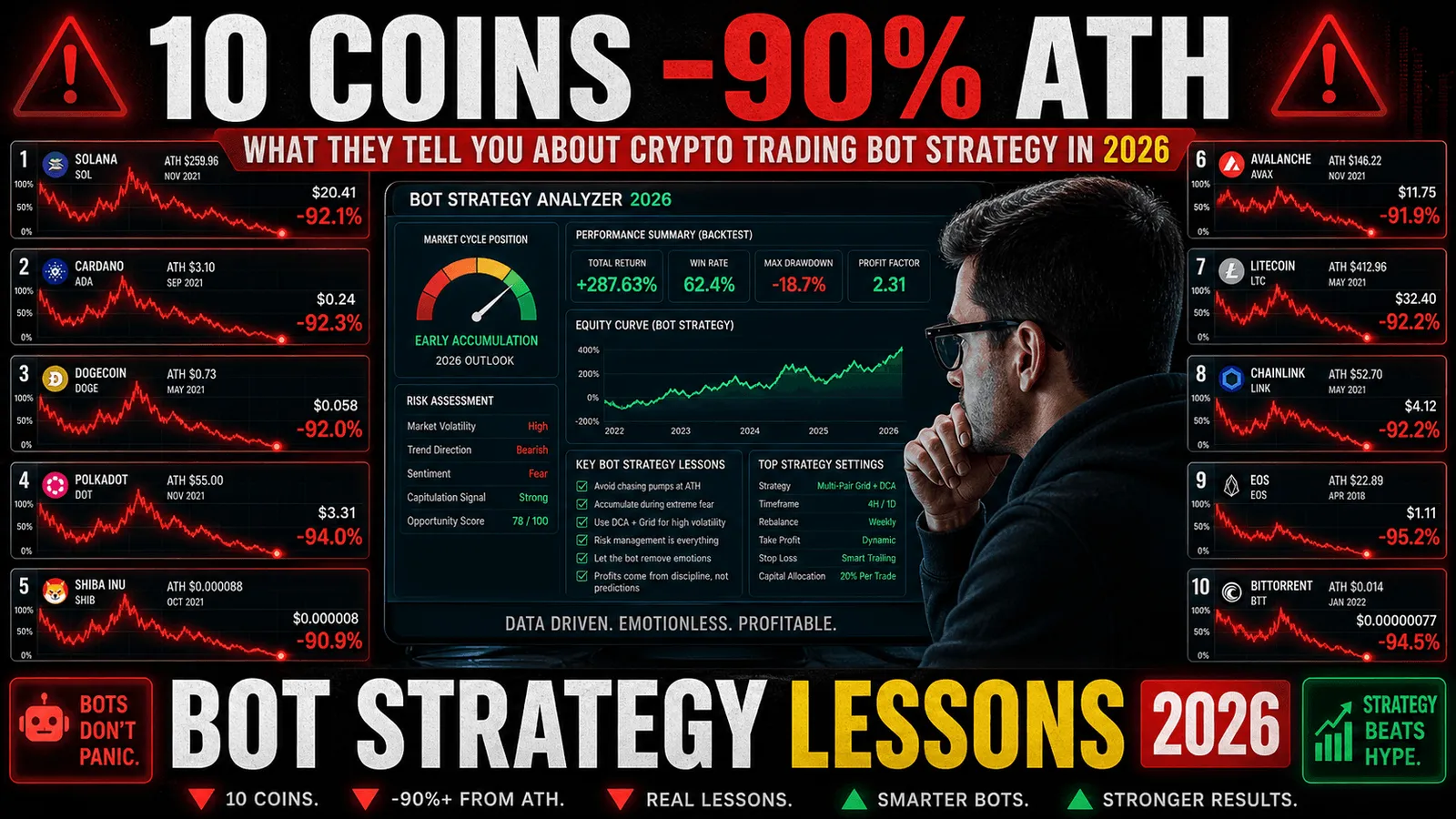
What 10 Coins Down 90%+ from Their All-Time Highs Tell You About Crypto Trading Bot Strategy in 2026
By Felix Götz – Co-Founder and CTO of ArrowTrade AG, building unCoded since 2016 in crypto trading. ...
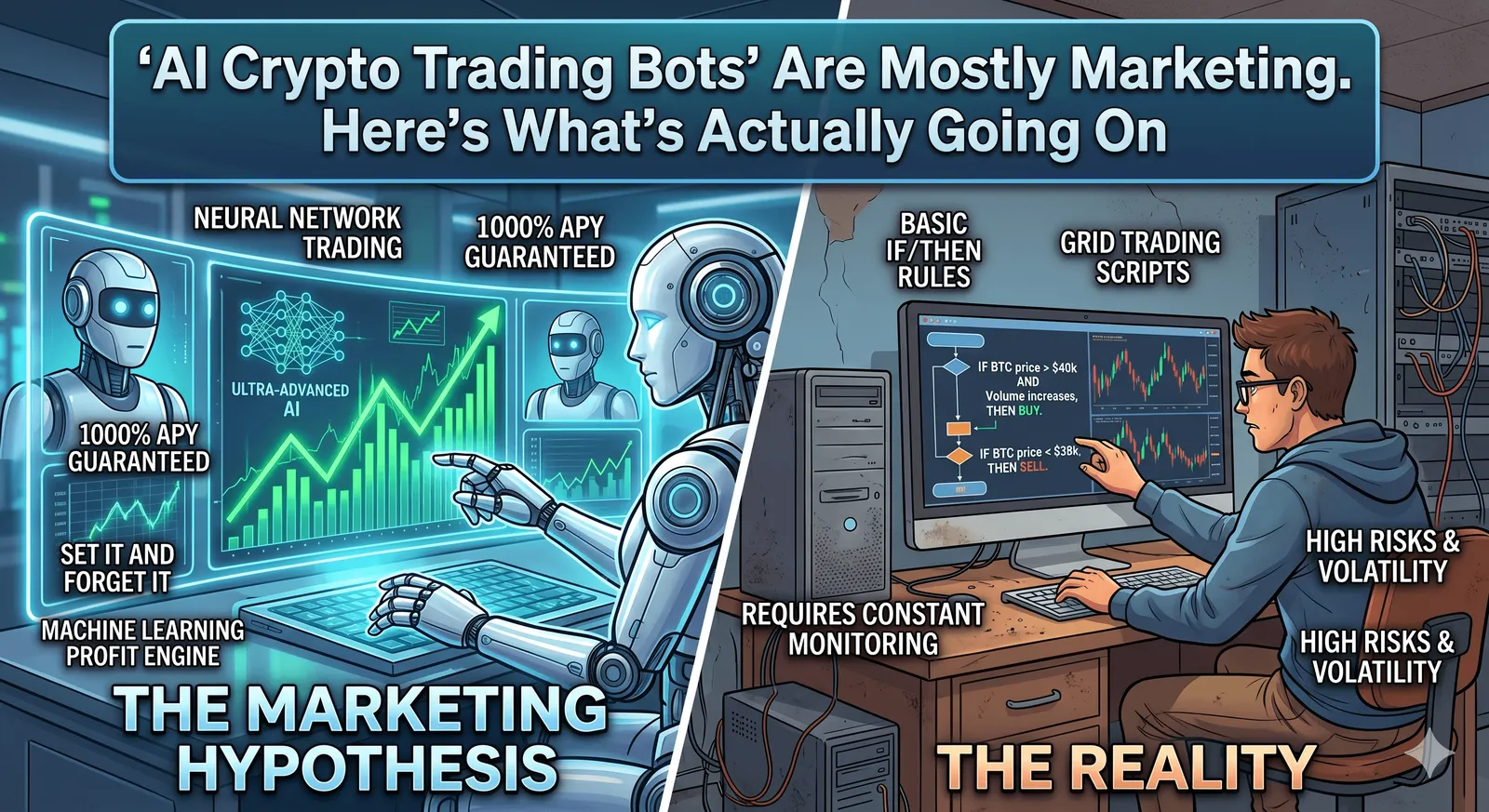
AI Crypto Trading Bots - Are Mostly Marketing. Here's What's Actually Going On.
By Felix – founder of unCoded, trading crypto since 2016. In 2026 the crypto trading bot market is f...
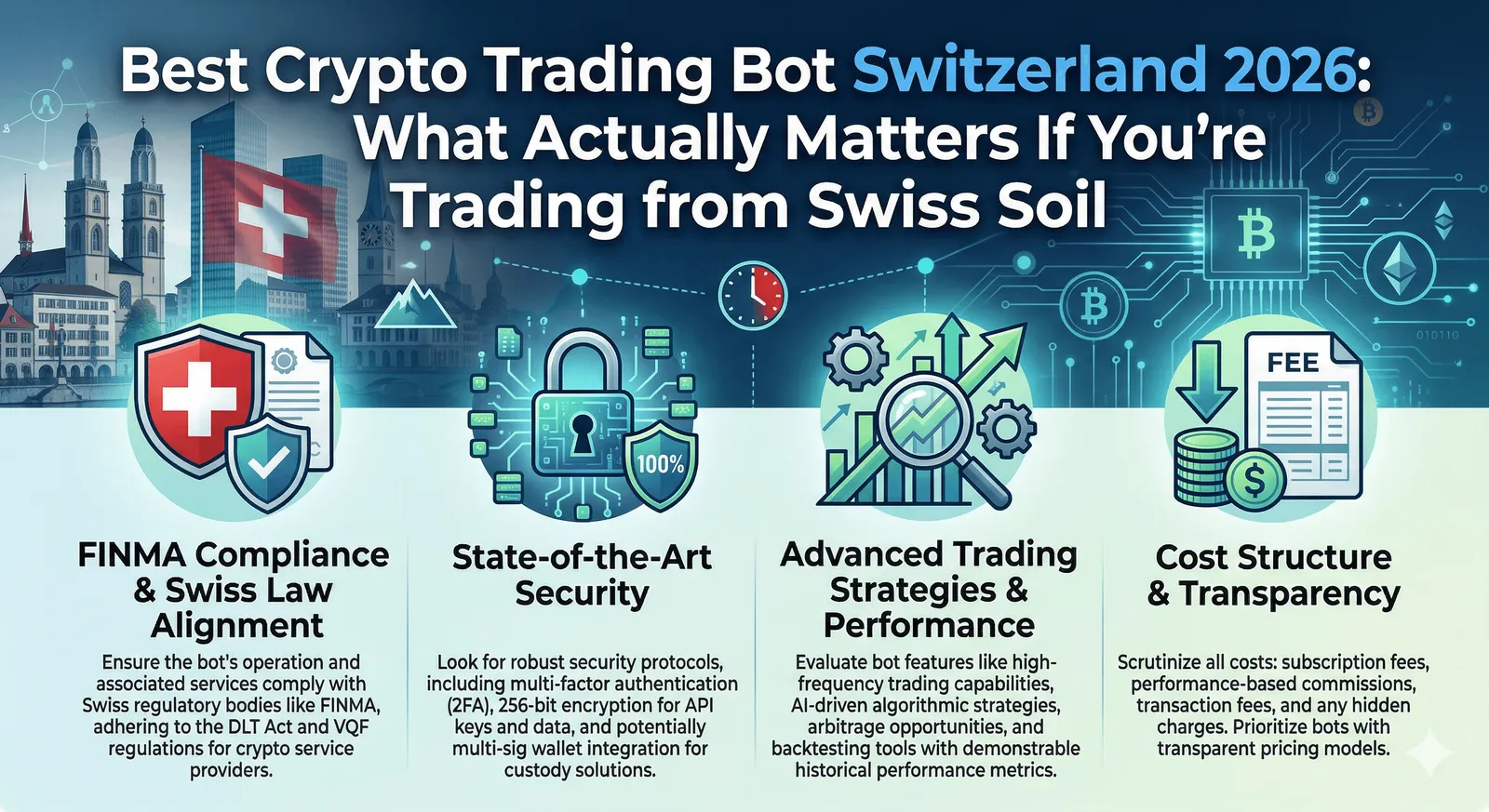
Best Crypto Trading Bot Switzerland 2026: What Actually Matters If You're Trading from Swiss Soil
By Felix – founder of unCoded, ArrowTrade AG, Switzerland. Trading crypto since 2016. If you're base...

Crypto Trading Bot in 2026: What you really need to know – and why most lists are lying to you
By Felix – crypto trader since 2016, founder of unCoded. I've used almost every bot on these lists a...

unCoded Roadmap 2026 – Dashboard, Multi-Bot and the Futures Step
The trading bot we want to use ourselves every day If you've been in crypto for a while, you know th...

The Digital Euro 2026: Infrastructure Reality Over Surveillance Myths
Many founders hear the term digital euro and immediately think of state surveillance. They misunders...

OBV Indicator Explained: On-Balance Volume Trading Strategy 2026
OBV Indicator Explained: On-Balance Volume Trading Strategy 2026 By Felix – founder of unCoded, trad...