The 97% Rule: Why Most Binance Tokens Are Dying (And Why Your Bot Can't Save Them)
 By Felix Götz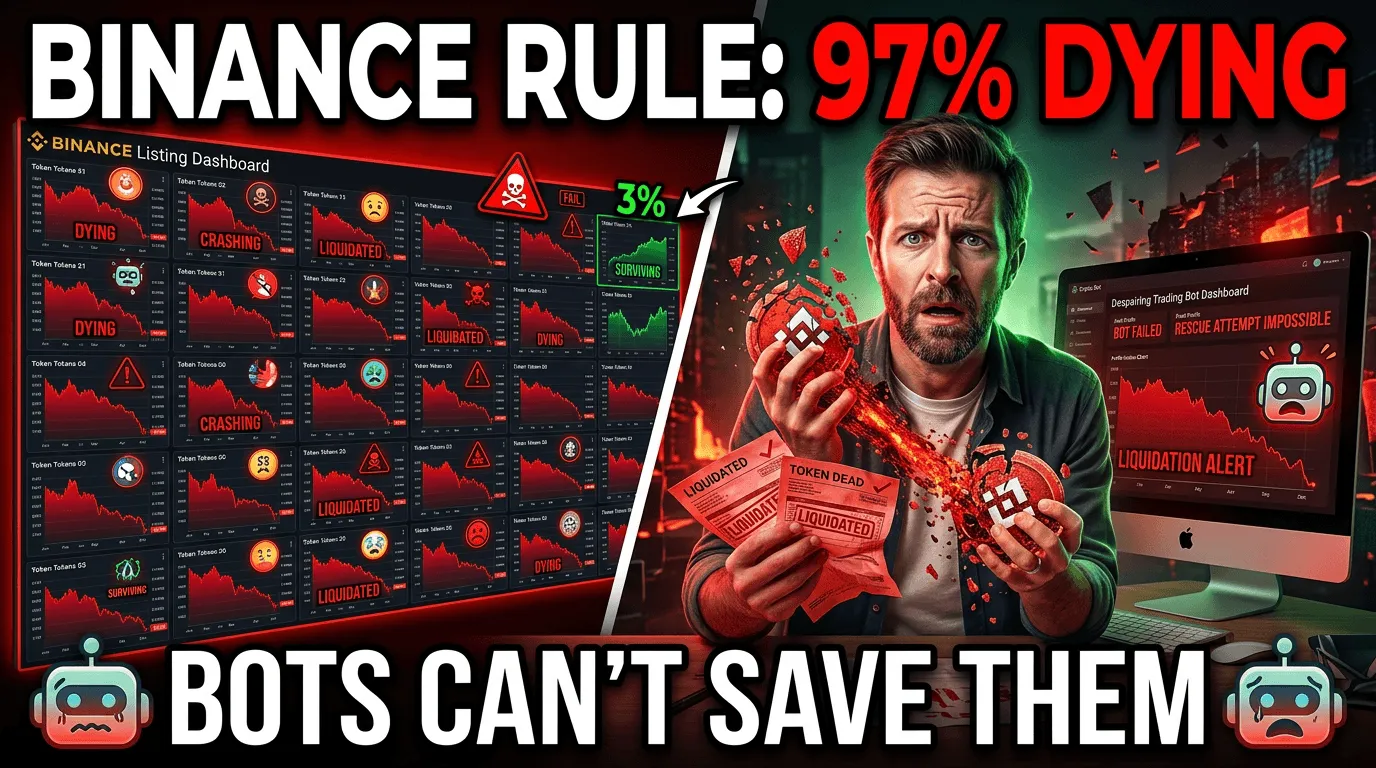
By Felix – founder of unCoded, trading crypto since 2016.
I'm going to state something uncomfortable that most people in the crypto trading bot industry won't say out loud:
Roughly 97% of all tokens ever listed on Binance are currently at or near their all-time lows against USDT.
Not 97% of volume. Not 97% of market cap. Ninety-seven percent of individual tokens. Check the charts yourself. Pull up any altcoin that's been listed for more than two years. The vast majority are making new lows quarter after quarter, often 80-95% below their peaks, with the line continuing downward.
This single observation changes everything about how you should think about trading bots, strategy selection, and what's actually realistic in crypto markets.
Let me walk through why.
The observation itself
Take any random sample of tokens that Binance listed three or more years ago. Look at their charts. The pattern is remarkably consistent: an initial pump around listing, a peak sometime in the first six to eighteen months, and then a long slow grind downward that doesn't reverse.
Some examples across different categories:
Gaming tokens that were worth €2-5 during the 2021 bull run now trade for €0.10-0.30. Not 50% down. 90-95% down, with no sign of reversal.
Layer-1 alternatives that launched with enormous fanfare and reached double-digit prices now trade in pennies. Many of the Ethereum competitors of 2021 are down 92-97% from their peaks, and the people who bought them are still holding losses while newer tokens capture the narrative attention.
DeFi governance tokens that reached €20-50 at peak now trade between €0.50 and €3. Protocols that still function, still generate fees, still have users – their tokens just keep losing value because supply keeps increasing and demand doesn't match it.
Memecoins that had their moment and never recovered. Metaverse tokens from 2021 that nobody talks about anymore. AI-themed tokens from 2023 that pumped on the narrative and collapsed when the narrative moved on.
The pattern isn't random. It's structural. And it's not going away.
Why this happens
Three forces work together to push almost all altcoins toward their all-time lows over time.
Token inflation. Most crypto projects have emission schedules that release new tokens continuously. Staking rewards, liquidity incentives, team vesting, ecosystem funds – all of these add supply. For the token price to stay flat, demand must grow at exactly the rate supply grows. In practice, demand rarely keeps up. Supply increases linearly or exponentially. Demand is driven by narrative and attention, which move to new tokens. Result: persistent downward price pressure baked into the tokenomics.
Narrative rotation. Crypto markets run on stories. In 2021 it was NFTs and the metaverse. In 2022 it was DeFi summer. In 2023 it was AI tokens. In 2024 it was Solana memecoins. In 2025 it was prediction markets. Each cycle, capital and attention move to the new narrative. The tokens from old narratives don't gradually decline – they crash and then continue bleeding as the remaining holders slowly capitulate over months and years.
Binance's listing pace. Binance lists dozens of new tokens every year. Each new listing splits retail attention and liquidity further. The pool of retail capital chasing altcoins is finite and each new token listed takes from the same pool that's supposed to support existing tokens. Old listings compete for attention against newer, shinier alternatives. They lose that competition almost every time.
The combined effect: almost every altcoin is structurally priced to decline unless something exceptional happens to change its fundamental demand equation. That exceptional thing almost never happens for any given token.
Why this matters for trading bots
Here's where the bot marketing meets reality.
Every trading bot advertises strategies that work on "crypto pairs" generically. You configure your bot, point it at some token pair, and let the strategy run. The marketing implies that if the strategy is good, it'll work on whatever you choose to trade.
This is false in a very specific way. It's false because trading bots operate primarily on spot long strategies. They buy low and sell high. They assume mean reversion or trend continuation. They assume that the underlying asset has enough upward movement over time to produce trading opportunities.
If you apply this to a token that's structurally grinding toward all-time lows, the best possible outcome is that your bot loses less money than simple holding. The worst outcome – which is more common – is that your bot accumulates positions you can never profitably exit, because the token keeps making new lows faster than your strategy can react.
No bot strategy, no matter how sophisticated, can make a dying token profitable to trade over extended periods.
You can sometimes catch short-term bounces. You can sometimes scalp volatility within a range. But if the long-term trend is a persistent grind downward, you're swimming against a current that never stops.
The strategy isn't what determines whether you make money. The asset is.
The asset selection problem nobody talks about
Most retail bot users spend 90% of their effort on strategy configuration and 10% on token selection.
This ratio is inverted from what it should be.
If you're trading a token that's structurally trending toward its all-time low, no amount of strategy tuning produces consistent profitability. If you're trading a token that has genuine sustained demand and a healthy tokenomics structure, even a mediocre strategy produces acceptable returns.
Asset selection is where the returns actually come from. Strategy is where execution quality comes from. Both matter, but in that order.
The list of tokens that have genuinely appreciated over multi-year horizons is short:
Bitcoin. Reliably up over any multi-year window since 2013.
Ethereum. Mixed but generally up over multi-year windows, with significant corrections.
A small handful of established protocols with genuine revenue and controlled emissions – SOL at certain windows, occasionally LINK, sometimes BNB.
That's about it. Maybe ten to fifteen tokens total across all of crypto that have produced reliable multi-year appreciation through multiple cycles. Everything else is a coin flip at best and a slow bleed at worst.
When you see bot marketing showing a strategy generating returns on some obscure altcoin over a specific time window, ask yourself: did the strategy produce those returns, or did the asset happen to appreciate during that window? In almost every case, the answer is the latter. The strategy captured some portion of an upward move that came from the asset itself. Deploy the same strategy on the same asset during a different window – or on a different asset during the same window – and the results will often be completely different.
The survivorship bias in bot marketing
Bot marketing systematically shows you the tokens where strategies worked. It doesn't show you the tokens where the same strategies lost money.
This is a specific form of survivorship bias that's particularly damaging in crypto.
A platform promoting a strategy will backtest it on 20 different tokens, find the three where it produced strong positive returns, and put those three in the marketing. They'll call it "proven" and "battle-tested" because it worked on those specific assets during those specific windows.
What they won't show you is that the same strategy lost money on the other 17 tokens. Or that even on the winning tokens, the performance came primarily from the underlying asset appreciation rather than the strategy's edge.
This is why chart shuffling matters so much for backtesting – testing against many tokens simultaneously exposes this. A strategy that makes money on five tokens and loses money on ninety-five isn't a strategy. It's a lottery ticket that requires you to pick exactly the right assets to deploy on, and if you could pick the right assets you wouldn't need the strategy.
But chart shuffling isn't something most platforms offer, because the truth it reveals is bad for marketing. It's easier to sell single-asset success stories than to show distributions of results where most tokens produced losses.
What this means for how you should actually trade
If you accept that 97% of altcoins are dying, a few practical implications follow.
Trade Bitcoin. Optionally Ethereum. For long-term systematic strategies, these are the only two assets that reliably produce the kind of price appreciation that makes bot trading profitable over multi-year horizons. Everything else is trading against a structural headwind that will eventually overwhelm any strategy edge.
Be extremely skeptical of any bot strategy marketed as working on "altcoins" generically. Altcoins as a category are structurally declining. A strategy that works on the right altcoin during the right window isn't a strategy – it's a bet on that specific asset's survival and outperformance. The backtest is telling you what happened, not what will happen again.
If you want altcoin exposure, hold spot rather than trading. Active trading on altcoins typically underperforms simple holding, which itself usually loses money over multi-year horizons. If you believe a specific altcoin will appreciate, hold it and don't pay a bot to execute strategies on it. If you don't believe it will appreciate, don't hold it in any form.
Pair trading is harder than it sounds. Long/short pairs strategies can theoretically profit from altcoin declines, but retail bots don't implement these well, and the short side introduces complexity and borrow costs that usually eliminate any edge. Most retail "pairs trading" products are long-biased despite their branding.
Grid and DCA strategies on declining assets are capital destruction. These strategies profit from volatility within a range. If the range keeps resetting downward – which it does for declining assets – you accumulate positions at prices the asset never returns to. You end up with a portfolio of bags that can't be exited.
The honest answer for most retail traders: trade Bitcoin, maybe Ethereum, and accept that this is the universe of assets where systematic strategies actually produce returns. Everything else is gambling dressed up as trading.
Why most platforms won't tell you this
This entire article is commercially inconvenient for most bot platforms. Their revenue depends on users deploying strategies across many tokens – that's what generates trading volume, subscription justification, and the illusion of diverse product capability.
If users internalized the reality that only a tiny handful of assets actually support profitable systematic trading, bot platforms would look much smaller and less impressive. The product becomes "a tool for trading Bitcoin and sometimes Ethereum efficiently" rather than "a universal trading platform for crypto markets." The marketing deflates. The pricing premium gets harder to justify. The narrative of sophisticated multi-asset trading collapses.
So platforms don't tell users this. They promote the illusion that any token is a valid trading pair, that strategy quality matters more than asset selection, and that the backtests showing altcoin returns will generalize to future performance. It's a comfortable lie that keeps users subscribed and trading across many pairs, even as the 97% reality slowly grinds their portfolios downward.
I'm writing this because the profit-sharing model we use at unCoded doesn't work if users aren't profitable. We don't benefit from you trading a broad altcoin portfolio – we benefit from you actually making money, which means we benefit from you trading assets where making money is realistic. The incentive alignment forces honesty on this question in a way subscription platforms don't have.
The practical framework
Rather than optimizing strategies on tokens that will structurally decline, build your approach around reality:
Core systematic trading on Bitcoin. Active strategies, well-configured, running continuously. This is where bot trading produces actual returns over years because Bitcoin actually produces returns over years.
Secondary systematic trading on Ethereum. Similar logic, with slightly more volatility and slightly more risk. Good for diversifying beyond a single-asset concentration.
No systematic trading on altcoins. If you want altcoin exposure, hold spot in assets you believe in, accept the risk that they'll likely go to zero, and don't pretend that a bot strategy is going to extract returns from a structurally declining asset.
Occasional short-term altcoin plays if you spot a narrative early. Manual, small-sized, opportunistic. Not systematic. Not long-term. These are speculative bets, not systematic returns.
This framework is boring. It rules out 97% of the tokens on Binance as not worth systematic attention. It produces an approach that looks much less sophisticated than what bot marketing promises.
It also happens to be what actually works.
The conclusion nobody wants to hear
The bot industry wants you to believe that strategy quality determines your outcomes. It doesn't, primarily. Asset selection does.
If you trade Bitcoin with a mediocre strategy, you'll probably make money over time because Bitcoin appreciates. If you trade a dying altcoin with a perfect strategy, you'll probably lose money over time because the asset declines faster than any strategy can compensate for.
This is hard to accept because it makes the product sound much smaller than the marketing implies. It also makes the product much more honest about what it can actually do for you.
Good bot platforms help you execute strategies more consistently than you could manually. They don't make bad assets good. They don't turn dying tokens into profitable ones. They do one specific thing – disciplined execution of rules you've configured – and that thing only produces returns when the underlying asset cooperates.
Pick Bitcoin. Maybe add Ethereum. Ignore 97% of what Binance has listed. Let the bot do what bots are actually good at, on the assets where being good at that actually produces returns.
Anything else is trading against a current that never stops flowing in the wrong direction.
Felix is the founder of unCoded — a self-hosted, non-custodial Binance Spot trading bot with profit-sharing pricing. Documentation at uncoded.ch/docs . ArrowTrade AG, Switzerland.
Recommended Reading

Crypto Trading Bots Won't Make You Rich – But They Can Pay Your Bills
By Felix – founder of unCoded, trading crypto since 2016. Every time I see an ad for a crypto tradin...

Why Your Crypto Trading Bot Backtest Fails: Test Against 100 Charts, Not One
By Felix – founder of unCoded, trading crypto since 2016. Every backtest you've ever run lies to you...

Why Crypto Trading Bot Subscriptions Are More Expensive Than They Look
By Felix – founder of unCoded, trading crypto since 2016. Most retail traders evaluate trading bot p...

The Swarm Intelligence: Why unCoded Is Built Different
By Felix – founder of unCoded, trading crypto since 2016. Most trading bots work on an implicit assu...
Why 99% of My Trading Bot Customers Make Me Zero Money (And Why That's the Point)
By Felix – founder of unCoded, trading crypto since 2016. Here's something most founders wouldn't wr...
Bitcoin Trading vs Holding: The Honest Math No One Wants to Show You
By Felix – founder of unCoded, trading crypto since 2016. Let me start with the conclusion because i...
AI Crypto Trading Bots - Are Mostly Marketing. Here's What's Actually Going On.
By Felix – founder of unCoded, trading crypto since 2016. In 2026 the crypto trading bot market is f...